
You've tried the calm voice. You've tried the firm voice. You've crouched down, explained, distracted, threatened, and bargained. Nothing works. And the worst part? You don't even fully understand why. Toddler tantrums can be best explained and handled through biology. Once you understand what the baby is feeling and thinking, you’ll be better equipped to deal with it all.
Tantrums are one of the most exhausting parts of early parenting, not just because they're loud, but because nothing you try seems to help. You get down to their level, you explain calmly, you offer a hug, and somehow it only gets worse. That's not a parenting failure. That's biology.
The Tantrum Timeline: What Is Happening in the Brain
A tantrum is not just crying. Neuroscientists describe it as a three-stage biological event: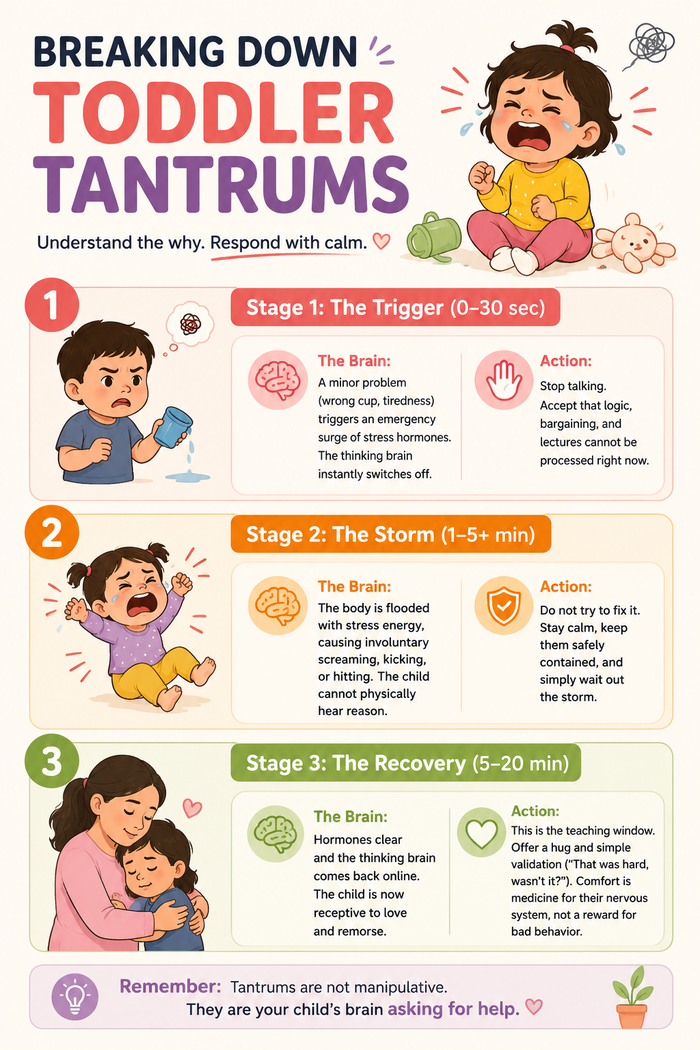
Stage 1: The Trigger (0–30 seconds)
Something sets off the amygdala, that deep, reactive alarm centre we talked about earlier. The trigger could be anything: you said no to more screen time, their sock was bunched up inside their shoe, a sibling grabbed their toy, or they were simply too hungry and too tired at the same time. To an adult, most of these seem trivial. To the toddler brain, they land as genuine distress, and the brain cannot tell the difference between 'small inconvenience' and 'real emergency’.Stress hormones surge through the body within seconds. And here is the part that changes everything for parents to understand: the 'thinking' brain, the part that could say "this is okay, I can calm down", gets completely flooded and switches off. Not dimmed. Off. Your child is no longer able to think, reason, or respond to your words. Not because they are ignoring you. Because that part of their brain is genuinely, temporarily unavailable.
Stage 2: The Storm (1–5 minutes, sometimes longer)
This is the full tantrum. Screaming, hitting, rolling on the floor, arching the back, and throwing things. It looks chaotic, because it is. The body is completely flooded with stress hormones and has no way to process them quickly.At this stage, your child literally cannot hear logic. This is not an exaggeration. The prefrontal cortex, the part of the brain that understands words like "stop," "calm down," or "if you do that one more time..." is flooded out and non-functional. Talking to it right now is like calling a phone that's switched off. The line is dead.
This is why the classic parenting instinct, to get down to their level, explain calmly, and reason it out, feels completely useless mid-meltdown. It is not your delivery that is the problem. It is the timing. The brain that could receive your message simply is not there yet. Trying to reason with a child in this state is like trying to talk someone through a panic attack with a PowerPoint presentation. It will not work, not because your child does not love or respect you, but because their brain is in a biological storm and needs it to pass through first.
Your job in Stage 2 is not to fix it. It is to stay calm, keep them safe, and wait.
Stage 3: Recovery (5–20 minutes)
The storm passes. It always does. Stress hormones slowly start to clear from the bloodstream, and the body begins to settle. Breathing slows. Muscles soften. And gradually, the thinking brain starts to come back online.This is a completely different child from the one who was screaming two minutes ago, and that is not an exaggeration. Biologically, their brains are in a different state now. The part that can feel shame, connection, love, and remorse is available again. You may notice them suddenly go quiet, look for you, or collapse into your arms. That is the nervous system signalling that the storm is over, and it is safe to reconnect.
This is the window that actually matters. Not during the tantrum, after it. A warm hug, a soft voice, a quiet "I've got you", these are not rewards for bad behaviour. They are medicine for a stressed nervous system. They tell the brain: big feelings are survivable, and the people I love are still here. Over time, that message is what builds genuine emotional resilience in children.
Keep conversation simple and short. "That was really hard, wasn't it?" Not a lecture. Not a list of consequences. Just presence, and the quiet reassurance that everything is okay now.
Whether you’re pregnant, a new mom, or navigating postpartum, you don’t have to do it alone. Join our support group to connect, share, and support one another.
FAQs on A Biological Breakdown of Toddler Tantrums: What Every Parent Needs To Know
- Why does my toddler hit me but not others?
This is actually a sign of secure attachment. Toddlers reserve their biggest emotional releases for the people they feel safest with, usually parents and primary caregivers. They know intuitively that you will not leave, even at your worst. It is hard to hear, but it means they trust you completely. - How long do toddler tantrums last, and when do they stop?
Most tantrums move through three stages lasting anywhere from 6 to 25 minutes in total. They naturally decrease as children develop emotional regulation skills. - What should you do during a tantrum: ignore it or intervene?
Neither. During the peak of a tantrum, the thinking brain is completely offline, and reasoning won't work. The right approach is to stay calm, ensure your child is safe, and wait for the storm to pass, then reconnect warmly once they've settled.