In this article:
In around 3-4% of all pregnancies, the foetal presentation remains breech until labour. With timely detection and the right care, such pregnancies can be managed well.
However, a breech pregnancy presents a few different challenges for both you and your baby.
What Is a Breech Presentation?
A breech foetal position means your baby is positioned with their buttocks, feet, or both facing downwards toward the birth canal instead of their head.
Normally, your baby lies head down, or in vertex presentation, in your womb at delivery.
However, in some pregnancies, the baby remains breech near labour. In such cases, there might be certain risks related to vaginal delivery.
If a baby stays in breech position even at 37 weeks of pregnancy, your doctor may plan your delivery differently. Your doctor may plan a C-section for the safest outcomes.
Common Types of Breech Positions
| Type of Breech | Position of the Baby |
| Frank breech | Buttocks down with legs lifted upward near the head |
| Complete breech | Buttocks down with knees bent |
| Footling breech | One or both feet positioned downward |
Among these, a frank breech is the most common type.
Why Does a Breech Pregnancy Happen?
The exact reason why breech pregnancies happen is still unclear. As per research, there are certain factors that increase the risk.
Possible Causes and Risk Factors
You may have a higher chance of breech pregnancy if:- You are pregnant with twins or multiples
- You have given birth to a premature baby in the past
- Your uterus has excessive or scanty amniotic fluid (your baby either gets too much space to move around in or less fluid to move around in)
- You have an abnormal shape of the uterus
- You have complications, like fibroids in the uterus
- You have placenta praevia
How Is Breech Pregnancy Diagnosed?
Your obstetrician may be able to tell you how your baby is lying inside your womb by doing a physical examination of your abdomen.
Your doctor may suspect a breech position during a routine antenatal check-up.
Sometimes, you may also notice:
- Strong kicks in the lower abdomen
- Pressure under the ribs
- A hard round structure near the upper abdomen, which may be the baby’s head
An ultrasound is the most reliable way to confirm the following:
- Baby’s position
- Placenta location
- Amount of amniotic fluid
- Baby’s growth
When is a Breech Pregnancy Diagnosed?
A baby is often in a breech position at some point during pregnancy. By this stage, most babies naturally move into a head-down position. However, a breech position becomes concerning when you are near 36 weeks of pregnancy.
After 37 weeks, a baby usually doesn’t turn its position on its own. This is because of limited space for movement.
At this point, your doctor considers it a breech presentation and plans the delivery accordingly.
What Is External Cephalic Version (ECV)?
If your baby remains breech near term, your doctor may discuss a procedure called 'external cephalic version' (ECV).
During ECV, the doctor gently applies pressure on your abdomen to try turning the baby into a head-down position.
Important Facts About ECV
| Aspect | Details |
| Usually done around | 36–37 weeks |
| Procedure location | Hospital setting |
| Monitoring required | Baby’s heart rate monitored carefully |
| Success rate | Varies depending on pregnancy factors |
When ECV May Not Be Suitable
ECV may not be advised if:
- You have placenta praevia
- There is vaginal bleeding
- Multiple pregnancy is present
- Certain uterine abnormalities exist
- Foetal distress is suspected
What Are the Risks of Breech Pregnancy?
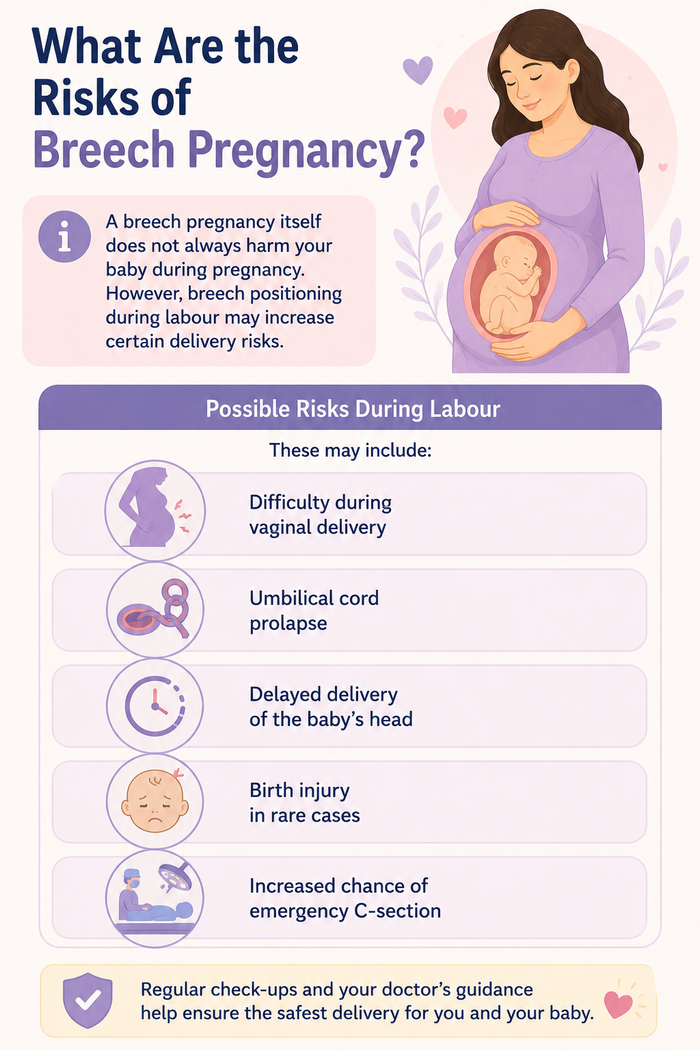
A breech pregnancy itself does not always harm your baby during pregnancy. However, breech positioning during labour may increase certain delivery risks.
Possible Risks During Labour
These may include:- Difficulty during vaginal delivery
- Umbilical cord prolapse
- Delayed delivery of the baby’s head
- Birth injury in rare cases
- Increased chance of emergency C-section
- The type of breech position
- Baby’s size
- Your pelvic measurements
- Whether labour starts naturally
- Your overall pregnancy health
Delivery Options for Breech Pregnancy
The safest delivery method depends on your individual pregnancy condition.
Your obstetrician usually considers the following:
- Type of breech presentation
- Gestational age
- Previous deliveries
- Baby’s estimated weight
- Hospital facilities and emergency support availability
Planned Caesarean Section
In many breech pregnancies, a planned C-section may be recommended because it may reduce certain delivery-related complications.
This is especially common if:
- The baby is a footling breech
- The baby appears large
- There are additional pregnancy complications
- It is your first delivery in some cases
Vaginal Breech Delivery
Sometimes, vaginal breech delivery may still be possible under strict medical supervision.
It may be considered if:
- The pregnancy is full-term
- The baby is not too large
- Frank breech presentation is present
- No additional complications exist
- Skilled specialists are available
If you are carrying a breech pregnancy, it's normal to have many questions. However, with proper monitoring and delivery planning, many breech pregnancies can be managed safely.
Most babies turn on their own before labour. But if that doesn't happen, your doctor may adjust your birth plan and plan a C-section delivery.
Your doctor will guide you on what to expect during a breech delivery and how to prepare for it. Understanding your options can help you make informed and appropriate decisions.
Whether you’re pregnant, a new mom, or navigating postpartum, you don’t have to do it alone. Join our support group to connect, share, and support one another.
FAQs on Breech Pregnancy: Diagnosis, Risks, and Delivery Options Explained
- Can exercise help turn a breech baby naturally?
Some exercises and posture techniques are commonly discussed. However, scientific evidence remains limited. You should always speak with your doctor before trying any methods at home. - Is a breech pregnancy always delivered by C-section?
No, not always. Although many breech pregnancies are delivered by C-section, some people may still have a carefully monitored vaginal breech delivery depending on their condition. - Can a breech baby turn during labour?
Sometimes, babies may still turn naturally before or during early labour. However, this becomes less common near full-term pregnancy.