
In this article:
Research shows language delay affects around 10–20% of 2-year-old toddlers, making it one of the most common developmental concerns in early childhood. Some children who speak late turn out to be perfectly fine. Others benefit enormously from early help. The key is knowing the difference.
What Is a Late Talker?
A late talker is a toddler, typically between 18 and 30 months old, who has fewer words than expected for their age, but whose understanding, play skills, and social development appear normal.
Late talkers are not the same as children with speech disorders or developmental conditions. Many late talkers catch up on their own. But some need a little extra support to get there, and recognising that early makes a huge difference.
Language Milestones: What's Normal According to Age?
Here's a simple guide to what most children can do at different ages:
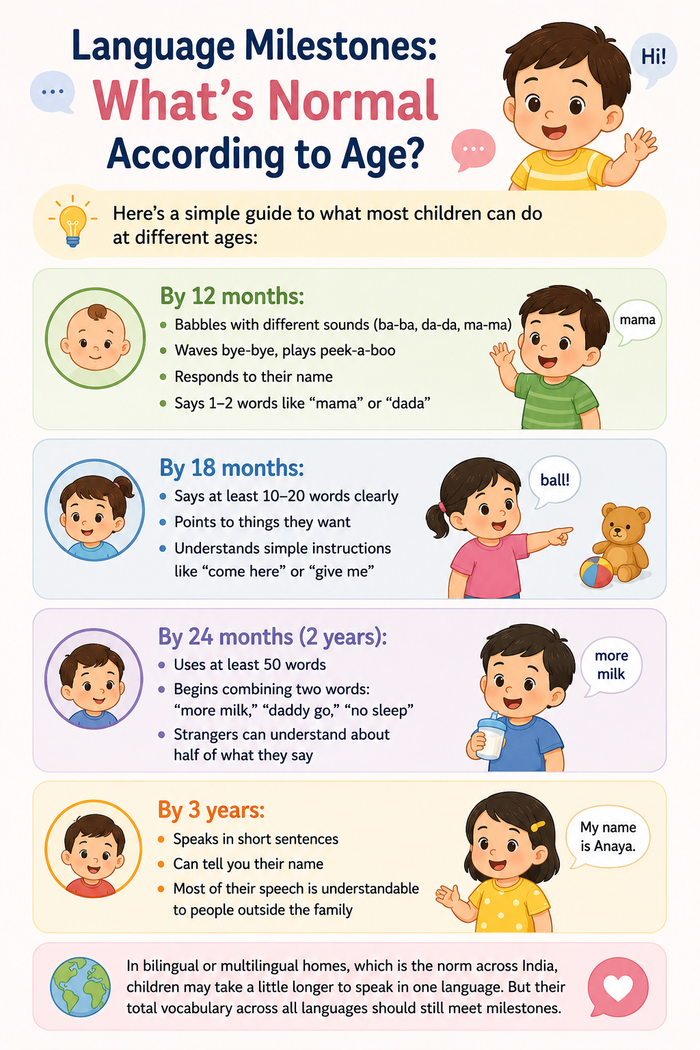
By 12 months:
- Babbles with different sounds (ba-ba, da-da, ma-ma)
- Waves bye-bye, plays peek-a-boo
- Responds to their name
- Says 1–2 words like "mama" or "dada"
By 18 months:
- Says at least 10–20 words clearly
- Points to things they want
- Understands simple instructions like "come here" or "give me"
By 24 months (2 years):
- Uses at least 50 words
- Begins combining two words: "more milk," "daddy go," "no sleep"
- Strangers can understand about half of what they say
By 3 years:
- Speaks in short sentences
- Can tell you their name
- Most of their speech is understandable to people outside the family
What Causes Language Delays?
Language delay doesn't have a single cause. Some common reasons include:
- Hearing loss: Even a mild, temporary hearing problem (like fluid in the ears from repeated infections, very common in children under 3) can slow language development.
- Multilingual exposure: Normal and manageable, but can briefly delay single-language word counts.
- Limited verbal interaction: Screen time replacing conversation, or caregivers who are less verbally engaged. Research with 18-month-olds links excessive screen time to expressive language delays, with the risk rising with each additional 30 minutes of screen time per day beyond recommended limits.
- Developmental conditions: Such as autism spectrum disorder (ASD), intellectual disability, or cerebral palsy.
- Prematurity: Premature babies often reach milestones slightly later; doctors usually adjust for gestational age.
- Family history: Late talking sometimes runs in families, with no other concerns.
Red Flags: Signs That Need Attention
The old advice, "boys talk late," "the second child always takes longer," "Einstein didn't talk till he was 4", is not always wrong. But it has also led many families to wait too long.
Watch for these warning signs at any age:
- Does not respond to their name by 12 months
- Does not babble or gesture (wave, point) by 12 months
- Says no words at all by 16 months
- Says no two-word phrases by 24 months (other than copying what you say)
- Loss of language they previously had; this is always a red flag
- Doesn't seem to understand simple requests
- Shows limited eye contact or doesn't seem interested in people
The "Wait and See" Trap
Many parents are told by relatives to "just wait, he will speak when he is ready." Sometimes this is true. But early intervention produces dramatically better outcomes than delayed treatment.
The brain is most ready to learn and adapt in the first three years of life. Speech therapy, language stimulation, and early support work best during this window. Waiting until age 4 or 5 because "he'll catch up" can mean missing the most effective period for help.
One large study found that of toddlers who were language delayed at age 2 and received early support, 60% had fully caught up by age 4.
What You Can Do at Home
These strategies are proven to boost language development:
- Talk more, screen less: Narrate your daily life. Now we're cutting the sabzi. This is a tomato, laal in colour.
- Read together every day: Even simple picture books build vocabulary fast. Point and name everything.
- Follow their lead: If they point at a dog, say "dog! Yes, that's a brown dog. The dog is running! Expand on whatever interests them.
- Don't rush to finish their sentences: Give them time to try. Wait with a warm, expectant look rather than jumping in.
- Reduce background noise: The TV running all day makes it harder for toddlers to tune in to language.
- Limit passive screen time: Videos don't teach language the way real conversation does, especially before age 2.
When to See a Doctor or Speech Therapist
See your paediatrician if your child:
- Misses any of the milestones listed above
- You have a gut feeling that something is off, and parents are often right
- Your child is 2 years old and has fewer than 50 words or isn't combining words
- Your child's speech is very hard to understand, even by family members
- There are other developmental concerns, like poor eye contact, repetitive behaviour, or social withdrawal
Whether you’re pregnant, a new mom, or navigating postpartum, you don’t have to do it alone. Join our support group to connect, share, and support one another.
FAQs on Is My Toddler a Late Talker? What's Normal and When to Seek Help
- My 2-year-old understands everything I say but doesn't speak much. Should I worry?
Good comprehension with limited speech is a positive sign. It suggests the delay may be expressive (output) rather than a deeper language or cognitive issue. However, a 2-year-old should still be using at least 50 words and combining two words. If not, see a paediatrician or speech therapist. - We speak Hindi at home and English at school. Could this confuse my toddler and delay their speech?
Growing up with two or more languages does not cause language delay. You should count words across all their languages. What matters is the total vocabulary, not how many words in one language. If your child is still falling short, even when counting all languages, then evaluation is recommended. - Can too much screen time cause speech delay in toddlers?
Yes, excessive passive screen time, especially before age 2, is associated with language delays. This is because language develops through back-and-forth interaction, not passive watching. The American Academy of Pediatrics recommends no screen time (except video calls) before 18–24 months.