In this article:
The gap between your pregnancies is one of the most important and most overlooked factors in maternal and infant health. Getting it right can make a difference for both you and your baby.
What Is Birth Spacing and Why Does It Matter?
Birth spacing (interpregnancy interval or IPI) is the time between the birth of one child and the conception of the next. It's different from the gap between two deliveries; it's about when your body starts another pregnancy, not just when the babies are born.
Your body goes through enormous changes during pregnancy and delivery. It takes time to restore the iron stores, nutrients, hormones, and uterine strength. If you conceive again too soon, your body hasn't fully recovered, and that affects both you and your next baby.
What Is the Ideal Gap Between Pregnancies?
When it comes to birth spacing, you don't have to rely on word of mouth. There are clear, evidence-based recommendations from recognised health bodies that give you a solid foundation to make an informed decision.
WHO (World Health Organization) Recommendations
The WHO recommends waiting at least 18 to 24 months after a live birth before trying to conceive again. This interval allows the mother's body to fully recover, replenish nutritional stores, and reduce the risk of complications for both mother and baby.NHM / MoHFW (Government of India)
India's own National Health Mission, under the Ministry of Health and Family Welfare, goes a step further. It recommends a gap of at least 3 years between births, slightly more conservative than the WHO, and specifically shaped around the Indian reality of widespread anaemia, malnutrition, and limited access to healthcare in many regions. What's alarming is that according to their own data (SRS 2020), nearly 1 in 2 births in India, 47.6%, happen before this recommended gap is reached.FOGSI (Federation of Obstetric and Gynaecological Societies of India)
FOGSI is the apex professional body of gynaecologists and obstetricians in India. Their clinical guidelines endorse a minimum interpregnancy interval of 18 to 24 months, with longer gaps specifically advised after caesarean deliveries or pregnancies with complications.The Risks of Getting Pregnant Too Soon
Conceiving within 6 to 12 months of a previous birth is associated with several health risks:
For the baby:
- Premature delivery: Higher risk of preterm birth (baby born before 37 weeks). A study found that short interpregnancy intervals (under 6 months) raise the risk of preterm birth by 50%.
- Low birth weight: This affects development and immunity
- Neonatal complications: Increased risk of neonatal death in the first 28 days
- Breast milk competition: Risk of nutritional deficiency if the mother is still breastfeeding
For the mother:
- Anaemia: Extremely common in Indian women, made worse by closely spaced pregnancies
- Uterine complications: Uterine rupture risk, especially after a C-section
- Maternal mental health: Postpartum depression that isn't fully resolved before the next pregnancy
- Nutritional depletion: Nutritional depletion, particularly of iron, folate, and calcium
Recommended Pregnancy Gap After Different Pregnancy Outcomes
A 2024 meta-analysis found that short birth intervals increase the risk of early neonatal mortality by 91% and neonatal mortality by 78%.
Doctors and global health bodies generally recommend:
| Situation | Recommended Wait | Why |
| After a normal vaginal delivery | 18 to 24 months | Full nutritional & hormonal recovery |
| After a C-section | At least 24 months | The uterine scar needs time to heal fully |
| After a miscarriage | At least 6 months | Uterine lining recovery, emotional healing |
| After a stillbirth | 6–12 months (with counselling) | Physical recovery + grief processing |
Note: Your doctor may personalise this based on your health, delivery history, and any complications you may have had.
Can Waiting Too Long Between Pregnancies Be Harmful?
On the flip side, waiting more than 5 years to have the next child also carries risks. Research shows that very long intervals are associated with:
- Pre-eclampsia (high blood pressure in pregnancy)
- Longer labour and a higher likelihood of C-section
- The uterus may have forgotten the adaptations from the first pregnancy
Birth Spacing After a C-Section
India has one of the highest C-section rates in the world, particularly in private hospitals in cities. If you've had a caesarean delivery, your situation requires extra attention.
The uterine scar from a C-section needs at least 24 months to heal properly. Getting pregnant before that increases the risk of uterine rupture, a rare but life-threatening emergency. It also increases the chance of placenta previa and placenta accreta in the next pregnancy.
Can You Get Pregnant While Breastfeeding?
Many women breastfeed exclusively for 6 months and continue for up to 2 years, which is the ideal. But breastfeeding does not reliably prevent pregnancy.
While it suppresses ovulation to some extent, a method called the Lactational Amenorrhoea Method (LAM) is only about 98% effective when all three conditions are met: your baby is under 6 months, you are exclusively breastfeeding (no formula, no solids, no long gaps), and your periods haven't returned.
If any of these conditions are not met, you can absolutely get pregnant while breastfeeding. Use contraception if you are not ready for another pregnancy yet.
How to Plan Your Ideal Birth Gap
Here are practical steps that work well:
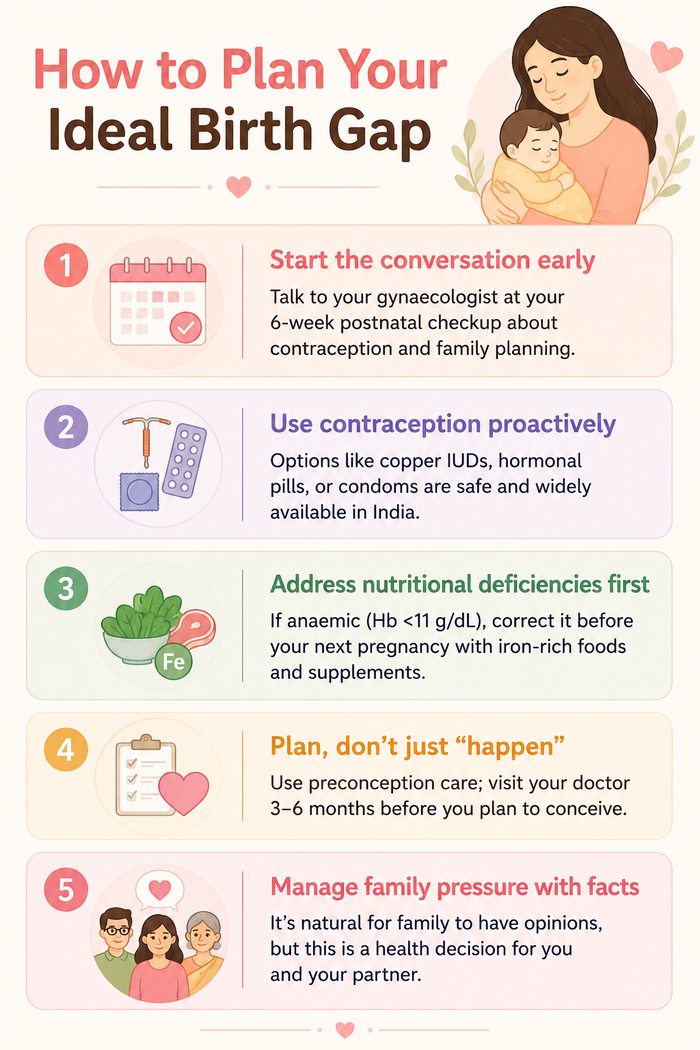
- Start the conversation early: Talk to your gynaecologist at your 6-week postnatal checkup about contraception and family planning.
- Use contraception proactively: Consider options like copper IUDs, hormonal pills, or condoms; all are safe and widely available in India.
- Address nutritional deficiencies first: If you're anaemic (haemoglobin below 11 g/dL), aim to correct it before your next pregnancy by increasing iron intake through iron-rich foods and supplements.
- Plan, don't just "happen": Use preconception care to your advantage; visit your doctor 3–6 months before you plan to conceive.
- Manage family pressure with facts: It's natural for family members to have opinions, but ultimately this is a health decision for you and your partner.
Mental and Emotional Recovery
Apart from physical recovery, having a baby is emotionally overwhelming. Postpartum depression affects 1 in 5 new mothers in India, and many cases go undiagnosed because of social stigma.Giving yourself adequate time between pregnancies also means giving your mind time to recover. A mother who is emotionally well is better equipped for another pregnancy and for raising happy, healthy children.
If you've experienced any baby blues, anxiety, or depression after delivery, speak to your doctor before planning the next pregnancy. There is no shame in this; it is a medical matter, not a personal weakness.
Whether you’re pregnant, a new mom, or navigating postpartum, you don’t have to do it alone. Join our support group to connect, share, and support one another.
FAQs on How Long Should You Wait Before Getting Pregnant Again?
- Is it safe to get pregnant again within 6 months of delivery?
Conceiving within 6 months of delivery significantly increases the risk of preterm birth, low birth weight, maternal anaemia, and uterine complications, especially after a C-section. The WHO advises a minimum gap of 18 months for the best outcomes. - What is the minimum safe gap between a C-section and the next pregnancy?
Doctors generally recommend at least 2 years after a caesarean before your next conception. This allows the uterine scar to heal fully and reduces the risk of uterine rupture, placenta previa, and other serious complications in the next pregnancy. - Can I get pregnant while breastfeeding?
Yes, you can. Breastfeeding reduces the chance of ovulation, but it is not a reliable contraceptive method unless all three LAM (Lactational Amenorrhoea Method) criteria are strictly met: baby under 6 months, exclusive breastfeeding, and no return of periods.