This flexibility becomes crucial during labour. As contractions build, your pelvis begins to tilt, expand, and slightly rotate to accommodate your baby’s head. The joints that make this possible include:
- Sacroiliac joints: Connect the sacrum to the hip bones and allow subtle forward–backward motion.
- Pubic symphysis: A fibrocartilage joint at the front of the pelvis that stretches by a few millimetres under relaxin.
- Sacrococcygeal joint: Where your tailbone meets the sacrum. It can move backwards during the pushing stage, increasing pelvic space by up to 2 cm.
How Your Baby Navigates the Pelvic Passage
Labour is not simply about your baby “coming down.” It’s a precise sequence of movements called the cardinal movements of labour. Your baby doesn’t travel straight. They twist, tuck, and turn through each level of your pelvis:
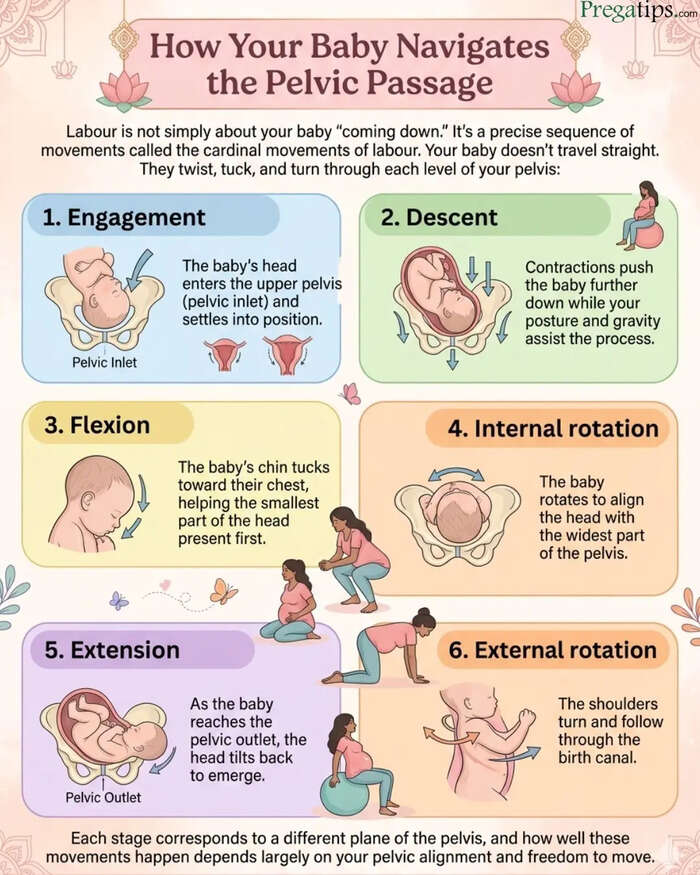
- Engagement: The baby’s head enters the upper pelvis (pelvic inlet) and settles into position.
- Descent: Contractions push the baby further down while your posture and gravity assist the process.
- Flexion: The baby’s chin tucks toward their chest, helping the smallest part of the head present first.
- Internal rotation: The baby rotates to align the head with the widest part of the pelvis.
- Extension: As the baby reaches the pelvic outlet, the head tilts back to emerge.
- External rotation: The shoulders turn and follow through the birth canal.
The Three Levels of the Pelvis During Birth
Understanding your pelvis as three “gateways” helps explain why movement matters:
- Pelvic Inlet: The top opening, where your baby first engages. Upright and forward-leaning positions (like standing, kneeling, or rocking on a birthing ball) allow gravity to draw the baby into this space.
- Midpelvis: The narrowest part, surrounded by muscles and ligaments. As the baby rotates here, side-lying or hands-and-knees positions can widen the space and ease pressure on your back.
- Pelvic Outlet: The final stretch, where the tailbone moves back. Squatting or kneeling can open this outlet by up to 20–30% more compared to lying flat.
Why Alignment Matters More Than “Pelvic Size”
Many women fear their pelvis is “too small” for birth. In reality, most pelvises are capable of accommodating birth when alignment and mobility are supported. True pelvic mismatch (called cephalopelvic disproportion, or CPD) is rare, affecting less than 1 in 250 births, and often linked to other factors like foetal positioning or medical complications.
What often causes difficulty is restricted movement (tight muscles, prolonged sitting, or lying in one position for too long) can limit pelvic flexibility. Keeping your pelvis balanced and mobile helps your baby find the easiest route down.
Key contributors to better alignment include:
- Strong but flexible pelvic floor muscles: They support the baby’s head but also stretch when needed.
- Neutral spine posture: Avoid excessive arching or slumping — both can misalign the sacrum.
- Freedom to move: Walking, swaying, kneeling, or even gentle hip circles keep the joints mobile.
The Hormones That Make It Possible
Your body orchestrates pelvic opening through a cascade of hormones:
- Relaxin: Peaks in late pregnancy, softening the ligaments around the sacroiliac and pubic joints.
- Progesterone: Helps maintain uterine calm early on but works with relaxin to loosen tissues.
- Oestrogen: Increases uterine sensitivity and improves blood flow to pelvic tissues.
- Oxytocin: Drives contractions that push the baby downward, also enhancing relaxation between contractions.
Positions That Help the Pelvis Open
Your birthing position directly affects how easily your baby can pass through. Here’s how each position changes pelvic dimensions:
- Upright (standing, kneeling, or squatting): Gravity assists descent and widens the pelvic outlet by allowing the sacrum to move freely.
- Hands-and-knees: Reduces back pain and encourages the baby to rotate into an optimal anterior position.
- Side-lying: Useful when you’re tired or on an epidural. Keeps pressure off major blood vessels and maintains good alignment.
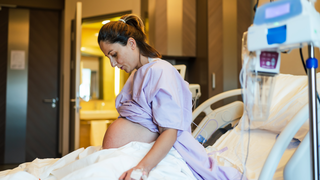
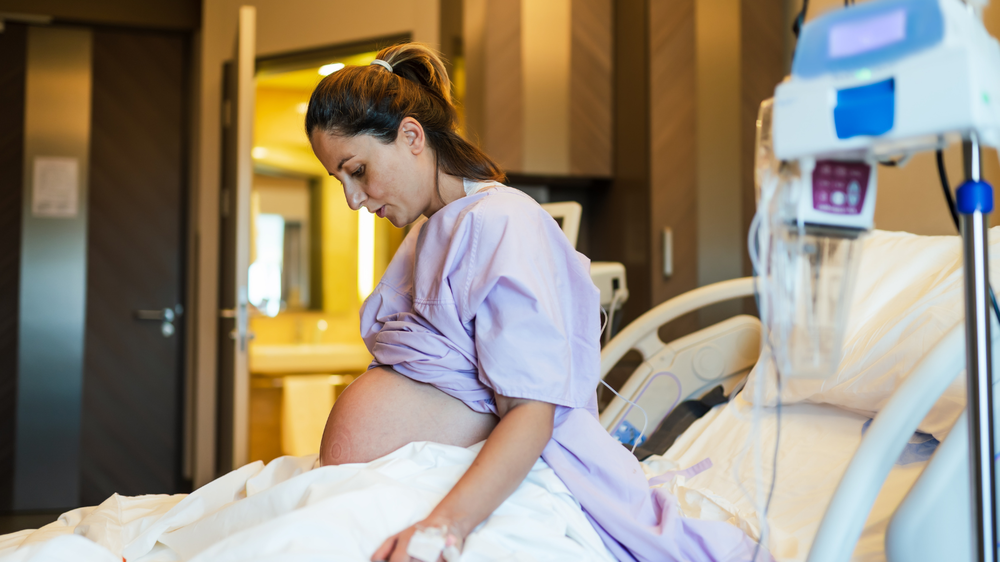
- Semi-sitting: Common in hospitals, but leaning too far back can compress the sacrum and limit movement. Adding a pillow behind your lower back helps.
When Pelvic Alignment Becomes a Challenge
Some factors can restrict pelvic movement or cause pain during labour:
- Pelvic girdle pain (PGP): Occurs when ligaments become overly loose, often leading to pain near the pubic bone or hips.
- Previous pelvic trauma or surgery: May limit mobility of the joints.
- Prolonged lying on the back: Compresses the sacrum and narrows the pelvic outlet.
- Strong epidural effect: Reduces sensation, making position changes harder.
The Role of Your Support Team
During labour, your partner or birth attendant can play a key role in maintaining alignment:
- Applying gentle pressure on the lower back or hips during contractions can relieve sacral strain.
- Supporting your legs or helping you change positions keeps your pelvis from locking in one angle.
- Encouraging upright positions during early labour and side-lying when you’re fatigued balances endurance with comfort.
Myths About “Tight Hips” or “Small Frames”
Your bone structure rarely determines your birth outcome. Studies from the Royal College of Obstetricians and Gynaecologists (RCOG) show that the baby’s position and maternal movement patterns influence labour progress far more than pelvic shape alone.
Tight hips don’t mean you can’t give birth vaginally. It simply means your muscles may need more relaxation and support. Prenatal yoga, gentle walking, and perineal massage are proven to help your body prepare.
When Medical Help Is Needed
Sometimes, even with optimal alignment, labour doesn’t progress.
Possible causes include:
- Baby’s head is not rotating correctly (occiput posterior position).
- Weak contractions despite good positioning.
- Structural issues like severe scoliosis or previous pelvic surgery.
Your pelvis is an intelligent, adaptive structure, not a rigid frame. Every movement, hormone, and contraction works in harmony to open the birth pathway. By staying mobile and aligned, you help your baby follow nature’s map with less resistance and more safety. Birth isn’t about force. It’s about flow, flexibility, and trust in what your body was built to do.
Whether you’re pregnant, a new mom, or navigating postpartum, you don’t have to do it alone. Join our support group to connect, share, and support one another.
FAQs on How Your Pelvis Opens During Birth: What Really Happens
- Can my pelvis be too small for a normal delivery?
True pelvic-foetal mismatch is rare. Most women’s pelvises adapt to hormonal and positional changes. Labour difficulties often stem from baby positioning or muscle tension rather than bone size. - Does lying flat on my back make labour harder?
Yes. It limits sacral movement and narrows the pelvic outlet. Upright or side-lying positions usually make contractions more effective and reduce pain. - What can I do before labour to support pelvic flexibility?
Regular walking, pelvic tilts, gentle stretches, and squats (if approved by your doctor) help maintain joint mobility and muscle strength.