
In this article:
How Many Wet Diapers Per Day: A Day-by-Day Guide for Newborns
In the first few days of life, your baby's kidneys are still adjusting. Their fluid intake is low because breast milk or colostrum is produced in small amounts. Here is what to expect:
| Age | Expected Wet Diapers Per Day | Notes |
| Day 1 (0–24 hrs) | 1 | First urine may be dark yellow or have orange-red crystals (urate crystals) |
| Day 2 | 2 | Colostrum is low in volume; output increases gradually |
| Day 3 | 3 | Milk transition begins; urine becomes pale |
| Day 4 | 4 | Urine should be clear to pale yellow by now |
| Day 5 onwards | 6–8 or more | Minimum 6 heavy wet diapers expected |
| 1–6 months | 6–8 | Consistent output; urine pale yellow |
| 6–12 months | 4–6 | Solids introduced; frequency may reduce slightly |
| 12 months+ | 4–5 | Bladder capacity grows; the pattern begins to resemble a toddler |
What Does Baby Urine Look Like?
Healthy baby urine is pale yellow and odourless. After the first 48 hours, dark yellow or orange-tinged urine is a sign the baby needs more fluids.
| Urine Appearance | What It Means |
| Clear to pale yellow | Well-hydrated |
| Bright or dark yellow | Mildly dehydrated; offer more feeds |
| Orange or brick-red specks | Urate crystals, normal in days 1–2, concerning after day 4 |
| Pink or red-tinged | Could be blood; see a doctor |
| Cloudy or strong-smelling | Possible urinary tract infection (UTI); get checked |
Signs Your Baby Is Peeing Too Little: Dehydration Warning Signs
According to the AAP guidelines, fewer than 6 wet diapers per day after day 5 is the primary red flag. Watch for these signs alongside low urine output:
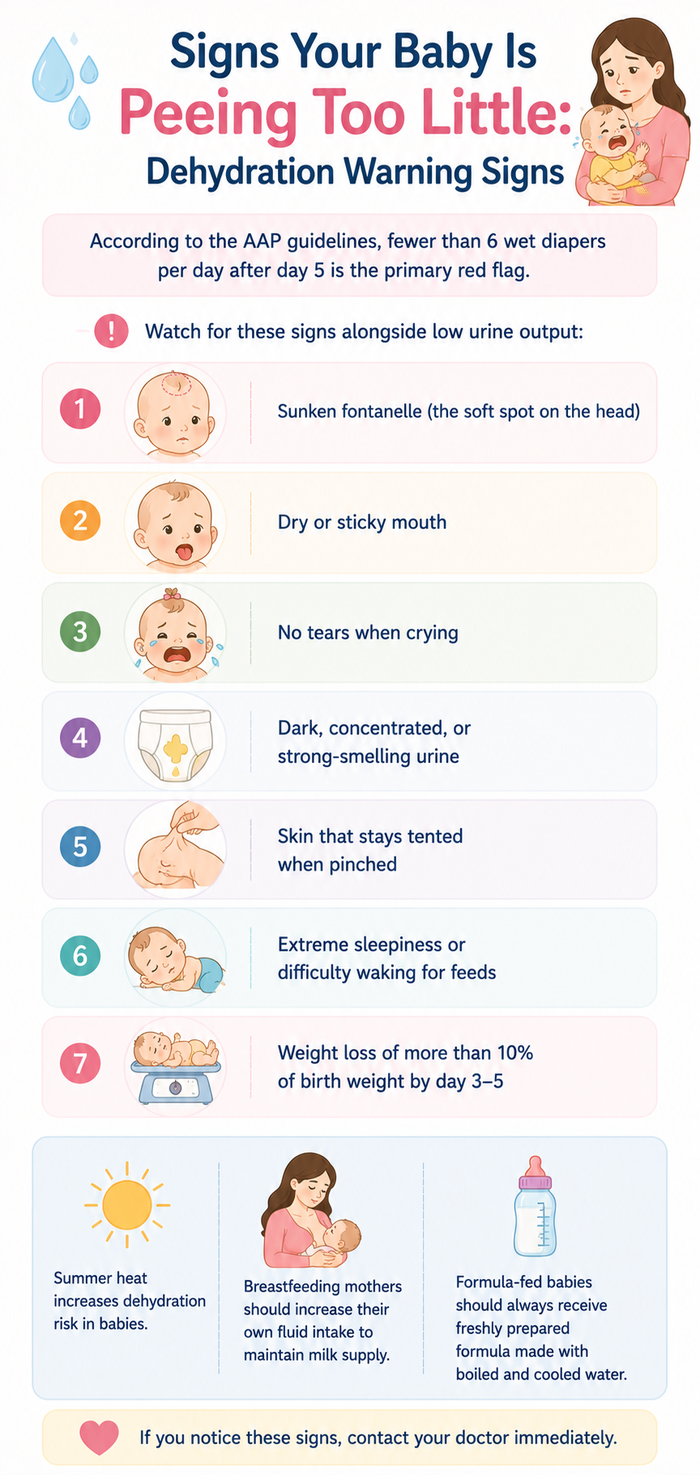
- Sunken fontanelle (the soft spot on the head)
- Dry or sticky mouth
- No tears when crying
- Dark, concentrated, or strong-smelling urine
- Skin that stays tented when pinched
- Extreme sleepiness or difficulty waking for feeds
- Weight loss of more than 10% of birth weight by day 3–5
Summer heat increases dehydration risk in babies. Breastfeeding mothers should increase their own fluid intake to maintain milk supply. Formula-fed babies should always receive freshly prepared formula made with boiled and cooled water.
Disposable vs Cloth Diapers: How to Count Wet Diapers Accurately
Modern disposable diapers are designed to absorb heavily and feel dry even after urination. This makes it harder to count wet diapers accurately.To check if a disposable diaper is wet, press gently on the inside pad; it will feel heavier or slightly gel-like when wet. With cloth nappies, which are still widely used in Indian households, wetness is obvious. Count the number of nappy changes in 24 hours rather than individual urinations.
When to See a Doctor
Most parents do not need to worry if their baby is feeding well, alert, and gaining weight. However, see a doctor if you notice:- No urine for 8 or more hours in a baby under 6 months
- Blood in the urine (pink, red, or rust-coloured stains in the diaper)
- Urine that smells unusually strong or sweet
- Pain or crying during urination
- Swelling around the eyes or face alongside reduced urination
- Persistent orange or red urate crystals beyond day 3
- Baby seems lethargic, is not feeding, or is losing weight
Whether you’re pregnant, a new mom, or navigating postpartum, you don’t have to do it alone. Join our support group to connect, share, and support one another.
FAQs on How Many Times Should a Baby Pee Per Day, By Age?
- Do formula-fed babies pee more or less than breastfed babies?
Both should wet roughly the same number of diapers, at least 6 per day from day 5 onwards. Formula is slightly more concentrated than breast milk, so formula-fed babies may produce slightly less urine, but the difference is minimal when feeds are on schedule, and volumes are appropriate. - My baby pees frequently, more than 10 times a day. Is that a problem?
In most cases, frequent urination in a breastfed baby often means they are feeding well, and the breast milk supply is good. As long as the urine is pale yellow and the baby is gaining weight, frequent wet diapers are not a concern. - Is it normal for a newborn to pee only once or twice a day in the first two days?
Yes. In the first 48 hours, a newborn's urine output is directly linked to colostrum intake, which is naturally low in volume. One wet diaper on day 1 and two on day 2 are expected. Output increases as mature breast milk comes in or formula feeds are established.