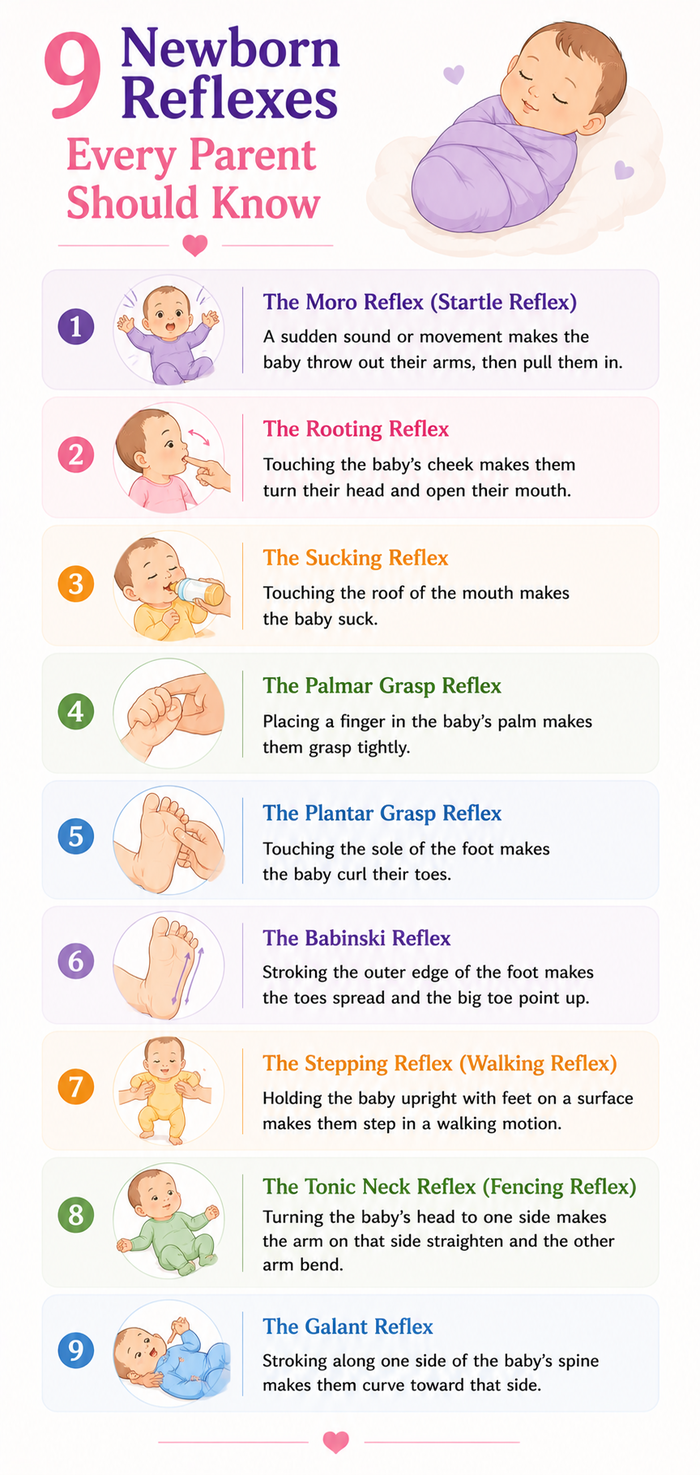
9 Newborn Reflexes Every Parent Should Know
The Moro Reflex (Startle Reflex)
When your baby is startled by a sudden noise, movement, or sensation of falling, their arms will flail outwards, their fingers spread, and then their arms will draw back to their body. You may even hear a small cry following this. The most common explanation given for this reflex is that it is a survival mechanism where the child reaches out to their caregiver due to the feeling of loss of balance. The Moro reflex usually fades away between two and four months.
In case the Moro reflex is not present when your baby is born, or it occurs on one side only, it might suggest nerve damage, bone fracture, or other problems related to neurology.
The Rooting Reflex
If you lightly touch the corner of your baby’s mouth or face, they will turn their head in that direction and open their mouth, looking like they’re trying to find their way to the nipple.
This is mostly an eating reflex, helping your child find their food source for eating. This reflex usually disappears around three to four months, as your child begins to eat intentionally.
If there is no rooting reflex or a weak one in your child, it may indicate neurological problems or immaturity.
The Sucking Reflex
Whenever there is any stimulation at the roof of the baby’s mouth, either from your breast, fingers, or a pacifier, they will automatically start sucking. The sucking reflex is vital for survival. Your baby has even been observed practising it in the womb, beginning around 32 weeks of gestation. While the reflex-driven sucking becomes voluntary, usually by about four months, the coordination for feeding carries on much longer. A weak suck can sometimes make feeding difficult for premature babies, but lactation consultants and neonatal care teams can provide support in the first few weeks.
The Palmar Grasp Reflex
When your finger is put in the palm of your infant, they will grasp it tightly. It has been speculated that this response is because your baby needs the ability to hold onto its mother. The palmar grasp reflex normally fades between three and six months. When your baby exhibits a weaker grasp on one side and a stronger one on the opposite, it may suggest some kind of nerve injury.
The Plantar Grasp Reflex
Press your finger against the sole of your baby's foot, just behind their toes, and you will see their toes curl downwards in an attempt to grab your finger. This is essentially the same as the palmar grasp, but for the foot, an ancient, primal grip reflex. Your baby will outgrow this reflex by nine to twelve months; at the same time, they learn how to stand and support themselves on their feet. Though opinions on this matter are divided, it is possible that a plantar grasp lasting beyond twelve months is indicative of delayed neurological development and needs to be brought to the attention of your paediatrician.
The Babinski Reflex
Stroke the outer side of the sole of your baby’s foot, starting from the heel and moving towards the toes. The great toe will move upward while the other toes will spread out.
This reflex is indicative of the immaturity of the infant’s nervous system. The Babinski reflex is expected to disappear between the ages of one and two years. Although normal in infants, the Babinski reflex in adults or older children may signal a problem in the nervous system.
The Stepping Reflex (Walking Reflex)
If you position your baby standing up straight with their feet against a solid surface, they will perform the steps in such a way that they alternate. It indicates that the basic reflex pathway that controls walking has been formed, but the baby does not have enough muscles and coordination to walk on purpose. The stepping reflex usually disappears after two months, but then it is followed by walking, which usually happens around the twelfth-month mark. It might mean that there may be some problem with the nerves or muscles of your child if he does not exhibit any stepping reflex at birth.
The Tonic Neck Reflex (Fencing Reflex)
In cases where the baby’s head is turned on one side when placed on their back, the leg and arm on that side will straighten, while the ones on the other side will curl up. It is popularly called the “fencing position.” It is thought that it assists the baby in eye-hand coordination development, as well as in developing movements such as reaching. It normally goes away between four and six months of age. The baby may not be able to bring their arms to the midline and play because this reflex is too pronounced. Talk to your paediatrician about this problem.
The Galant Reflex
When you run your finger down one side of your baby’s back near the spine, the body bends toward the touched side, and the baby’s hips shift towards the same side. This reflex is thought to be connected to childbirth and could help develop trunk movement skills that could come in handy in the future. This reflex fades away by the time your baby is four to six months old. An absent reflex on one or both sides can sometimes be indicative of a spinal cord injury, particularly after a difficult delivery. It's a good idea to mention any asymmetry to your doctor.
When to Contact Your Doctor
Contact your paediatrician if:
- One of the above reflexes is absent from birth or within the first couple of days postnatally.
- One of the above reflexes is present only on one side of the body.
- One of the above reflexes persists for longer than expected.
- Your baby seems excessively floppy or stiff.
- There is an unexpected change in your baby’s movement or responsiveness.
Newborn reflexes are assessed in normal postnatal check-ups. Do not skip your baby's check-ups, even if your baby appears to be happy and thriving.
Newborn reflexes are your baby's first language. These involuntary reflexes show you and your paediatrician that your baby's brain and nervous system are working properly. Knowing what to look for and when each reflex is expected and disappears allows you to have more confidence in your baby's development and to identify when a consultation with a professional might be necessary.
Whether you’re pregnant, a new mom, or navigating postpartum, you don’t have to do it alone. Join our support group to connect, share, and support one another.
FAQ on 9 Newborn Reflexes Every Parent Should Know About
- Are newborn reflexes normal brain development?
Yes, normal newborns display specific reflexes that are one aspect paediatricians consider indicative of normal brain development. Testing for those reflexes is routinely performed by a paediatrician within the first day or days after birth. - What occurs if reflexes do not disappear?
The presence of a reflex far beyond the age at which it should have disappeared can make it difficult to develop motor skills. Discuss persistent reflexes with your doctor, who will examine them more comprehensively. - Can I check newborn reflexes at home?
Most primitive reflexes can be easily observed by yourself on a natural basis. However, formal testing of all reflexes requires specialised knowledge to adequately assess the appropriate response strength and symmetry, and should be performed by a paediatrician.