
In this article:
This may feel unsettling. However, the purpose of such research is not to alarm you. It is to help you to become aware and foster healthy environments that shape the development of your growing kids. Your thoughtful parenting can help them have a better future.
What the AIIMS Findings Actually Suggest
The AIIMS study highlights an important association. Children below the age of 18 months with higher screen exposure were more likely to show:
- Reduced eye contact
- Limited social engagement
- Delayed communication responses
These behavioural issues become more noticeable when the children grow up to the age of three.
However, some studies also indicate that:
- Autism has strong genetic roots
- Screen exposure is only one possible influencing factor
- Early environment may affect how developmental traits appear
What Long-Term Research Reveals About Infant Screen Time
Several large-scale studies strengthen these observations.
Study 1
In this study, researchers followed and observed ~84,000 children over time.It found that higher screen exposure in the first two years was associated with a higher likelihood of autism diagnosis at 12 years, although the relationship was not found to be a direct cause after adjusting for socioeconomic factors.
Study 2
Another study done in Japan observed 57,980 children. It was reported that if children are given long screen times at the ages of one or two years, there is a greater likelihood of delays in their development.The delays were more pronounced for the following domains:
- Communication skills
- Problem-solving abilities
- Personal-social skills
Insights from Observational and Clinical Research
Beyond long-term studies, smaller clinical and observational research also indicates a similar association.
In several hospital-based studies:
- Children showing autism-like traits often had significantly higher daily screen exposure
- Many children also had a history of reduced parent–child interaction
In another observational analysis:
Toddlers with more than 3-4 hours of screen time every day showed increased behavioural concerns. These included:- Reduced responsiveness
- Repetitive behaviours
- Delayed speech
What Neuroscience Tells Us About Early Development
Let’s look at how the brain develops in early life to appropriately understand these facts.
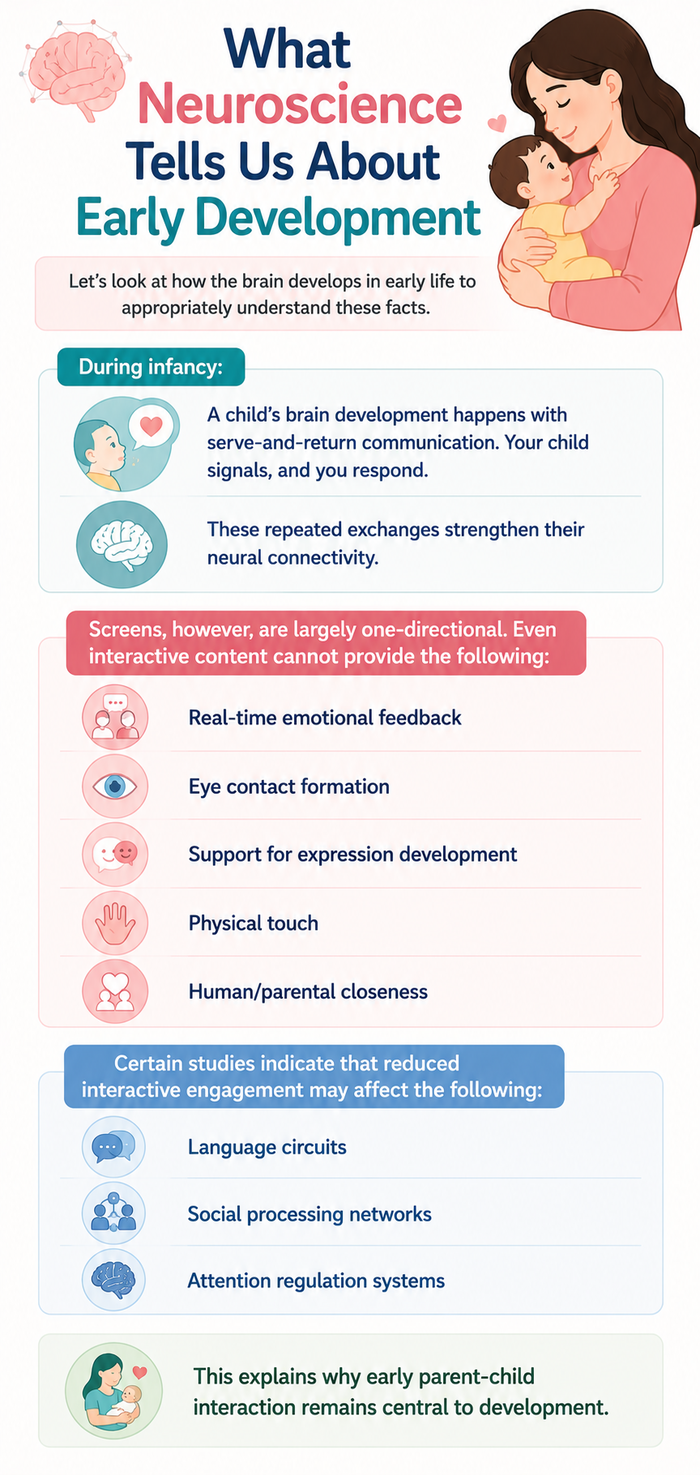
During infancy:
A child’s brain development happens with serve-and-return communication. Your child signals, and you respond.
These repeated exchanges strengthen their neural connectivity.
Screens, however, are largely one-directional. Even interactive content cannot provide the following:
- Real-time emotional feedback
- Eye contact formation
- Support for expression development
- Physical touch
- Human/parental closeness
- Language circuits
- Social processing networks
- Attention regulation systems
The Role of Parent–Child Interaction
One consistent finding across studies is reassuring. Strong parent–child interaction can buffer developmental deficits.
It has also been observed that even in homes where children are watching screens, similar developmental gaps are less likely when there is higher caregiver engagement.
This indicates that responsive communication improves language and socialisation skills in developing kids.
Ultimately, your physical and verbal closeness matter deeply. The following effective tips can support your child’s development significantly:
- Talking while feeding or dressing
- Responding to babbling
- Working on eye contact during play
Screen Exposure Patterns in Indian Settings
In many Indian families, young parents often have several responsibilities to manage every day.
This constantly puts them under stress. In this case, screens (television, smartphones, etc.) can seem like a logical way for time management.
Recent data suggest:
- In India, it is common to see children under five years old exceeding recommended screen time limits
- Exposure frequently begins within the first year
- Screens used during feeding
- Mobile devices used to calm distress
- Television running in the background
Practical Ways to Reduce Screen Time for Infants
You cannot eliminate screens overnight. However, the following tips can help in making practical shifts gradually.
- Keep mealtimes screen-free to encourage interaction
- Reduce background television noise
- Switch off the screen 2-3 hours before sleep
- Face-to-face communication
- Simple play activities
- Outdoor exposure as much as possible
Your attentive, consistent engagement plays a powerful role in your child’s development, helping shape their future in lasting ways. Early childhood is influenced not by occasional habits alone, but by repeated, nurturing interactions that build emotional security, cognitive growth, and lifelong resilience.
Whether you’re pregnant, a new mom, or navigating postpartum, you don’t have to do it alone. Join our support group to connect, share, and support one another.
FAQs on Can Screen Time for Infants Harm Development? What New Research Shows
- Does screen time directly cause autism?
No. Current evidence shows an association, not causation. Numerous factors may lead to autism. Genes and environment have a major role to play in this. - What is the recommended screen time for infants?
Most experts advise not to introduce screens to your children under 18 months, except for occasional video calls. After that, limited and supervised use is recommended. - Can limiting screen time now improve my child's development?
Yes. Early childhood development is adaptable. Improving your interactions and minimising screen time will greatly contribute to your child’s health.