
In this article:
What Is Polyhydramnios?
During pregnancy, your baby floats in a warm, protective cushion of fluid inside the amniotic sac. This fluid, called amniotic fluid, plays a vital role. It protects the baby from bumps and pressure, helps the lungs develop, keeps the umbilical cord from being compressed, and maintains the right temperature.
Normally, the amount of amniotic fluid increases steadily through pregnancy and then gradually decreases as the due date approaches. The baby swallows the fluid and excretes it through urine, a constant cycle that keeps the levels balanced.
Normal Amniotic Fluid Levels During Pregnancy
At around 34 weeks of pregnancy, fluid volume typically peaks at roughly 800 ml to 1,000 ml (about one litre). By the time the due date arrives, this naturally reduces to around 600 ml. An amniotic fluid index (AFI) of 8–24 cm is considered normal at most stages of pregnancy.
How Polyhydramnios Is Classified
Polyhydramnios (say: pol-ee-hy-DRAM-nee-os) is the medical term for when there is too much amniotic fluid, more than what is expected for the stage of pregnancy. Doctors measure this using an ultrasound technique and diagnose polyhydramnios when the amniotic fluid index (AFI) exceeds 24–25 cm, or when a single deepest pocket of fluid measures more than 8 cm.
Polyhydramnios is further classified by severity:
Mild: an AFI of 25–29.9 cm
Moderate: 30–34.9 cm
Severe: 35 cm or above
How Common Is It and Who Is at Risk?
Polyhydramnios is diagnosed in about 1–2% of all pregnancies. Severe cases are far less common but do need careful monitoring.
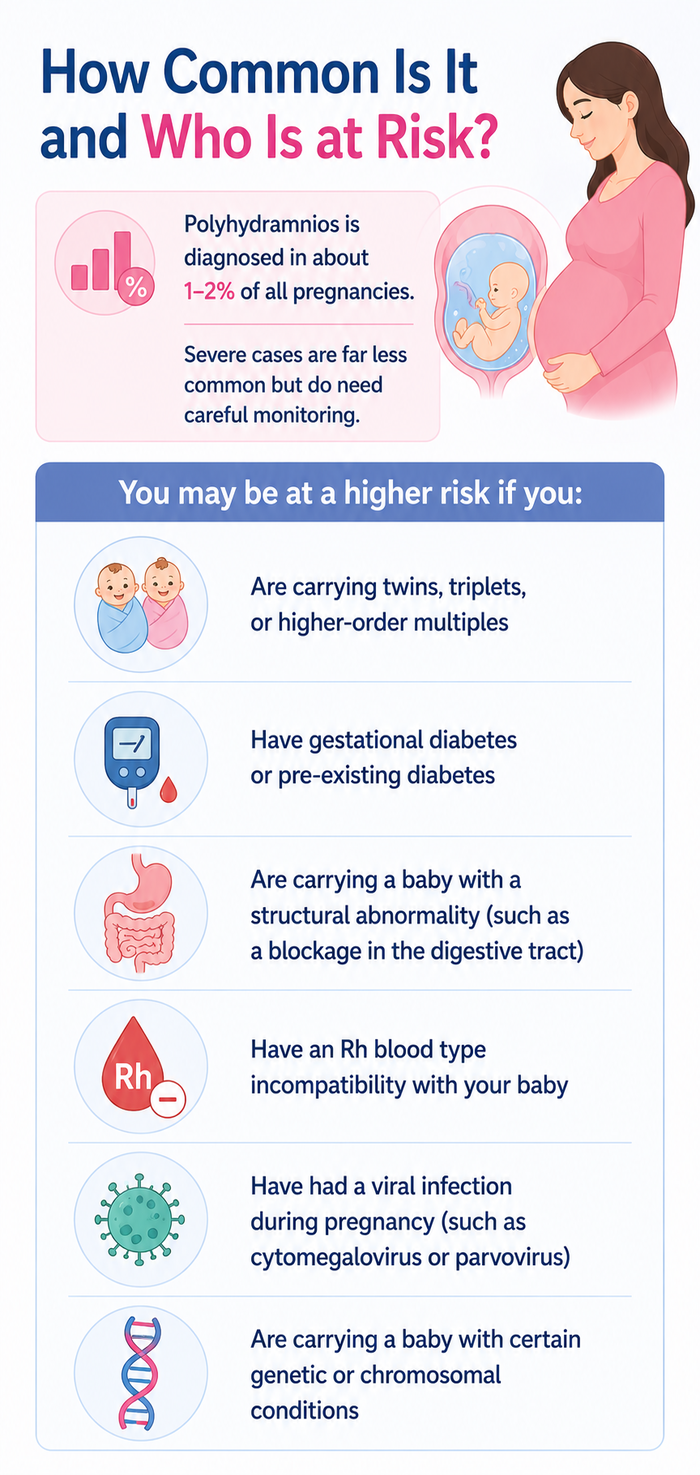
You may be at a higher risk if you:
- Are carrying twins, triplets, or higher-order multiples
- Have gestational diabetes or pre-existing diabetes
- Are carrying a baby with a structural abnormality (such as a blockage in the digestive tract)
- Have an Rh blood type incompatibility with your baby
- Have had a viral infection during pregnancy (such as cytomegalovirus or parvovirus)
- Are carrying a baby with certain genetic or chromosomal conditions
When a cause is found, the most common ones are maternal diabetes and foetal structural abnormalities, which together account for the majority of non-idiopathic cases. Polyhydramnios is also significantly more common in pregnancies affected by diabetes, with some studies suggesting it occurs in nearly 1 in 5 diabetic pregnancies, compared to about 1–2% in the general population.
Symptoms of Polyhydramnios During Pregnancy
Mild polyhydramnios often has no symptoms at all; it may only be noticed on a routine ultrasound scan. However, as fluid levels rise, you might begin to feel some noticeable changes.
Common symptoms can include:
- A larger-than-expected belly (fundal height measuring ahead of dates)
- A feeling of heaviness or tightness in the abdomen
- Shortness of breath or difficulty breathing (as the uterus presses upward)
- Heartburn or indigestion that feels worse than usual
- Swelling in the legs and feet
- Difficulty getting comfortable, especially when lying down
If you notice your belly is growing very quickly, feel sudden pressure or breathlessness, or have a gut feeling that something is not right, always contact your healthcare provider.
How Is Polyhydramnios Diagnosed?
Polyhydramnios is diagnosed through an ultrasound scan. Your doctor or sonographer will measure the amniotic fluid using one of two standard methods:
- Amniotic Fluid Index (AFI): The abdomen is divided into four sections, and the fluid in each is measured. A total score above 24–25 cm is considered polyhydramnios.
- Single Deepest Pocket (SDP): The largest single pocket of fluid is measured. A reading above 8 cm is diagnostic.
What Are the Risks?
Here is an honest, balanced look at the risks, keeping in mind that many cases are mild and uneventful.
Potential risks associated with polyhydramnios include:
- Preterm labour: The extra fluid puts pressure on the uterus, which can trigger early contractions.
- Premature rupture of membranes (PROM): The membranes holding the fluid can break earlier than expected.
- Umbilical cord prolapse: When the waters break, a rush of fluid can cause the cord to slip down before the baby, a rare but serious emergency.
- Placental abruption: The placenta separates from the uterine wall before delivery.
- Postpartum haemorrhage: An overstretched uterus may not contract as effectively after delivery, increasing bleeding risk.
- Malpresentation: More fluid gives the baby extra room to move, so it may not settle into the head-down position.
From Monitoring to Medicine: How Polyhydramnios Is Managed
Treatment depends entirely on how much fluid there is, what is causing it, and how far along you are in pregnancy.Mild Polyhydramnios
In many cases, particularly when levels are only slightly elevated and no cause is found, the approach is careful monitoring rather than active treatment. This typically involves more frequent ultrasound scans and check-ups to track fluid levels and the baby's well-being.
Treating the Underlying Cause
If gestational diabetes is the cause, controlling blood sugar levels often helps bring fluid levels down naturally. If an infection is responsible, treating it can help. In cases of twin-to-twin transfusion syndrome, more specific interventions may be needed.
Amnioreduction
In cases where fluid levels are high enough to cause significant discomfort or risk, a procedure called amnioreduction may be performed. Using a fine needle guided by ultrasound, a doctor carefully drains some of the excess fluid. This can provide significant relief and reduce risks. It may need to be repeated if fluid accumulates again.
Indomethacin
In some carefully selected cases, a medication called indomethacin (a type of anti-inflammatory drug) may be used to reduce the baby's urine production and thereby reduce fluid levels. This is typically only used before 32 weeks and requires close monitoring.
Early Delivery
If polyhydramnios is severe or associated with other complications, your care team may recommend delivering the baby earlier than the due date, with appropriate support in place. Every decision is made with both the mother's and the baby's well-being at the centre.
Labour and Delivery With Polyhydramnios
Your labour and delivery plan may be adjusted if you have polyhydramnios. Your team will be prepared for the possibility of waters breaking with extra force and will monitor the baby closely for any signs of cord prolapse. Continuous foetal heart rate monitoring is usually recommended.
If the baby is in a breech (bottom-down) position, a caesarean section may be planned. After delivery, your uterus will be monitored closely to ensure it contracts well and bleeding stays within normal limits.
Self-Care Tips for Women With Polyhydramnios
Here’s what you can do if you’re living with a high-risk pregnancy diagnosis:
- Attend all scheduled prenatal appointments and ultrasound scans
- Monitor your baby's movements daily; a reduction in movements should always be reported promptly
- Rest when your body asks for it; avoid strenuous activity if you have moderate to severe polyhydramnios
- If you have gestational diabetes, follow your dietary plan and blood sugar monitoring closely
- Speak to your doctor about what symptoms to watch for and when to go to the hospital
- Reach out to a counsellor or support group if anxiety about your pregnancy is affecting your wellbeing
Prognosis: What to Expect
Outcomes depend largely on the underlying cause and its severity. Idiopathic mild cases generally resolve on their own, often without any intervention. When an underlying condition is identified and well-managed, most women still go on to deliver healthy babies.
Severe or unmanaged polyhydramnios carries a higher risk of complications, but modern obstetric care significantly improves outcomes.
Whether you’re pregnant, a new mom, or navigating postpartum, you don’t have to do it alone. Join our support group to connect, share, and support one another.
FAQs On Too Much Amniotic Fluid During Pregnancy? Understanding Polyhydramnios
- What foods or lifestyle changes help with polyhydramnios?
If your polyhydramnios is linked to gestational diabetes, a low-glycaemic diet and blood sugar control can help reduce fluid levels meaningfully. Otherwise, there is no specific diet proven to reduce amniotic fluid. Staying well-hydrated, reducing vigorous physical activity in severe cases, and attending all monitoring appointments are the most effective steps. - Can I still have a normal vaginal birth with polyhydramnios?
Many women with polyhydramnios do have vaginal births. However, your birth plan will be reviewed carefully. If the baby is in an awkward position, if fluid levels are very high, or if there are other complications, a caesarean section may be recommended. Your obstetric team will discuss the safest plan for you individually. - Is polyhydramnios dangerous for the baby?
Mild polyhydramnios carries a very low risk, and most babies are born healthy. More severe cases do carry higher risks, including preterm birth, cord prolapse, and malpresentation, but these are closely monitored and managed by your care team. The underlying cause (if any) matters more than the fluid level alone.