
In this article:
Not all the time does financial stress come as fear or panic. For many people, it means always doing mental math, making plans, or feeling anxious about the future. Changes in the lives of people who have been fired are intimately linked to their ability to handle money.
Your body still knows about these problems, even if you try to ignore or deal with them in silence. The brain sees financial instability as a sign of insecurity. Over time, this background stress can change how hormones work, how balanced emotions are, and the conditions under which conception happens.
Why Financial Stress Often Goes Unnoticed
Financial stress is different from sudden emotional distress. It tends to settle in slowly and stay for long periods. Because it becomes part of daily thinking, it often goes unrecognised or is dismissed as usual. However, the nervous system does not ignore it. The body remains alert when there is ongoing uncertainty around security and stability.
This type of stress can be particularly draining because it lacks a clear endpoint. The mind keeps revisiting future scenarios and possible outcomes. It keeps the body's stress reaction going even when you're resting.
Financial stress can have several adverse effects on the body, such as:
- Keeping the brain in a constant state of planning.
- Stress signals stay on even when there isn't a problem right now.
- Instead of healing, you spend your emotional energy on worry.
- The nervous system has a hard time getting back to a peaceful state.
- The body sees financial uncertainty as a long-term danger.
Financial Stress on Hormones
Hormones rely on unambiguous and consistent communication between the brain and the body. Financial stress disrupts this communication by triggering survival pathways. When the brain senses ongoing insecurity, it prioritises functions related to protection over those related to reproduction.
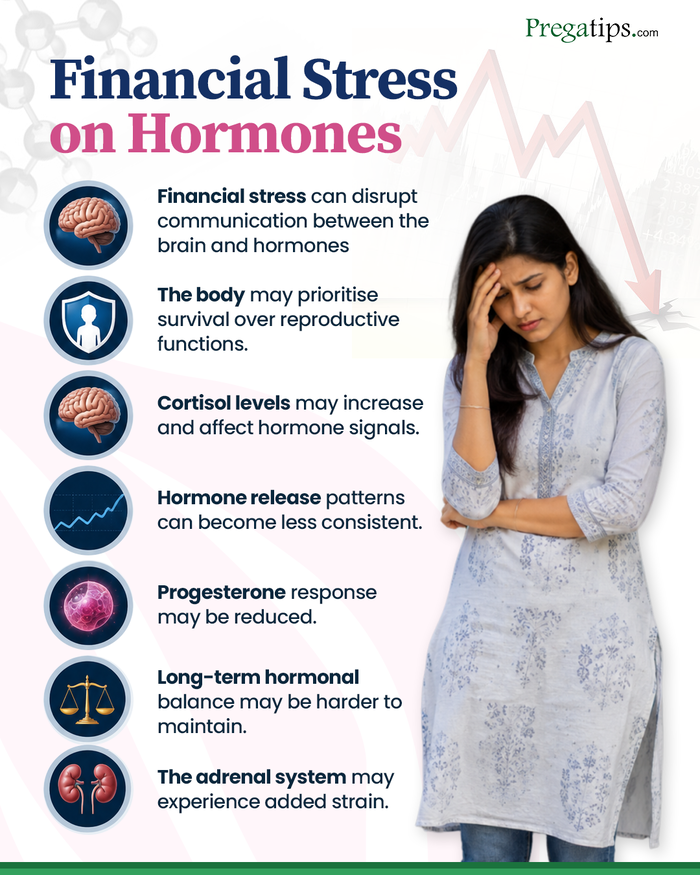
The hypothalamus plays a central role here. It receives emotional and stress-related information and decides how hormones should be released. Under financial strain, this system may become less consistent.
Hormonal effects linked to financial stress include:
- Increased cortisol levels interfere with reproductive hormone signals.
- Disruption in the timing of hormone release across the cycle.
- Reduced sensitivity to progesterone during the second half of the cycle.
- Difficulty maintaining hormonal balance over time.
- Greater strain on the adrenal system, which supports stress regulation.
These responses are the body’s way of coping with perceived instability.
The Emotional Weight of Financial Uncertainty
Money-related stress often carries emotional layers such as guilt, fear, or self-doubt. You may question whether you are prepared enough or worry about future responsibilities. These thoughts can create internal pressure even when nothing is spoken aloud.
Holding these emotions inside keeps the nervous system in a state of activation. Emotional suppression does not reduce stress. It often increases it. The body continues to respond as though the threat is unresolved.
Every day, emotional experiences linked to financial stress include:
- Feeling pressure to achieve results quickly due to the costs involved.
- Guilt about spending money on tests or consultations.
- Fear of future financial strain after conception.
- Hesitation to share concerns with family or friends.
- Emotional withdrawal as a way to cope.
These emotional responses add to the overall stress load the body carries.
Can Financial Stress Affect Menstrual Cycle Regularity?
When stress becomes chronic, the body adapts by conserving energy. Reproductive processes are sensitive to these changes. If the brain senses that conditions are uncertain, it may subtly alter hormonal patterns.
It does not always show up as noticeable cycle changes. Sometimes it appears as minor irregularities or increased premenstrual symptoms. Over time, these changes can make the cycle feel less predictable.
Effects on cycle patterns may include:
- Variations in ovulation timing.
- Increased cycle-to-cycle inconsistency.
- More pronounced physical symptoms before menstruation.
- Changes in sleep can further affect hormones.
- Reduced overall sense of physical balance.
These shifts are often gradual and easy to overlook.
The Role of Mental Load in Reproductive Health
Financial stress adds to the mental load, which is the constant background thinking your mind carries. Planning, budgeting, and anticipating future needs all take cognitive energy. This mental load keeps the brain engaged and alert.When the mind does not get enough rest, the nervous system stays active. It affects how well the body can repair, regulate, and recover. Hormonal systems work best when the brain feels safe enough to rest.
Mental load-related effects include:
- Difficulty switching off even during rest periods.
- Increased fatigue without a clear physical cause.
- Reduced emotional resilience over time.
- Heightened sensitivity to stressors.
- Slower recovery after emotional disappointment.
Reducing mental load can support both emotional and physical balance.
How Financial Stress Affects Emotional Connection & Support
Money worries can also influence relationships. Conversations may feel tense or avoided altogether. Emotional closeness can be affected when both partners are carrying unspoken concerns.Emotional distance increases stress rather than reducing it. Feeling unsupported or misunderstood adds another layer of pressure to the body’s stress response.
Relationship-related effects include:
- Avoiding discussions to prevent conflict.
- Feeling isolated in personal worries.
- Reduced emotional safety within the relationship.
- Increased internal pressure to cope alone.
- Less opportunity for emotional reassurance.
Financial stress may be silent, but its impact is real. The body responds to ongoing uncertainty by staying alert and conserving energy. Over time,e this can influence hormones, emotional well-being, and the overall environment needed for conception.
Recognising financial stress as a legitimate source of strain allows space for compassion rather than self-blame. When stress is acknowledged rather than ignored, the body has a better chance of finding balance again.
You’re not alone in your journey when trying to conceive. Join our supportive community to connect with others, share experiences, and find encouragement every step of the way.
FAQs on The Silent Impact of Financial Stress on Conception
- Is it possible for financial stress to affect conception even if health reports are regular?
Yes, stress from money problems influences how hormones function, not just how many there are. Tests may look normal, but stress can still affect how hormones communicate. - Is it common to feel bad about money when you're trying to get pregnant?
Yes, many people feel guilty or stressed about how much they spend. These feelings are normal and don't mean you've failed as a person. - How can you deal with money problems without getting more anxious?
Recognising your worries, setting reasonable goals, and asking for emotional support can all help ease the strain within. Taking small efforts toward clarity might help the body deal with stress.