In this article:
Why Are Babies More Vulnerable to Heatstroke Than Adults?
Babies' sweat glands are not fully developed, which makes it harder for them to regulate their body temperature in hot weather. As a result, they overheat faster and struggle to cool themselves the way older children or adults can.
There are other factors too:
- They rely entirely on caregivers to adjust their clothing, environment, and feeding.
- They lose fluids faster, through sweating, rapid breathing, and increased urine output, which leads to dehydration quickly.
- They cannot move away from heat; a baby left in a hot room, a parked car, or a sun-exposed pram cannot escape.
According to UNICEF, the younger the child, the faster they overheat, and children develop heat stress more quickly and severely than adults.
Heat Exhaustion vs Heatstroke in Babies: Key Differences
Heatstroke does not appear suddenly. It usually follows heat exhaustion, which is the body's warning stage. Once heat exhaustion signs appear, you have less than 30 minutes to cool your baby before it progresses to heatstroke.
| Sign | Heat Exhaustion | Heatstroke |
| Skin | Flushed, red, sweaty | Hot, dry, no sweating |
| Temperature | Below 40°C | Above 40°C (104°F) |
| Crying | Irritable, excessive crying | Too weak to cry |
| Wet diapers | Fewer than usual | Few or none |
| Energy level | Tired, lethargic | Floppy, unresponsive |
| Eyes | Normal or glassy | Glazed, unfocused |
| Breathing | Normal or slightly fast | Rapid or laboured |
| Urgency | Cool down immediately | Medical emergency |
Signs of Heatstroke in Babies
Babies cannot communicate discomfort verbally; these physical signs are your only clues:
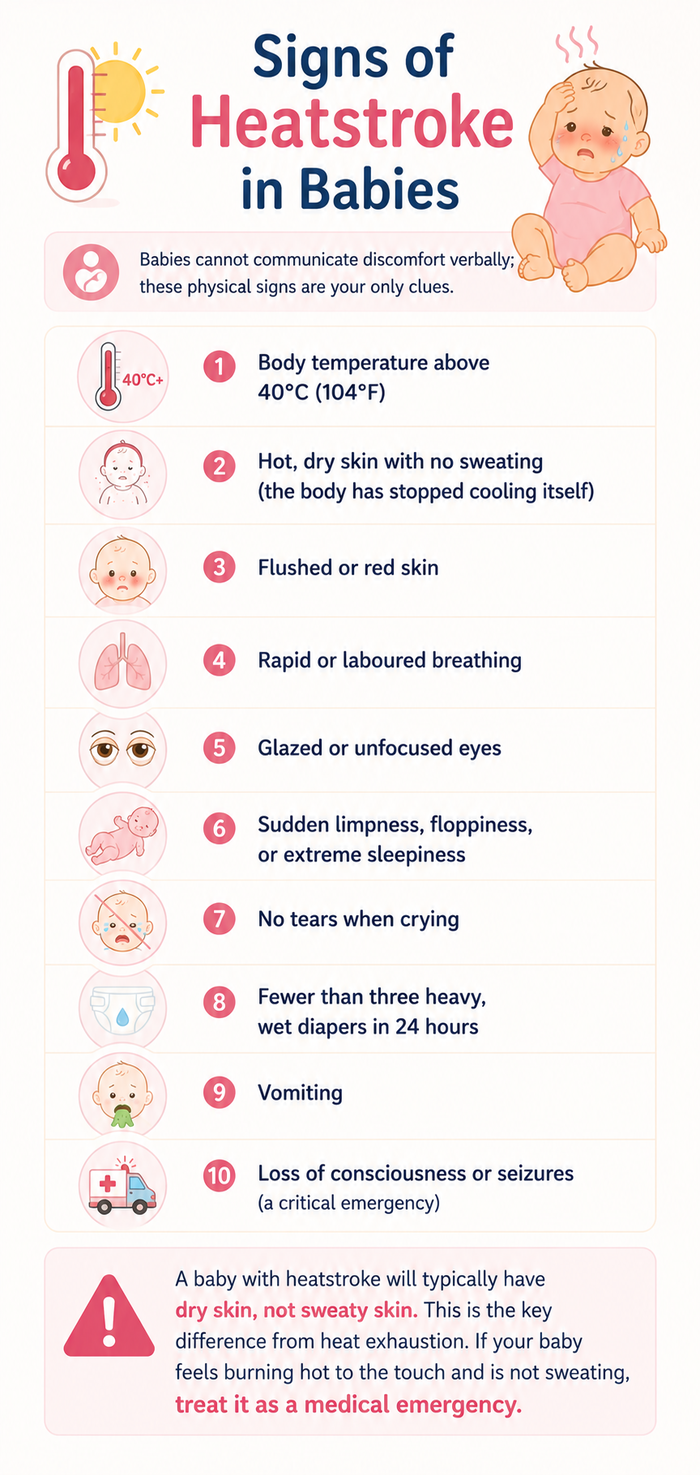
- Body temperature above 40°C (104°F)
- Hot, dry skin with no sweating (the body has stopped cooling itself)
- Flushed or red skin
- Rapid or laboured breathing
- Glazed or unfocused eyes
- Sudden limpness, floppiness, or extreme sleepiness
- No tears when crying
- Fewer than three heavy, wet diapers in 24 hours
- Vomiting
- Loss of consciousness or seizures (a critical emergency)
A baby with heatstroke will typically have dry skin, not sweaty skin. This is the key difference from heat exhaustion. If your baby feels burning hot to the touch and is not sweating, treat it as a medical emergency.
What to Do If You Suspect Heatstroke in Your Baby
Act immediately. Do not wait to see if the baby improves on their own.
- Take your baby to the nearest hospital right away
- Move your baby to a cool place, indoors with a fan or air conditioning, or at least into shade.
- Remove excess clothing; strip down to a single light layer.
- Cool the skin; sponge the baby with a cool (not ice-cold) wet cloth, focusing on the armpits, neck, and forehead.
- Fan them while continuing to apply cool water to the skin.
- Do not give water by mouth if the baby is vomiting or unconscious.
- Do not use ice-cold water or ice packs directly on the skin; this can cause shock.
- Keep cooling until help arrives; do not stop until the skin feels cooler to the touch.
How to Prevent Heatstroke in Babies
Prevention requires consistency, especially during the peak heat season.
- Keep babies indoors between 11 AM and 4 PM (hottest hours of the day).
- Dress babies in loose, light-coloured cotton clothing (avoid synthetic fabrics that trap heat).
- Never leave a baby in a parked vehicle, even with windows slightly open; car temperatures can rise by 10°C within 10 minutes.
- Feed more frequently; breastfed babies under 6 months get enough fluids from breast milk; do not supplement with water unless advised by your paediatrician. Babies over 6 months can be given small amounts of cooled boiled water.
- Avoid covering strollers or prams with blankets.
- Use a fan or air cooler in the baby's room; if neither is available, keep windows open at night and close them during the day to trap cool air.
- Check the baby's room temperature (the ideal sleep environment for a baby is between 22°C and 26°C).
Whether you’re pregnant, a new mom, or navigating postpartum, you don’t have to do it alone. Join our support group to connect, share, and support one another.
FAQs on Do Babies Get Heat Stroke? Signs You Should Never Ignore
- At what temperature is a baby considered to have heatstroke?
A baby is considered to have heatstroke when their core body temperature exceeds 40°C (104°F). At this point, the body's internal cooling system has failed, and the condition is a medical emergency. - Can a baby get heatstroke indoors?
Yes. Heatstroke can occur indoors, especially in rooms with poor ventilation, during a power cut, or when a baby is overdressed in warm weather. The cause is overheating, not just sun exposure. - Can heatstroke cause long-term damage in babies?
Yes. If not treated immediately, heatstroke can cause brain damage, organ failure, and in severe cases, death. Prompt emergency treatment significantly reduces the risk of permanent complications.