In this article:
What Is the Wearable Ultrasound Patch for Pregnancy Monitoring?
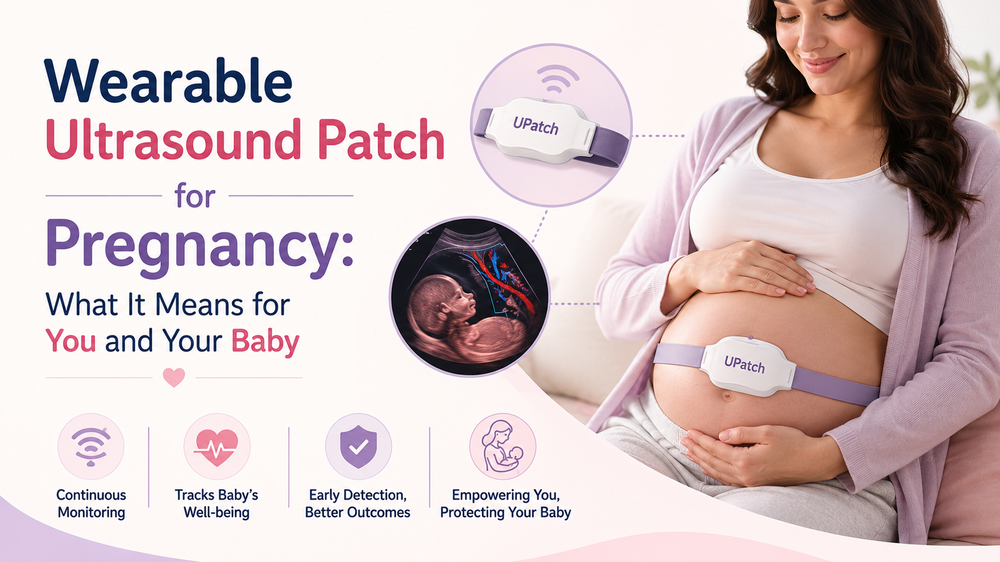
A wearable ultrasound patch for pregnancy monitoring is a soft, flexible device that sticks to a pregnant woman's abdomen and uses sound waves to continuously track the baby's position, blood flow, and heart rate in real time, flagging warning signs of complications such as pre-eclampsia and intrauterine growth restriction (IUGR) as they develop.
UPatch was validated in a study published in Nature Biotechnology in May 2026 across 62 pregnancies, with results closely matching those of standard handheld ultrasound devices.
Why Current Pregnancy Monitoring Falls Short
Standard pregnancy ultrasound scans are scheduled at fixed points during a pregnancy; typically two to three in a low-risk pregnancy. These provide a snapshot of the baby's health at a single point in time. Between scans, complications can develop without detection.
Another monitoring method is cardiotocography (CTG), which tracks foetal heart rate and uterine contractions, but has a high rate of false alarms. Also, it cannot measure blood flow in the umbilical cord or provide detailed images of the baby.
Professor Sheng Xu of Stanford University, a senior author of the study, explained that current diagnostic devices are intermittent and can only capture a snapshot of what is happening with the baby. Patients can only take these measurements in a hospital, which means a significant amount of data is missed between visits.
How Does the UPatch Work?
The UPatch is made from a soft, flexible material that moulds to the abdomen's curved surface. Inside, it contains ultrasound transducers, components that emit and receive sound waves, along with a special acoustic lens and shielding to improve signal quality.
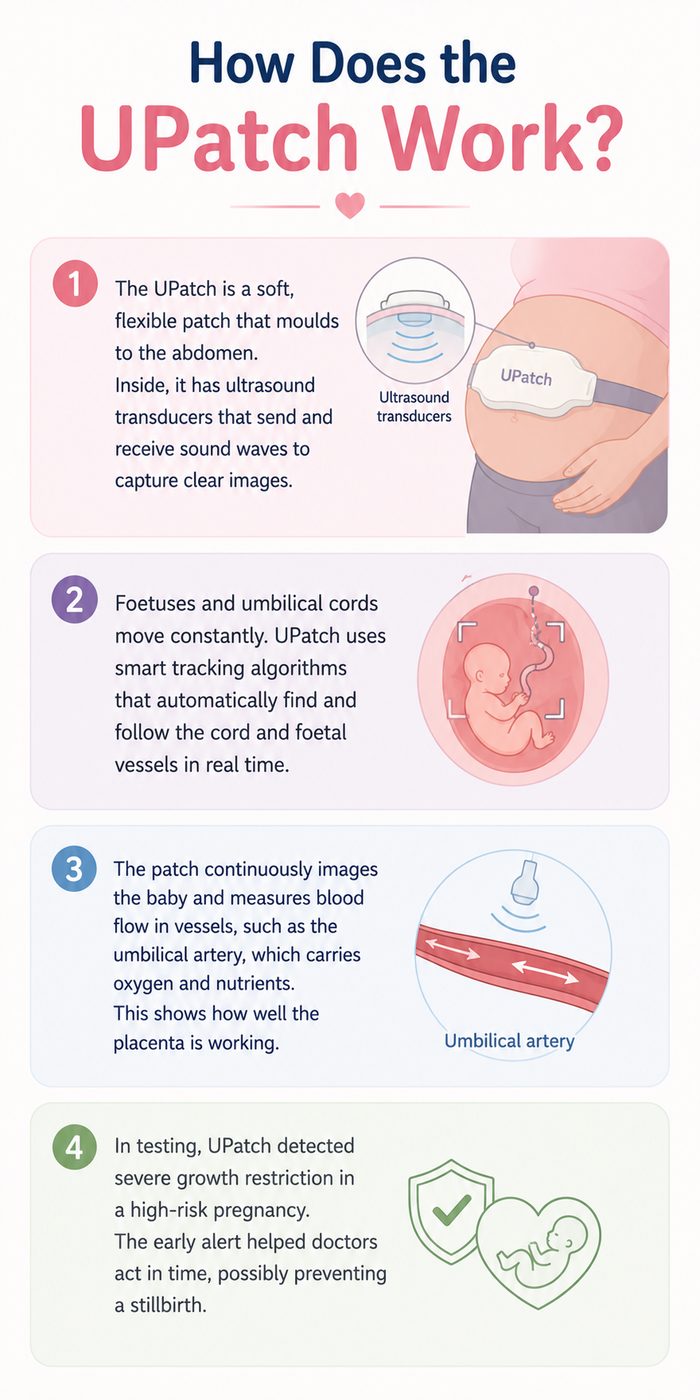
One of the main technical challenges was that a foetus and its umbilical cord move constantly. To solve this, the research team built autonomous tracking algorithms that automatically identify and follow the cord and foetal vessels as they shift position. This means the device maintains accurate measurements even when the mother or baby moves.
The patch can image the baby continuously and measure blood flow in vessels, including the umbilical artery, which carries oxygen and nutrients to the baby. Blood flow in this artery is a direct indicator of how well the placenta is functioning.
During testing, the UPatch detected a severe case of intrauterine growth restriction in a patient with pre-eclampsia. The data prompted doctors to proceed with an early caesarean delivery. The researchers say this intervention may have prevented a stillbirth.
What Pregnancy Complications Can the UPatch Help Detect?
The device is primarily designed for high-risk pregnancies, which include pregnancies affected by:
- Pre-eclampsia, a condition involving high blood pressure that can restrict blood flow to the baby
- Gestational diabetes, which can affect foetal growth
- Gestational hypertension (raised blood pressure during pregnancy)
- Intrauterine growth restriction, where the baby is not growing at the expected rate
- Large for gestational age (LGA) pregnancies
The study tested the device across all of these conditions. The team also noted that foetal blood flow measurements can change dynamically over time, with temporary shifts that would not be visible in a brief clinic scan.
Beyond high-risk pregnancies, the researchers point to potential benefits in low-resource settings. In regions where skilled ultrasound technicians are limited or where hospital visits are difficult, a wearable patch that works independently could expand access to prenatal care.
Where Is This Technology Headed?
The current version of the UPatch is connected to external electronics via wires, meaning it is not yet fully portable. The team at UC San Diego is now developing a wireless version.
According to lead author Tom Park, the long-term goal is a wearable ultrasound system that can be used continuously in daily life, including at home and during normal activities.
Dr Antoniya Georgieva from the University of Oxford, another senior author of the study, noted that continuous data from devices like this also opens up new research opportunities.
Is the Wearable Ultrasound Patch Safe During Pregnancy?
The UPatch uses the same ultrasound technology already used in routine pregnancy scans, which has a well-established safety record in obstetric care. The study published in Nature Biotechnology reported no adverse effects in any of the 62 pregnancies in which the device was tested.
Safety for Mothers
For the mother, the patch is made from soft, flexible material that adheres to the abdomen without discomfort. No skin reactions or side effects were reported during testing.
Safety for Baby in Womb
For the baby, the sound wave frequencies used are consistent with those in standard diagnostic ultrasound, which has been used safely in pregnancy for decades.
Current Regulatory Status
It is important to note that the UPatch is currently a research device and has not yet received regulatory approval for routine clinical use. As with any new medical technology, independent large-scale safety studies will be required before it becomes available outside a clinical trial setting.
Understanding how foetal blood flow changes throughout a pregnancy could help researchers identify the signals that distinguish healthy pregnancies from those at risk, information that standard scans simply cannot provide.
Whether you’re pregnant, a new mom, or navigating postpartum, you don’t have to do it alone. Join our support group to connect, share, and support one another.
FAQs on Wearable Ultrasound Patch for Pregnancy: What It Means for You and Your Baby
- Is the wearable ultrasound patch safe for the baby?
The UPatch uses the same type of ultrasound technology already used in standard pregnancy scans, which has an established safety record. The study does not report any adverse effects from device use. However, the patch is currently a research device; it has not yet received regulatory approval for routine clinical use. - When will the wearable pregnancy ultrasound patch be available?
The UPatch is still at the proof-of-concept stage. The research team is developing a wireless version, but a timeline for clinical availability or regulatory approval has not been announced. - Can this device replace routine antenatal scans?
No. The UPatch is designed to complement existing care, particularly for monitoring between scheduled scans in high-risk pregnancies. Routine antenatal scans serve several purposes, including structural assessment of the baby, which this patch does not replace.