
One common test is the Day 2-3 scan. It is done in the early days of your menstrual cycle. This scan provides important details about your fertility and helps guide your next steps on the journey to conception.
In this guide, our expert explains the purpose of a Day 2-3 scan, what doctors look for during the examination, and what the findings may mean for your fertility.
Why Does the Timing of a Day 2-3 Scan Matter?
Your menstrual cycle brings many changes each month. Your hormones rise and fall, follicles in your ovaries grow, and the lining of your uterus thickens to prepare for a possible pregnancy.But days 2 and 3 of your period are different. At this time, these changes have only just started. Your ovaries are relatively inactive, and the follicles are still small. This makes it easier for doctors to clearly see your ovaries and assess your reproductive health.
Because your body is at the start of a new cycle, a Day 2-3 scan can help doctors count the small follicles, look for ovarian cysts, and check any uterine abnormalities.
Important Findings on a Day 2-3 Scan
The following findings can help doctors better understand your fertility and reproductive health:Ovarian Reserve
One main reason for a Day 2-3 scan is to check your ovarian reserve. It means the number of eggs left in your ovaries. Every woman is born with a fixed number of eggs, and this number reduces with age.During the scan, doctors look at your ovaries to see if the egg supply matches your age.
- A healthy ovarian reserve may mean you respond better to fertility treatments if needed.
- A lower-than-expected reserve may mean fewer eggs, which can make conception harder.
Antral Follicle Count (AFC)
Antral follicles are small fluid-filled sacs inside your ovaries. Each one has an immature egg.During a Day 2-3 scan, doctors count these follicles to estimate your ovarian reserve.
- A normal count usually means your ovaries have a healthy number of follicles.
- A lower count may suggest fewer eggs and a reduced reserve.
- A very high count can sometimes be seen in women with PCOS.
Ovarian Cysts
The scan can also help in evaluating ovarian cysts. These are fluid-filled sacs that grow on or inside your ovaries. Many cysts are harmless, cause no symptoms, and disappear on their own. Some cysts may grow bigger, cause discomfort, or affect fertility.Polycystic Ovarian Changes
A Day 2-3 scan can show polycystic ovarian morphology. This means your ovaries have more small follicles than usual. These changes may be seen in women with PCOS or other hormone imbalances.Finding many small follicles on an ultrasound does not always mean you have PCOS. Doctors also check your symptoms, your menstrual cycle, hormone levels, and other test results before making a diagnosis.
Uterine Health
A Day 2-3 scan also checks your uterus. Doctors look for conditions that may affect conception or pregnancy, such as fibroids, polyps, scar tissue, or structural changes.A healthy uterus gives the right environment for implantation and pregnancy. If the scan shows any concerns, your doctor may suggest more tests or treatment depending on what is found. Finding uterine issues early can improve pregnancy outcomes and support your fertility planning.
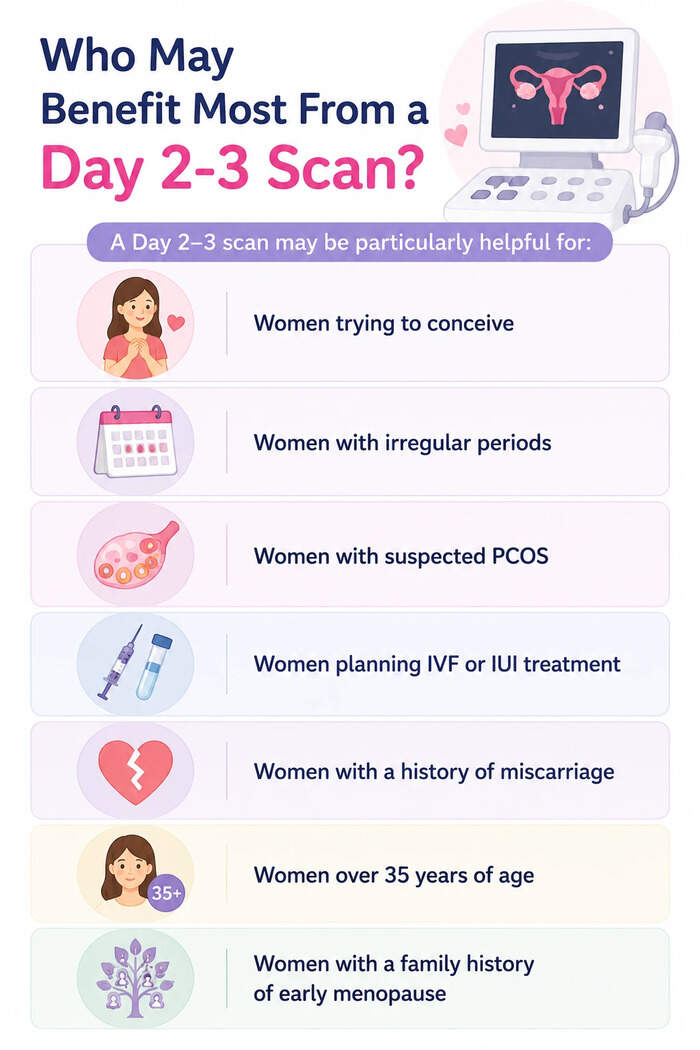
Who May Benefit Most From a Day 2-3 Scan?
A Day 2–3 scan may be particularly helpful for:- Women trying to conceive
- Women with irregular periods
- Women with suspected PCOS
- Women planning IVF or IUI treatment
- Women with a history of miscarriage
- Women over 35 years of age
- Women with a family history of early menopause
Can a Day 2–3 Scan Predict Your Chances of Pregnancy?
No, a Day 2–3 scan cannot predict whether you will become pregnant. Pregnancy depends on many factors, including egg quality, ovulation, sperm health, and the condition of the fallopian tubes. The scan only provides information about your ovaries and uterus. However, it can only help doctors identify potential fertility concerns.When Should You Speak to a Fertility Specialist?
You may consider consulting a fertility specialist if:- You have been trying to conceive for a year without success
- You are over 35 and have been trying to conceive for one year
- You have irregular or absent periods
- You have experienced recurrent miscarriages
- You have been diagnosed with PCOS, endometriosis, or other reproductive health conditions
You’re not alone in your journey when trying to conceive. Join our supportive community to connect with others, share experiences, and find encouragement every step of the way.
FAQs on What Is a Day 2-3 Scan? Why Fertility Specialists Recommend It
- Can a Day 2–3 scan be done during heavy bleeding?
Yes. In most cases, a Day 2–3 scan can still be performed during your period, even if your flow is heavy. If you have concerns, speak with your doctor before the appointment. - What is considered a normal AFC count?
A normal AFC varies with age and individual factors. In general, a higher AFC suggests a better ovarian reserve, while a lower count may indicate fewer remaining eggs.