
In this article:
We’ll explain and decode these myths.
Myth 1: Blighted Ovum Indicates Infertility
Fact: One Blighted Ovum Does Not Predict Infertility
Research shows that most people with a single blighted ovum later have healthy pregnancies.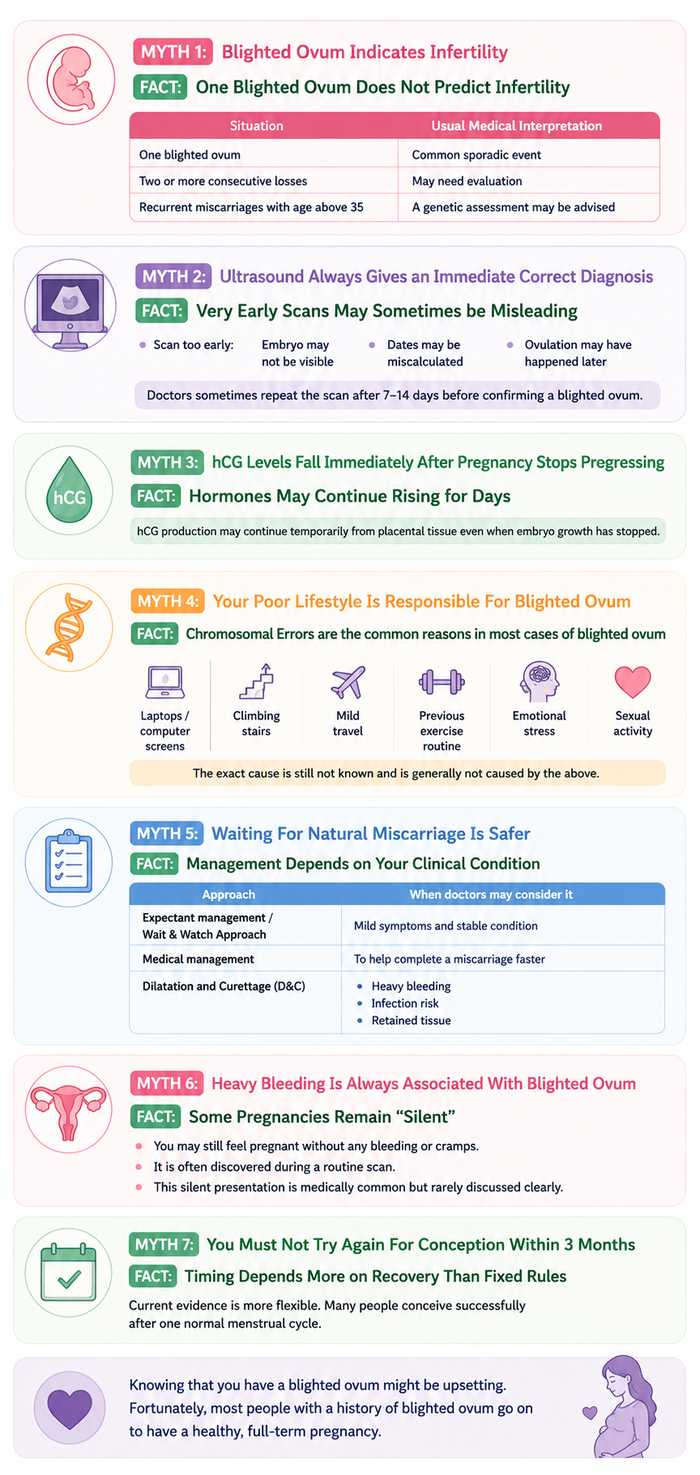
Doctors usually do not recommend extensive fertility testing after one isolated early miscarriage.
| Situation | Usual Medical Interpretation |
| One blighted ovum | Common sporadic event |
| Two or more consecutive losses | May need evaluation |
| Recurrent miscarriages with age above 35 | A genetic assessment may be advised |
Myth 2: Ultrasound Always Gives an Immediate Correct Diagnosis
Fact: Very Early Scans May Sometimes be Misleading
One of the least discussed issues is the incorrect timing of early scans.If the ultrasound is done too early:
- The embryo may not yet be visible
- Dates may be miscalculated
- Ovulation may have happened later than expected
Myth 3: hCG Levels Fall Immediately After Pregnancy Stops Progressing
Fact: Hormones May Continue Rising for Days
Many people panic when pregnancy symptoms continue after diagnosis.This happens because hCG production may continue temporarily from placental tissue even when embryo growth has stopped.
Myth 4: Your Poor Lifestyle Is Responsible For Blighted Ovum
Fact: Chromosomal Errors are the common reason in most cases of blighted ovum
According to studies, a blighted ovum is linked to abnormal chromosomal development during fertilisation.However, the exact cause is still not known.
It is generally not caused by:
- Using laptops or computer screens
- Climbing stairs
- Mild travel
- Previous exercise routine
- Emotional stress
- Sexual activity
Myth 5: Waiting For Natural Miscarriage Is Safer
Fact: Management Depends on Your Clinical Condition
All three management approaches may be medically appropriate depending on your symptoms and scan findings.| Approach | When doctors may consider it |
| Expectant management/Wait & Watch Approach | Mild symptoms and stable condition |
| Medical management | To help complete a miscarriage faster |
| Dilatation and Curettage (D&C) |
|
Myth 6: Heavy Bleeding Is Always Associated With Blighted Ovum
Fact: Some Pregnancies Remain “Silent”
- Some cases won’t exhibit obvious signs.
- You may still feel pregnant without any bleeding or cramps.
- It is often discovered during a routine scan
- This silent presentation is medically common but rarely discussed clearly.
Myth 7: You Must Not Try Again For Conception Within 3 Months
Fact: Timing Depends More on Recovery Than Fixed Rules
Older advice often suggested waiting 3–6 months. Current evidence is more flexible.Many people conceive successfully after one normal menstrual cycle.
Knowing that you have a blighted ovum might be upsetting. Fortunately, most people with a history of blighted ovum go on to have a healthy, full-term pregnancy.
You’re not alone in your journey when trying to conceive. Join our supportive community to connect with others, share experiences, and find encouragement every step of the way.
FAQs on Blighted Ovum Explained: Myths, Facts, and What to Know
- Is a blighted ovum a kind of miscarriage?
Yes, a blighted ovum is considered an early miscarriage, as it happens before 13 weeks of pregnancy. - Is it true that a blighted ovum is common with IVF?
No. Normally, the chances of having a blighted ovum with a natural conception are the same as with IVF. - When do doctors investigate recurrent blighted ovum?
Your doctor may recommend extensive testing after two or more consecutive early miscarriages.