
In this article:
When Does "No" Become a Concern?
Speak to your paediatrician if the refusal is accompanied by:
- Delayed speech or language: A toddler who says no frequently, but struggles to communicate with other words, may have a language delay. By 18 months, most children use at least 10 words. By age 2, they should be combining two words, such as "no milk" or "no sleep."
- Extreme or prolonged tantrums: Tantrums lasting more than 30 minutes regularly, or involving breath-holding, self-injury, or complete inability to calm down even with a caregiver present, need professional review.
- Regression in mastered skills: If a child who was toilet trained begins refusing and loses the skill, or a child who was eating independently suddenly cannot, this regression, paired with increased refusal, may signal stress, illness, or a developmental concern.
- Significant difficulty: When refusal is constant and continues without improvement over weeks, it warrants a developmental assessment.
- Social withdrawal: If a toddler is avoiding eye contact, not responding to their name, showing little interest in playing with other children, or losing previously acquired social skills, it requires paediatric attention, as it can indicate autism spectrum disorder.
What to Do When Your Toddler Refuses Everything
According to the CDC, here are a few parenting tips for toddlers:
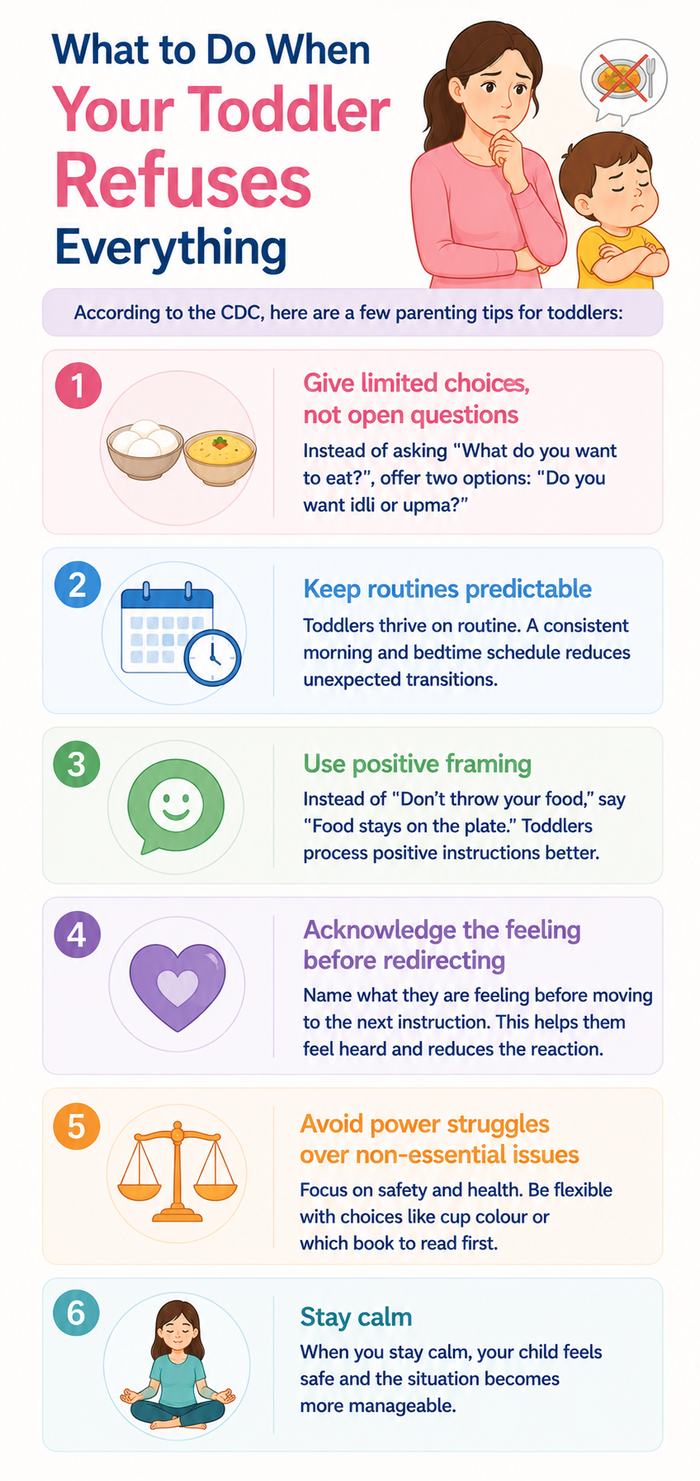
- Give limited choices, not open questions: Instead of asking "What do you want to eat?", offer two options: "Do you want idli or upma?"
- Keep routines predictable: Toddlers thrive on routine. A consistent morning and bedtime schedule reduces the number of unexpected transitions, which are a common trigger for refusal.
- Use positive framing: Instead of "Don't throw your food," say "Food stays on the plate." Toddlers process positive instructions more effectively than negative commands.
- Acknowledge the feeling before redirecting: When a toddler refuses, name what they are feeling before moving to the next instruction. This tells the child their feelings have been heard, which reduces the intensity of the reaction.
- Avoid power struggles over non-essential issues: Pick the situations that genuinely require compliance (safety, health) and allow flexibility on others (which colour cup to use, which book to read first).
- Stay calm: When a caregiver remains composed, the child's brain receives a signal that the situation is safe and manageable.
How Long Does the "No" Phase Last?
For most children, the peak of refusal behaviour occurs between 18 months and 3 years. It begins to reduce naturally as language skills develop, giving toddlers more ways to communicate needs and frustrations.
By ages 4 to 5, most children can negotiate verbally and understand reason to a greater degree. However, parents who respond to the phase with consistent, calm boundaries tend to see it resolve more smoothly.
Regular refusal is a toddler's way of learning that they exist, that they have preferences, and that those preferences can matter to others, a lesson that is fundamental to healthy development.
Whether you’re pregnant, a new mom, or navigating postpartum, you don’t have to do it alone. Join our support group to connect, share, and support one another.
FAQs on Why Your Toddler Says No to Everything, And What to Do
- Is it okay to let my toddler say no sometimes?
Yes. Allowing toddlers to refuse non-essential things, a particular snack, a specific game, or which side of the road they hold your hand on supports healthy autonomy. Saying yes to small decisions reduces the overall frequency of refusal in situations that matter. - How do I handle a toddler who refuses to eat?
Paediatric guidelines recommend a division of responsibility: parents decide what food is offered, when, and where; the child decides whether and how much to eat. Pressuring a toddler to eat increases food refusal. Offering one familiar food alongside new ones, eating together as a family, and avoiding distractions at mealtimes are strategies recommended by the Indian Academy of Pediatrics. - Does saying no to everything mean my toddler has Oppositional Defiant Disorder?
Not unless the behaviour is severe, persistent beyond age 5, and significantly disrupts daily life. ODD is a clinical diagnosis that requires a formal evaluation by a developmental paediatrician or child psychologist. Most toddlers who go through a strong "no" phase do not have ODD; they are developmentally on track.