In this article:
It's an average, not a rule, and applying it rigidly to every pregnancy can turn a manageable situation into unnecessary panic. The truth is that hCG levels behave differently from person to person, and a slower rise does not automatically spell trouble.
Possible Reasons for Slow-Rising hCG Levels
Several different situations can lead to slower-than-expected increases in hCG levels. Some are harmless, while others may require medical attention.
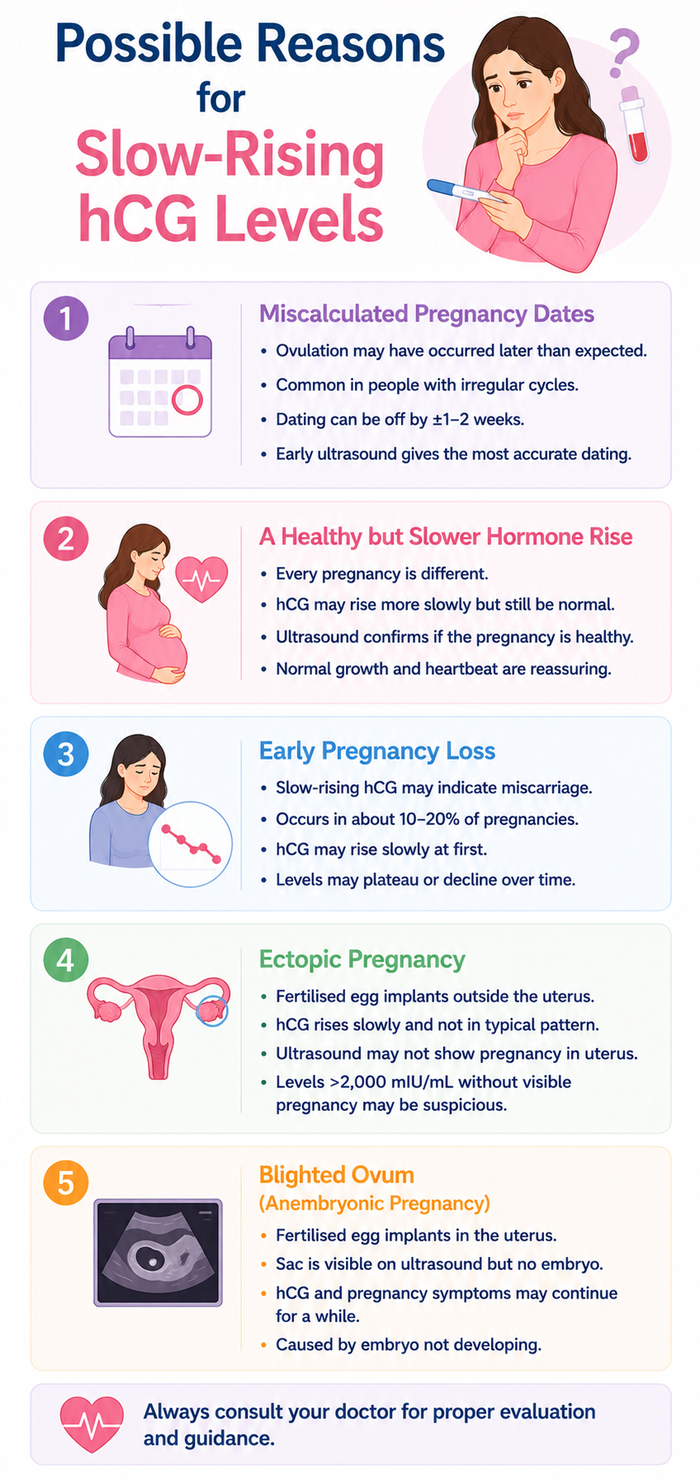
Miscalculated Pregnancy Dates
This situation is particularly common in people with irregular menstrual cycles, where ovulation does not occur predictably. Studies show that up to 50% of women do not ovulate on day 14, which is often assumed in standard calculations.
Pregnancy dating based only on the last menstrual period can be off by about ±1–2 weeks or more, especially when compared with first‑trimester ultrasound estimates, which are generally more accurate. Early pregnancy ultrasounds using measurements such as crown‑rump length are considered the most reliable method for dating because they reduce this variability.
A Healthy but Slower Hormone Rise
Doctors often rely on additional tests, such as ultrasound scans, to confirm whether the pregnancy is developing normally.
If the ultrasound shows normal growth and a heartbeat, slower increases in hCG may not be a cause for concern.
Early Pregnancy Loss
Early pregnancy loss (miscarriage) is common, occurring in about 10% to 20% of clinically recognised pregnancies, often due to chromosomal abnormalities.
In early pregnancy loss:
- hCG levels may rise slowly at first.
- Eventually, the levels may plateau or decline.
Ectopic Pregnancy
In ectopic pregnancy:
- hCG levels may increase slowly
- The hormone may not follow the typical doubling pattern
- Ultrasound may not show a pregnancy inside the uterus
Slower-than-expected increases in hCG can be seen in ectopic pregnancies, and levels above 2,000 mIU/mL without a visible intrauterine pregnancy on ultrasound may be suspicious.
Because ectopic pregnancies can become dangerous if left untreated, doctors carefully monitor symptoms and test results to detect them early.
Blighted Ovum (Anembryonic Pregnancy)
This means that:
- A fertilised egg implants in the uterus
- The gestational sac can still be seen in the uterus during an ultrasound
- But the embryo is not visible because it has not developed
Because the placental cells continue to produce pregnancy hormones like hCG for a period, blood tests and pregnancy tests may still be positive, and symptoms of early pregnancy (such as nausea or breast tenderness) can persist initially.
On an ultrasound scan, this appears as an empty gestational sac without a visible embryo, even though the sac and placenta may continue to grow for a short time.
Since the early pregnancy tissue is still present, the body may continue producing hCG for some time. As a result, hCG levels may rise initially, but often increase more slowly than expected, plateau, or stop rising normally.
Medical studies estimate that a blighted ovum accounts for roughly half of all first‑trimester miscarriages, making it one of the most common underlying causes of early pregnancy loss.
Doctors usually confirm this diagnosis with an ultrasound scan, which shows an empty gestational sac without a developing embryo when one should be visible by around 6–7 weeks of pregnancy.
How Do Doctors Evaluate Slow-Rising hCG Levels?
When hCG levels rise more slowly than expected, doctors typically do not make a diagnosis based on one test alone. Instead, they use a combination of monitoring and imaging.
Repeat Blood Tests
When hCG levels appear lower or rise more slowly than expected, doctors usually repeat the blood test every 48–72 hours until the pregnancy location is confirmed or levels normalise. This helps them see how the hormone levels are changing over time.Looking at this pattern of change is often more helpful than relying on a single test result. If the levels continue to rise steadily, it may suggest that the pregnancy is still developing. If the levels rise very slowly, stop increasing, or begin to fall, doctors may recommend further tests or an ultrasound to understand what might be happening.
Ultrasound Examination
An ultrasound scan is another important test doctors use to understand how a pregnancy is developing. It allows them to look inside the uterus and check for early signs of pregnancy.In most cases, doctors may be able to see a gestational sac in the uterus at around 5–6 weeks of pregnancy. A little later, usually by 6–7 weeks, they may also be able to see the developing embryo and detect a fetal heartbeat.
These findings help doctors confirm that the pregnancy is developing in the uterus and progressing as expected.
Monitoring Symptoms
Doctors may also ask about symptoms such as pain, bleeding, or dizziness, which could provide additional clues about what is happening.In addition to blood tests and ultrasound scans, doctors may also ask about any symptoms you may be experiencing. These can include abdominal or pelvic pain, vaginal bleeding, dizziness, or unusual discomfort.
By considering these symptoms along with test results, doctors can better assess the situation and decide whether further evaluation or treatment is needed.
When Should You Contact Your Doctor?
It is perfectly normal to feel concerned if your hCG levels are not rising as quickly as anticipated.
You should seek medical care right away if you experience:
- Severe abdominal or pelvic pain
- Heavy vaginal bleeding
- Shoulder pain
- Dizziness or fainting
Whether the cause turns out to be something as simple as an earlier-than-expected pregnancy or something that needs medical attention, the most important thing you can do is stay in close contact with your doctor, attend your follow-up appointments, and try not to rely on a single test result to conclude.
Whether you’re pregnant, a new mom, or navigating postpartum, you don’t have to do it alone. Join our support group to connect, share, and support one another.
FAQs on Slow-Rising hCG Levels: What They Mean and When to Seek Help
- What hCG level is considered dangerously low in early pregnancy?
There is no single dangerous hCG number. What matters more is whether the levels are rising, staying flat, or falling over time. Your doctor will always look at your results alongside your symptoms and ultrasound findings, not the number alone. - Can stress cause hCG levels to rise slowly?
There is currently no strong scientific evidence that emotional stress directly causes slow-rising hCG levels. However, stress can sometimes affect overall health during early pregnancy. If you are worried about your results, the most helpful thing is to speak openly with your healthcare provider. - How do I know if my slow-rising hCG is a sign of ectopic pregnancy?
Slow-rising hCG alone cannot confirm an ectopic pregnancy. Doctors look for a combination of signs, including hCG levels that are not rising as expected, no visible pregnancy inside the uterus on ultrasound, and symptoms such as one-sided pelvic pain, vaginal bleeding, or dizziness.