
Here are 8 practical ways to bond with your newborn in the first month.
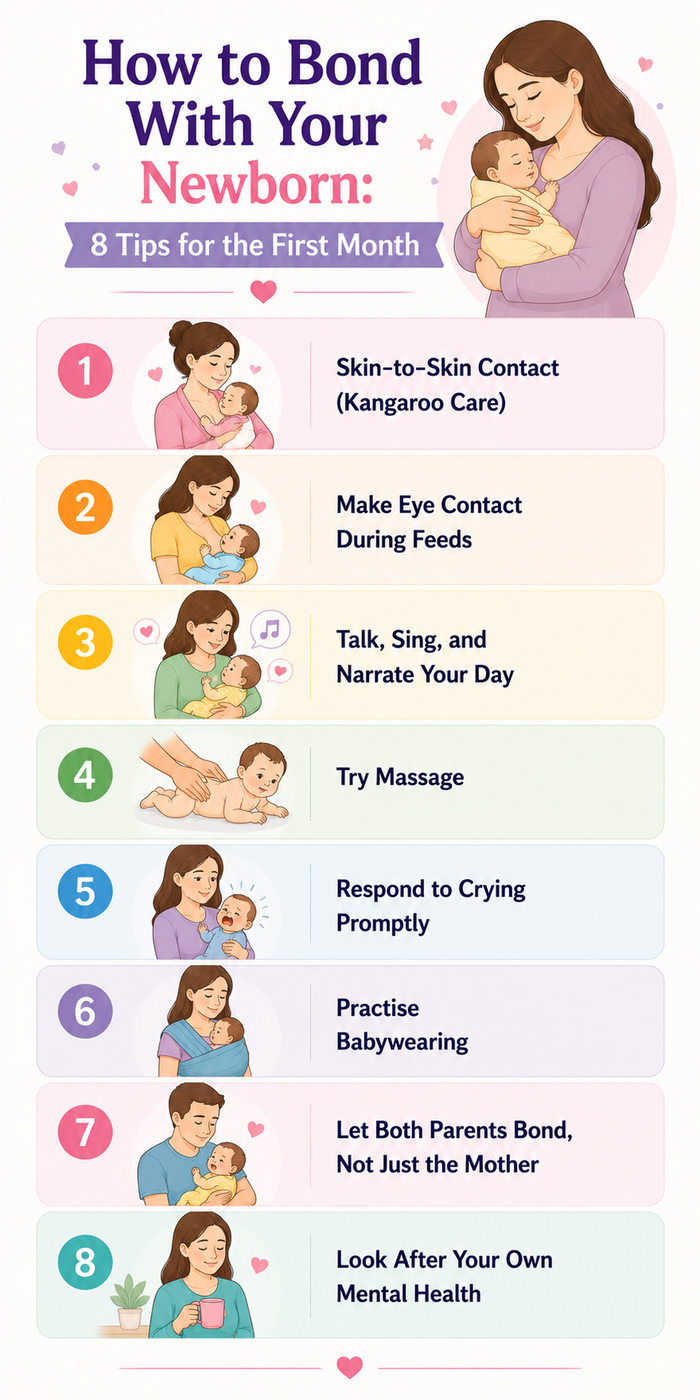
1. Start With Skin-to-Skin Contact (Kangaroo Care)
Skin-to-skin contact means placing your baby on your bare chest, with a light blanket over both of you. The World Health Organization recommends this practice from the first hours after birth.
When your baby rests on your chest, their body temperature, heart rate, and breathing stabilise. Skin-to-skin contact also triggers the release of oxytocin (bonding hormone) in both parent and baby.
2. Make Eye Contact During Feeds
A newborn's vision is clearest at a distance of 20–30 cm, which is roughly the distance between your face and theirs during breastfeeding or bottle feeding.
Gazing into your baby's eyes during a feed sends a clear signal: I see you, I am here. Studies in developmental psychology show that sustained eye contact activates the social brain in infants and builds the foundation for communication and trust.
3. Talk, Sing, and Narrate Your Day
Your baby already knows your voice. Foetuses begin responding to sounds from around 25 weeks of pregnancy. In the first month, hearing your voice continues to be deeply comforting.
Narrate what you are doing: "Now I am changing your nappy," "Let us have a bath", in a calm, warm tone. Sing a lullaby, a film song, or anything you enjoy. The content matters less than the consistency and warmth of the voice.
4. Try Massage
Baby massage is one of the oldest bonding practices. Research confirms that regular baby massage improves bonding, sleep quality, and reduces crying in newborns, with additional benefits for weight gain in preterm and low-birthweight babies.
Consider learning the technique yourself, even for some sessions, so the experience becomes a direct bonding moment between you and your baby.
5. Respond to Crying Promptly
A common concern among new parents, particularly those who grew up hearing that picking up a crying baby will 'spoil' them, is whether responding too quickly creates dependence.
Research consistently shows that babies who receive prompt, responsive caregiving in the first months of life develop secure attachment, and securely attached babies tend to grow into more confident, emotionally resilient toddlers.
6. Practise Babywearing
Carrying your baby in a sling, wrap, or carrier keeps them close to your body throughout the day, with your heartbeat, warmth, and movement all familiar from the womb. This closeness supports the regulation of the baby's temperature and stress hormones.
Babywearing frees your hands, which means you can go about daily tasks while keeping your baby settled and near. For working parents or those managing a household, this is a practical way to maximise contact time during the first month.
7. Let Both Parents Bond, Not Just the Mother
Bonding is not exclusive to the birthing parent. Research shows that fathers who engage in skin-to-skin contact, feeding (including bottle feeding expressed milk), and caregiving tasks in the first month develop strong attachment bonds with their newborns.
While family support is valuable, ensure that both parents have consistent daily caregiving time with the newborn to build their own bonds.
8. Look After Your Own Mental Health
Bonding can be harder when you are exhausted, anxious, or experiencing postpartum depression or anxiety, all of which are common and treatable. Approximately 10–15% of mothers and up to 10% of fathers experience postpartum depression.
If you feel persistently low, disconnected, or are struggling to feel warmth towards your baby, speak to your gynaecologist.
Bonding with your newborn is not a single moment; it is built day by day, feed by feed, through every small act of warmth and attention in that first extraordinary month.
Whether you’re pregnant, a new mom, or navigating postpartum, you don’t have to do it alone. Join our support group to connect, share, and support one another.
FAQs on How to Bond With Your Newborn: 8 Tips for the First Month
- What if I do not feel an instant bond with my newborn?
Skin-to-skin contact, responding to cries, and consistent caregiving all progressively build the bond. If you feel persistently disconnected after several weeks, speak to your doctor to rule out postpartum depression. - Can fathers bond with a newborn in the same way as mothers?
Bonding is based on consistent, responsive interaction, not on being the birth parent. Fathers who are actively involved in the first month tend to maintain closer bonds with their children throughout their childhood. - Does bonding with a newborn after a C-section take longer?
A C-section can delay immediate skin-to-skin contact, which is one of the earliest bonding triggers. However, bonding is not a single golden hour, and a C-section does not put you behind.