In this article:
How Does the Infant Brain Develop During the First Year?
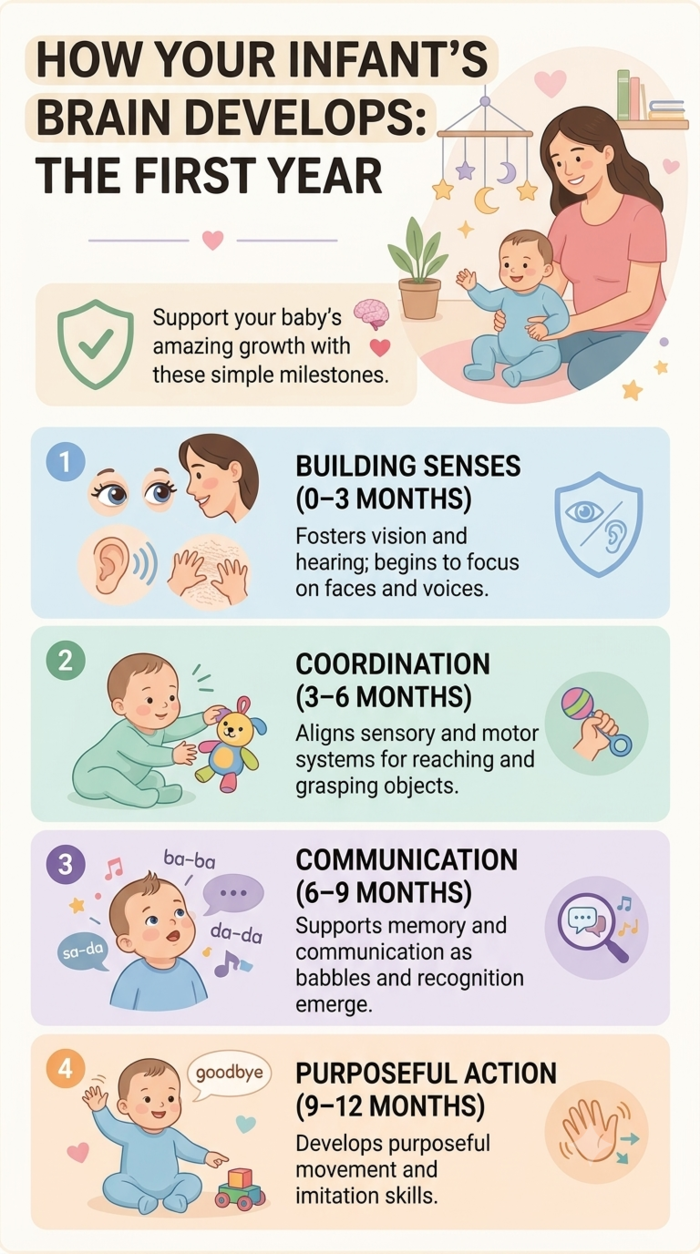
Different brain regions mature at different rates, supporting new abilities as your baby grows.1. The first few months
During this time, your baby’s foundations for vision, hearing, movement, and attention are developing. These senses start getting better gradually as their ability to focus on faces, recognise familiar voices, and respond to touch and sounds improves.
2. Around 3–6 months
Your baby may start reaching for objects, grasping them and bringing them towards their mouth. Dr Sahoo explains that developing brain systems increasingly coordinate vision, hearing and movement, supporting these emerging skills.
3. Around 6–9 months
Brain networks involved in memory, attention and communication continue to develop. Your baby may recognise familiar people, respond to their name, explore objects and experiment with different babbling sounds.
4. Around 9–12 months
At this age, your baby may start doing the following activities:
- Imitating gestures
- Responding to simple words
- Communicating through gestures
- Becoming more purposeful in their movements
What Happens to Brain Connections?
One important process during infancy is the development of synapses, which allow nerve cells to communicate. Frequently used connections can become stronger, while less-used connections may gradually be eliminated through a process called synaptic pruning.Another process is myelination, in which nerve fibres develop a fatty covering called myelin. This helps electrical signals travel more efficiently through the nervous system.
Brain development therefore involves more than an increase in size. The organisation and communication of neural networks also change.
How Do Early Experiences Influence the Developing Brain?
Everyday experiences help shape your baby's developing brain. Talking, singing, reading and playing provide opportunities to process sounds, language and social cues.Dr Sahoo highlights the importance of responsive interaction. When your baby looks at you, makes a sound or gestures and you respond appropriately, these repeated exchanges strengthen connections involved in communication and social development.
You do not need to constantly teach or stimulate your baby. Face-to-face interaction, play and responding to your baby's sounds are meaningful everyday experiences.
Adequate nutrition, sufficient sleep and a safe, nurturing environment also support healthy neurological development.
Developmental milestones vary between children. Dr Sahoo advises focusing on steady progress across different areas and discussing any significant delay or loss of previously acquired skills with a neonatologist or paediatrician.
Whether you’re pregnant, a new mom, or navigating postpartum, you don’t have to do it alone. Join our support group to connect, share, and support one another.
FAQs on The Science of Infant Brain Development in the First Year
- What happens to a baby's brain during the first year?
The brain forms and strengthens neural connections supporting movement, sensory processing, communication, memory and social interaction. - Are a baby's brain connections formed only through learning?
No. Brain development involves biological processes as well as experiences that help shape and strengthen neural pathways. - Is the first year the most important period for brain development?
The first year is an important period of rapid development, but brain development continues throughout childhood and adolescence.