In this article:
What Motor Milestones Come Before a Baby Sits Up?
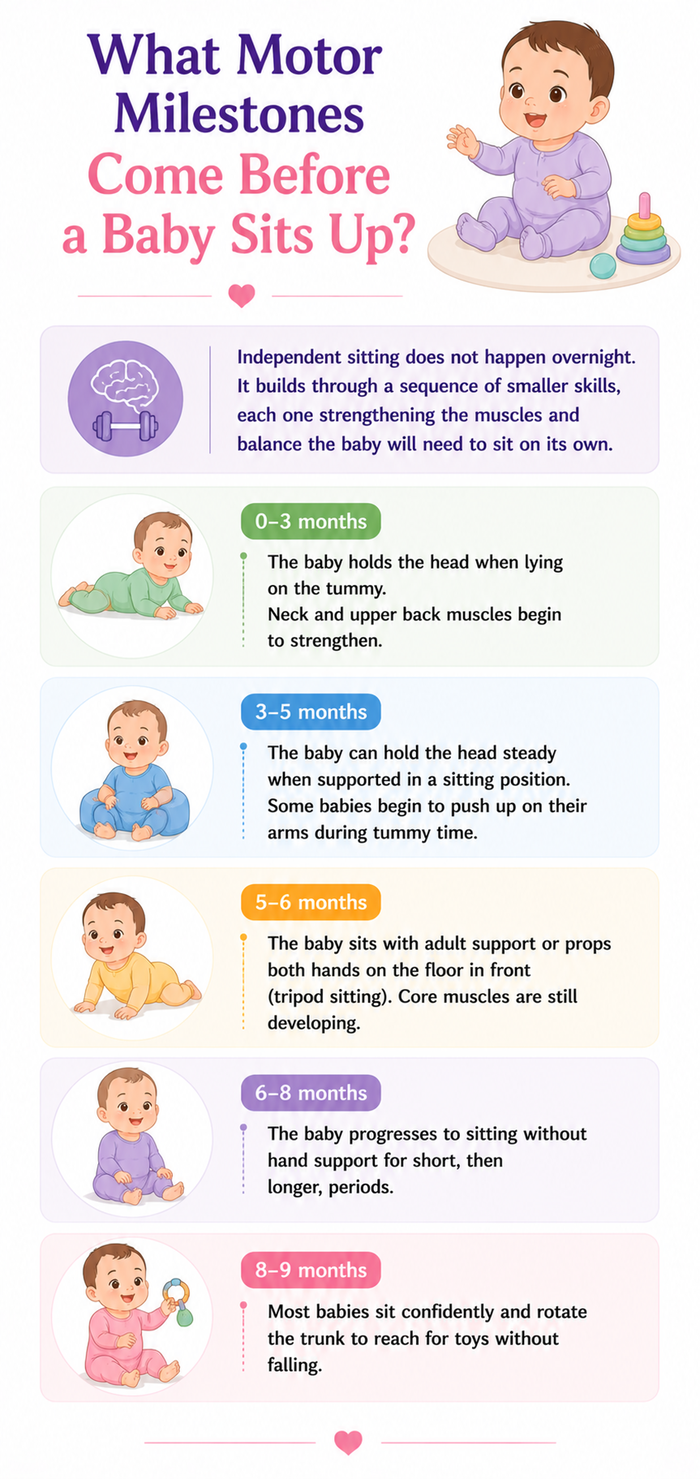
Independent sitting does not happen overnight. It builds through a sequence of smaller skills, each one strengthening the muscles and balance the baby will need to sit on its own.
- 0–3 months: The baby holds the head when lying on the tummy. Neck and upper back muscles begin to strengthen.
- 3–5 months: The baby can hold the head steady when supported in a sitting position. Some babies begin to push up on their arms during tummy time.
- 5–6 months: The baby sits with adult support or props both hands on the floor in front (tripod sitting). Core muscles are still developing.
- 6–8 months: The baby progresses to sitting without hand support for short, then longer, periods.
- 8–9 months: Most babies sit confidently and rotate the trunk to reach for toys without falling.
How Can You Help Your Baby Learn to Sit Up?
Parents can support the process through daily activities that build the right muscles without rushing the timeline.
- Tummy time: Even a few minutes of supervised tummy time several times a day strengthens the neck, shoulder, and back muscles needed for sitting. The American Academy of Pediatrics (AAP) recommends starting tummy time in the first weeks of life.
- Supported sitting practice: From around 4–5 months, you can place the baby in a sitting position with your hands supporting the sides, or seat them on a firm flat surface with a rolled towel or pillow around them for short sessions.
- Reduce time in carriers: Prolonged time in infant seats or carriers can delay the muscle activation that happens when a baby is placed on a flat surface. Limit use to practical needs.
- Place toys just out of reach: Once the baby can tripod-sit, placing a toy slightly to one side encourages the baby to shift weight and practise balance.
- Prioritise floor play over lap sitting: Floor time on a firm mat allows the baby to work on balance naturally.
What Are the Signs of a Sitting Milestone Delay?
Speak to your paediatrician if you notice any of the following:
- The baby cannot hold their head steady by 4 months.
- There is no attempt to push up on arms during tummy time by 5 months.
- The baby cannot sit even with full adult support by 6 months.
- The baby shows no interest in bearing weight on the legs when held upright by 7 months.
- The baby has not achieved independent sitting by 9 months.
These signs do not always indicate a problem (preterm babies are assessed against an adjusted age), but they are worth discussing with a doctor promptly.
Does Baby Massage Help With the Sitting Milestone?
Baby massage is a deeply embedded practice in Indian parenting, often including oil massage followed by gentle stretching of the limbs. While there is limited high-quality research specifically linking massage to sitting milestones, studies suggest that tactile stimulation and gentle movement support overall motor development in infants.
Massage is not a recognised clinical treatment for motor milestone delays, but it poses no harm when done gently and can complement daily tummy time and floor play as part of infant care.
For most babies, consistent floor time and tummy time from the early weeks is all it takes to get this milestone, and if yours is taking a little longer, a paediatrician can help rule out any concerns.
Whether you’re pregnant, a new mom, or navigating postpartum, you don’t have to do it alone. Join our support group to connect, share, and support one another.
FAQs on When Should a Baby Start Sitting Without Support?
- What is the role of tummy time in baby sitting development?
Tummy time strengthens the neck, upper back, and shoulder muscles a baby needs to sit upright. Each time a baby lifts their head while on their stomach, these muscles build the strength and control that eventually support independent sitting. - What if my 7-month-old baby is not sitting yet?
A 7-month-old who has not yet achieved independent sitting is still within the normal range. Continue daily tummy time and floor play. If there is no sitting with support by 6 months or no independent sitting by 9 months, consult your paediatrician. - Is it normal for a breastfed or formula-fed baby to sit later?
The feeding method does not influence sitting milestones. The key factors are the amount of active floor time and tummy time the baby receives, overall muscle tone, and gestational age at birth.