
Feeding your baby can be a learning experience for both of you. Some days may feel easy, while other days may leave you with questions about your baby's feeding habits. It is normal to wonder whether your baby is feeding well or getting enough milk.
Every baby is different, and feeding habits can change as your baby grows. In this guide, we explain what paced feeding is, its benefits and the mistakes to avoid during feeding.
What Does Paced Feeding Mean?
In paced feeding, you hold your baby in a slightly upright position. The bottle is kept almost flat so that milk does not flow too quickly. This gives your baby enough time to drink, swallow, and breathe comfortably. Your little one can pause during the feed and start again when ready. Feeding in this way may help your baby stay relaxed and avoid feeling rushed during bottle feeds.Why Do Many Parents Choose Paced Feeding?
Many parents choose paced feeding because the usual bottle-feeding position may cause milk to flow too quickly. When a baby lies back and the bottle is held upright, milk may flow into the mouth faster than the baby can manage.As a result, your baby may gulp milk, swallow extra air, or look uncomfortable after feeding. Some babies may spit up more often or want another feed soon after finishing a bottle. Babies who receive both breast and bottle feeds may also become used to the faster bottle flow.
A recent study suggests that paced feeding may make bottle feeding feel more natural and support a more relaxed feeding experience for babies and parents.
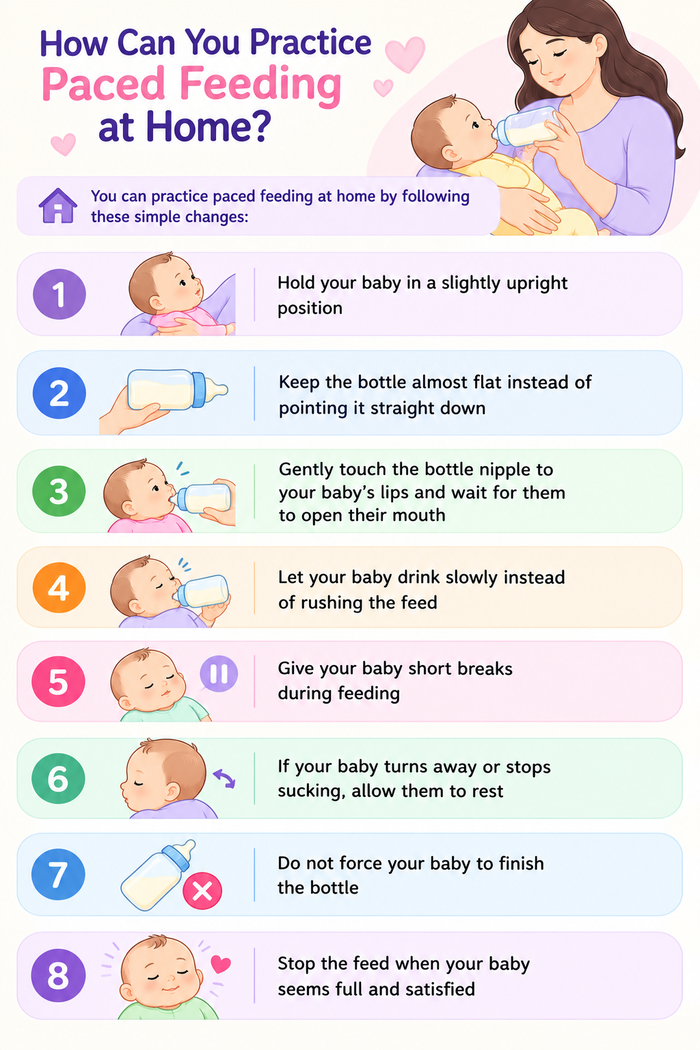
How Can You Practice Paced Feeding at Home?
You can practice paced feeding at home by following a few simple changes during bottle feeds:- Hold your baby in a slightly upright position
- Keep the bottle almost flat instead of pointing it straight down
- Gently touch the bottle nipple to your baby's lips and wait for them to open their mouth
- Let your baby drink slowly instead of rushing the feed
- Give your baby short breaks during feeding
- If your baby turns away or stops sucking, allow them to rest
- Do not force your baby to finish the bottle
- Stop the feed when your baby seems full and satisfied
Signs That Your Baby May Be Feeding Too Fast
You may notice a few signs that your baby feeds too fast:- Your baby coughs or chokes while drinking
- Milk leaks from the corners of the mouth
- Your baby takes very few pauses during the feed
- Breathing seems rushed while drinking
- Your baby pushes the bottle away
- The bottle is finished within a few minutes
- Your baby looks tired before finishing the feed
Babies Who May Need Slower Feeds
Paced feeding may be helpful for the following babies:- Premature babies who need more time during feeds
- Newborn babies who are still learning to bottle-feed
- Babies who receive both breast milk and bottle feeds
- Babies who are cared for by different family members
- Babies who prefer small and frequent feeds
- Babies who get distracted during feeding
- Babies who return to bottle feeding after breastfeeding
- Babies who seem more comfortable with slower feeds
Things to Avoid During Paced Feeding
There are some common mistakes that can make paced feeding less helpful. This includes:- Changing the feeding position too often
- Trying to hurry the feed when your baby needs more time
- Distracting your baby with toys or screens during feeding
- Continuing the feed when your baby seems sleepy
- Comparing your baby's feeding time with that of other babies
- Feeding in a noisy or uncomfortable environment
- Following a feeding schedule instead of your baby's needs
When Should You Speak to a Doctor?
You should speak to your doctor if you notice any of the following:- Your baby is not gaining weight as expected
- Your baby coughs or chokes during most feeds
- Your baby regularly refuses to feed
- Your baby vomits after many feeds
- You have concerns about your baby's feeding, growth, or overall health
Whether you’re pregnant, a new mom, or navigating postpartum, you don’t have to do it alone. Join our support group to connect, share, and support one another.
FAQs on What Is Paced Feeding and Why Is It Recommended?
- Can paced feeding be started at any age?
Yes, paced feeding can be introduced whenever your baby starts bottle feeding. It may be used for newborns as well as older babies. As your baby grows, you can adjust the feeding pace according to your baby's needs and comfort. - Can paced feeding be used at night?
Yes, paced feeding can also be practised during night feeds. Keeping the feed slow and allowing short pauses may help your baby stay calm and settle more comfortably after feeding, making nighttime feeds feel less rushed for both of you. - Should I burp my baby during paced feeding?
Many parents find it helpful to burp their baby during feeding breaks. Burping may help release swallowed air and improve comfort. If your baby seems unsettled or gassy during feeds, taking a short burping break can help.