
While these two conditions may sound similar, they are not the same, especially regarding management options.
Children who are late talkers catch up after some time, but children with language disorders can have issues understanding, learning or using language.
Knowing about these distinctions will help you track your child’s progress through these stages in life and assist them with professional care if required.
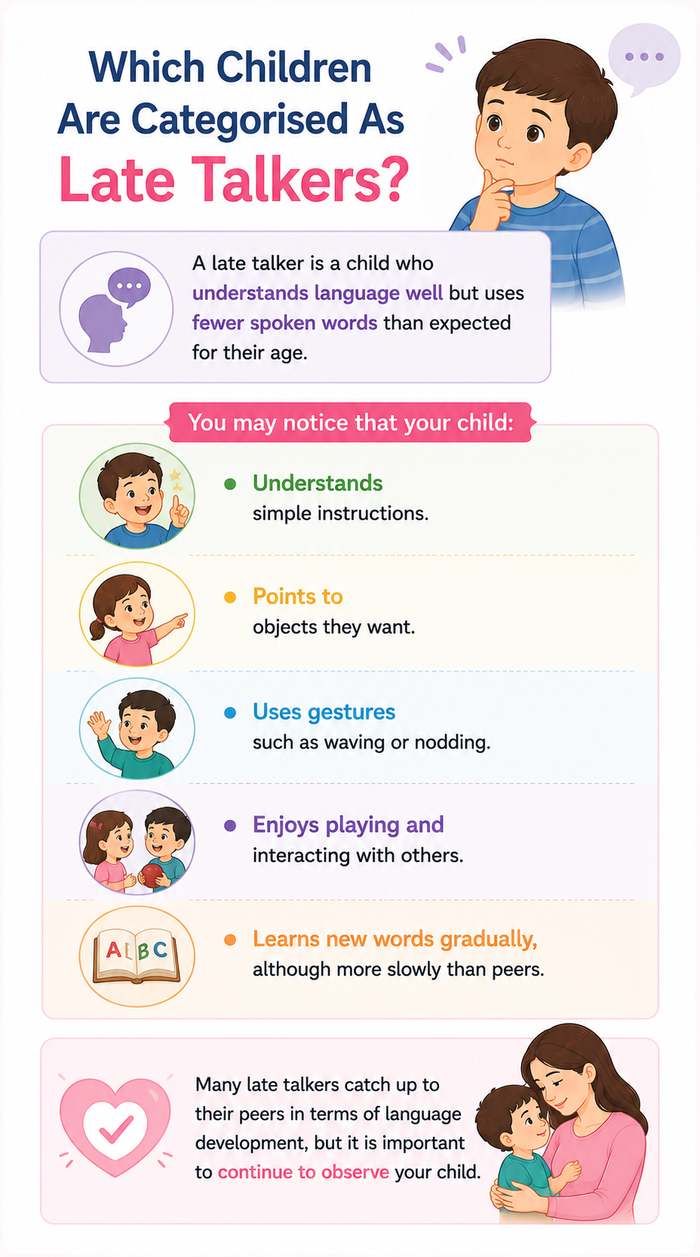
Which Children Are Categorised As Late Talkers?
A late talker is a child who understands language well but uses fewer spoken words than expected for their age.You may notice that your child:
- Understands simple instructions
- Points to objects they want
- Uses gestures such as waving or nodding
- Enjoys playing and interacting with others
- Learns new words gradually, although more slowly than peers
Signs Indicating Language Disorder
A language disorder affects how your child understands, uses, or organises language. It can affect both spoken communication and learning.Your child may:
- Find it difficult to understand everyday instructions
- Use very few words for their age
- Struggle to form simple sentences
- Have trouble answering basic questions
- Find conversations difficult, even as they grow older
Key Differences Between Late Talkers and Language Disorders
The following are the key differences:Understanding Skill Develops Before Speaking Skill
One of the biggest differences is language comprehension.
A late talker usually understands:
- Their name
- Familiar routines
- Everyday instructions
- Simple questions
Nonverbal Communication Is More
Speech is only one part of communication.
A late talker often communicates by:
- Pointing
- Eye contact
- Facial expressions
- Bringing objects to you
- Gestures and sounds
Speed of Language Learning Progress
Children who are late talkers usually continue adding new words and begin combining them into short phrases.
However, slower developments may require more attention, particularly if your child:
- Learns very few new words during several months
- Has problems combining two words by age two
- Fails to grasp even simple language
- Shows limited progress despite regular communication in the family
Social Interaction and Play
Unlike a child with language disorders, a late talker usually enjoys the following:
- Eye contact
- Pretend play
- Interacting with others
When Should You Consult A Doctor?
You should consult a doctor for a developmental assessment if your child:- Is not responding consistently to their name
- Is saying very few or no meaningful words by around two years
- Is having difficulty understanding simple instructions
- Is losing the communication abilities they had already developed
- Is showing concerns with hearing, interaction, or overall development
- A hearing assessment
- Developmental evaluation
- Referral to a speech and language therapist
Whether you’re pregnant, a new mom, or navigating postpartum, you don’t have to do it alone. Join our support group to connect, share, and support one another.
FAQs on Late Talker vs Language Disorder: What's the Difference
- Can a child who is a late talker catch up without intervention?
Yes, many such children tend to catch up to their peers in terms of language development. But it is vital to monitor the development of such children carefully. - Is language disorder the same as speech delay?
No. While delayed speech is only about the ability to speak, language disorder may affect comprehension, developing speech, forming correct sentences, expressing, and using language. - Can problems with hearing lead to delayed talking?
Yes, it can. That is why it is necessary to test a child’s hearing ability if the suspicion of delayed language development arises.