
In this article:
What Is Expressive Language Disorder?
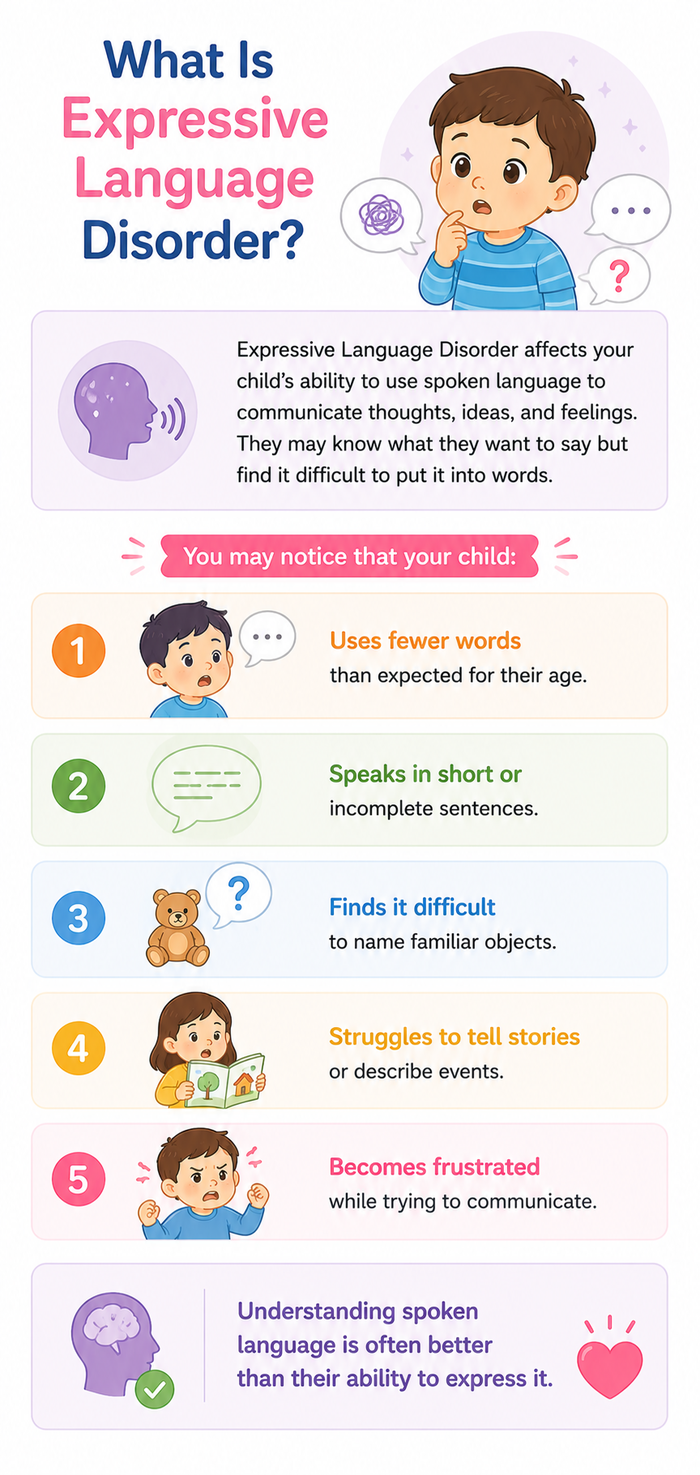
Expressive Language Disorder affects your child's ability to use spoken language to communicate thoughts, ideas, and feelings. Your child may know what they want to say but find it difficult to put it into words.You may notice that your child:
- Uses fewer words than expected for their age
- Speaks in short or incomplete sentences
- Finds it difficult to name familiar objects
- Struggles to tell stories or describe events
- Becomes frustrated while trying to communicate
What Is Receptive Language Disorder?
Receptive Language Disorder affects your child's ability to understand spoken language. They may hear words clearly but have difficulty making sense of what others say.Your child may:
- Find it difficult to follow instructions
- Need questions repeated several times
- Misunderstand conversations
- Have difficulty learning new words
- Appear inattentive because they do not fully understand spoken language
Expressive Language Disorder vs Receptive Language Disorder: Key Differences
The following are the key differences:Difference in understanding language
Children with Expressive Language Disorder usually understand conversations better than they can express themselves.
Children with Receptive Language Disorder have difficulty understanding spoken words, questions, or instructions, even when their hearing is normal.
Difference in speaking and vocabulary
Expressive Language Disorder mainly affects spoken communication. Your child may have a limited vocabulary or struggle to form complete sentences.
In Receptive Language Disorder, speech may seem appropriate at times, but understanding the meaning of words and sentences remains challenging.
Difference in following instructions
In Expressive Language Disorder, your child is able to follow instructions (age-appropriate). This is because their ability to understand spoken language is usually better preserved.
However, in Receptive Language Disorder, your child may find it difficult to understand even simple directions.
Difference in learning at school
Expressive Language Disorder may make it harder for your child to answer questions, participate in discussions, or explain their ideas.
Receptive Language Disorder can affect classroom learning because understanding lessons, instructions, and new vocabulary becomes more difficult.
Difference in social communication
Both conditions can affect friendships, but in different ways.
A child with “Expressive Language Disorder” may understand conversations but struggle to join in.
A child with “Receptive Language Disorder” may struggle to process what others say. This condition makes interactions difficult for them.
Difference in diagnosis
Your child's specialist will conduct a thorough speech/language assessment and a detailed developmental history analysis.
Distinctive Features
| Feature | Expressive Language Disorder | Receptive Language Disorder |
| Main difficulty | Using language | Understanding language |
| Speaking | Often affected | May be normal or affected |
| Understanding instructions | Usually appropriate | Often difficult |
| Vocabulary | Limited spoken vocabulary | Difficulty understanding words |
| Conversation | Knows what to say but struggles to express it | May misunderstand what others say |
When Are These Conditions Diagnosed?
You may notice signs during infancy. The first sign might be a delay in achieving communication milestones.However, these conditions become more apparent in preschool or early school years, especially when language comprehension becomes more difficult. Generally, an accurate diagnosis can be established at this time.
How Can You Support Your Child?
Early support can help your child build communication skills and participate more confidently in daily activities.You can:
- Follow the assessment and therapy plan recommended by your healthcare team
- Read books together every day
- Use short, clear sentences during conversations
- Give sufficient response time to your child
- Support your child with conversations while they are playing with other children
- Ask for special guidance for your child from teachers
- Communicate with your speech and language therapist about every change
Whether you’re pregnant, a new mom, or navigating postpartum, you don’t have to do it alone. Join our support group to connect, share, and support one another.
FAQs on Expressive Language Disorder vs Receptive Language Disorder: What's the Difference?
- Can a child have both Expressive and Receptive Language Disorders?
Yes. Some children have difficulties with both understanding and expressing language. This is often referred to as a mixed receptive-expressive language disorder. - At what age can Expressive or Receptive Language Disorder be diagnosed?
Developmental concerns may appear in the toddler years, but these disorders are often diagnosed during the preschool or early school years after a comprehensive speech and language assessment. - Does a language disorder always mean autism?
No. Language disorders and Autism Spectrum Disorder (ASD) are different conditions. Although some children with autism also have language difficulties, many children with language disorders do not have autism.