
Understanding how it works and when it may be considered can help parents feel more prepared for conversations about cord care after delivery.
We spoke with Dr Amit Gupta, Senior Consultant – Paediatrician & Neonatologist, Motherhood Hospitals, Sector 48, Noida, to better understand umbilical cord milking and its role in newborn care.
What Is Umbilical Cord Milking?
Umbilical cord milking is a technique in which a healthcare professional gently compresses the umbilical cord and moves the blood toward your baby. This helps transfer blood remaining in the placenta and cord to the newborn within a short period.Unlike delayed cord clamping, which allows blood to flow naturally from the placenta to the baby while the cord remains unclamped for a period, cord milking actively moves the blood through the cord.
Why Is Umbilical Cord Milking Done?
Before birth, the placenta supplies the baby with oxygen and nutrients through the umbilical cord. After birth, some blood remains within the placenta and cord.Moving some of this blood to the newborn may increase circulating blood volume. This can be particularly relevant for babies born prematurely, who may have a higher risk of anaemia and may need blood transfusions.
How Is Umbilical Cord Milking Performed?
There are two broad approaches:1. Intact-cord milking
Here, the umbilical cord remains attached to the placenta. The healthcare professional repeatedly compresses a section of the cord and moves the blood toward the baby before the cord is clamped.
2. Cut-cord milking
In this approach, the cord is first clamped and cut, leaving a segment of cord. The blood within that segment is then moved toward the baby by compression.
Umbilical Cord Milking vs Delayed Cord Clamping
These two methods are sometimes confused, but there is an important difference.- Delayed cord clamping allows blood to pass naturally from the placenta to the baby before the cord is clamped. The process generally takes at least 30-60 seconds, depending on the situation and clinical guidance.
- Umbilical cord milking actively pushes blood through the cord and can be completed much faster.
Possible Benefits of Umbilical Cord Milking
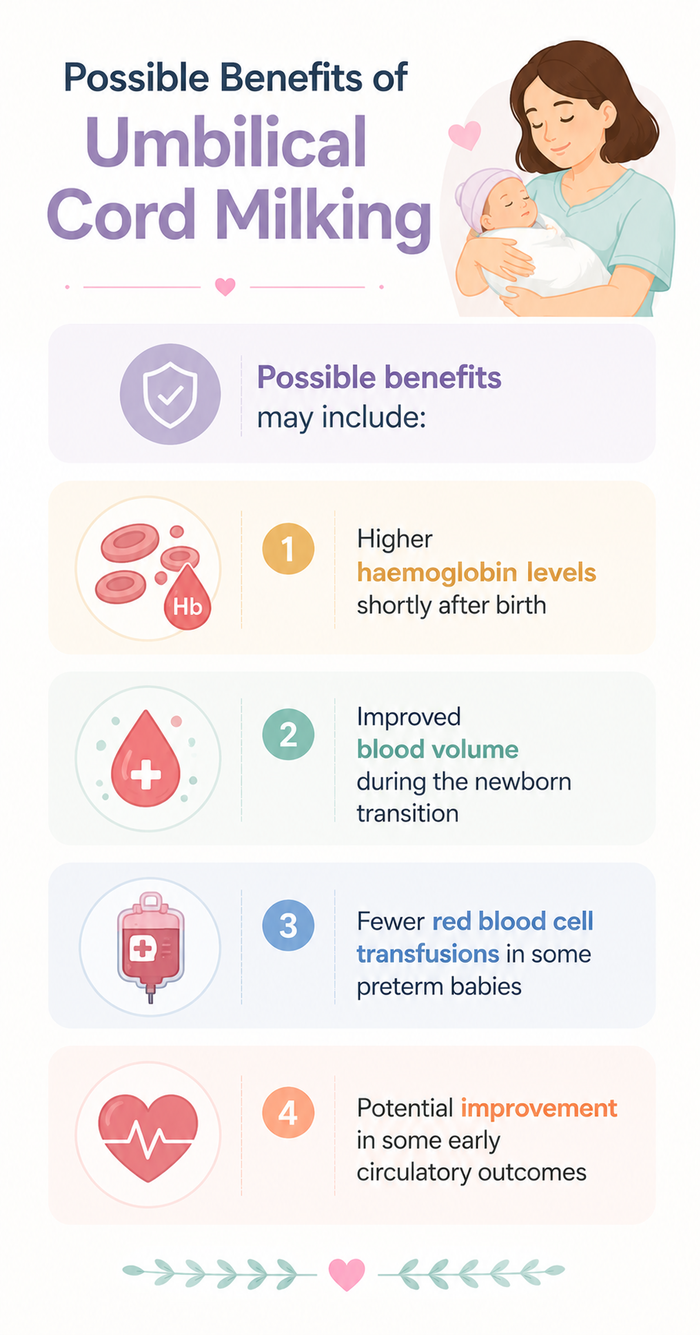
Possible benefits may include:- Higher haemoglobin levels shortly after birth
- Improved blood volume during the newborn transition
- Fewer red blood cell transfusions in some preterm babies
- Potential improvement in some early circulatory outcomes
Is Umbilical Cord Milking Safe for All Babies?
No. It is not recommended for babies born before 28 weeks because of the risk of brain bleeding. For babies born at 28–36 weeks, delayed cord clamping may be considered when it is not possible. For healthy term babies, evidence is still limited.“Cord milking is not needed for every baby. The decision depends on the baby’s gestational age, condition at birth, and whether the baby needs immediate medical care.”
- Dr Amit Gupta, Senior Consultant – Paediatrician & Neonatologist, Motherhood Hospitals, Sector 48, Noida
When Might Doctors Consider Cord Milking?
Doctors may consider cord milking when rapid placental blood transfer is desirable, and the usual approach of delayed cord clamping cannot be used. For example, there may be circumstances where waiting for the usual period of delayed clamping is not feasible.Umbilical cord milking is one of several approaches doctors may use to support a newborn’s transition after birth. Its use depends on the baby’s maturity, health, and delivery circumstances. Rather than being a routine step, it is chosen when the medical team believes it may offer a benefit without adding unnecessary risk.
Whether you’re pregnant, a new mom, or navigating postpartum, you don’t have to do it alone. Join our support group to connect, share, and support one another.
FAQs on Umbilical Cord Milking: What Is It and When Is It Recommended?
- Is umbilical cord milking the same as delayed cord clamping?
No. Delayed clamping allows blood to flow naturally, while cord milking gently pushes blood through the cord. - Is cord milking done after every birth?
No. It depends on the baby’s gestational age, condition, and delivery circumstances. - Is cord milking recommended for full-term babies?
Not routinely. Delayed cord clamping is generally preferred for stable term babies when appropriate.