In this article:
When Do Babies Start Pointing?
Some babies begin pointing as early as 9 months. Most do so by 12 months, while onset after 13 months is considered late. Most babies begin with a whole-hand reach or open-palm gesture before shifting to index-finger pointing.At 12 months, children use an open-hand point with fingers spread, and a tap with fingers together, as an indicative gesture to draw the attention of others to things of interest.
Parents often notice pointing when a baby reacts to a crow on the window ledge, or the pressure cooker whistling on the stove, familiar, visually engaging objects in many homes. Babies point at things that hold their attention and that they want to share.
What Are the Two Types of Pointing in Babies?
Researchers identify two distinct types of pointing: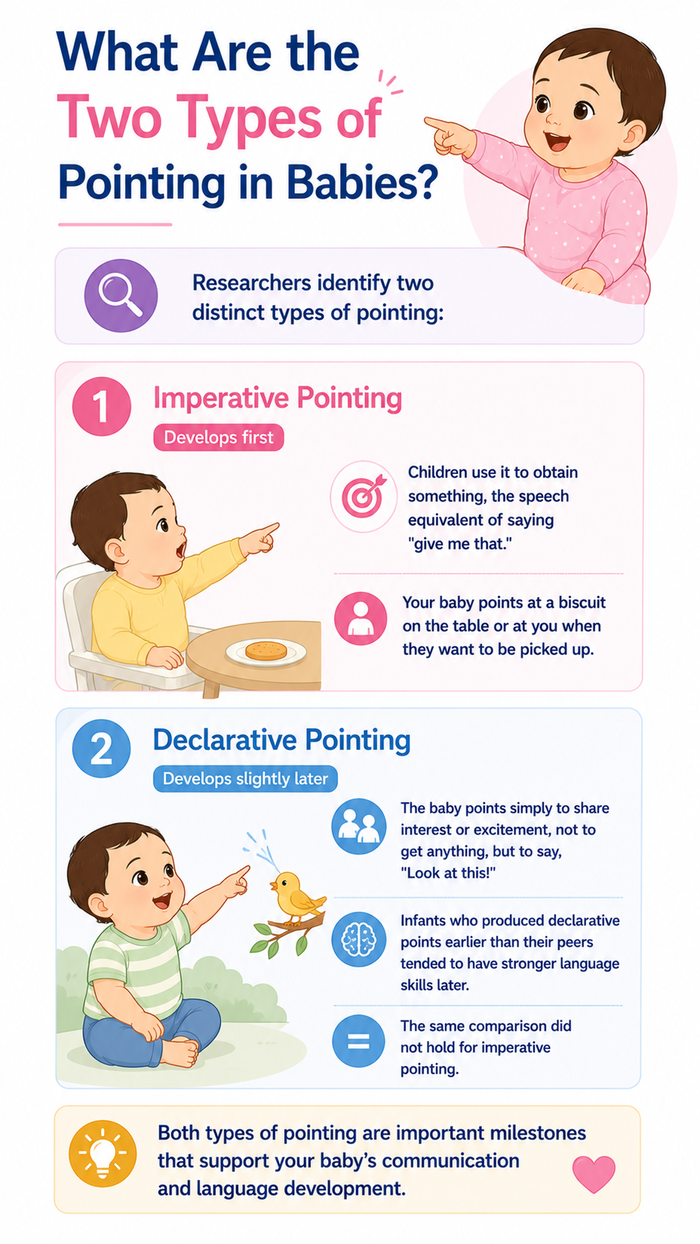
- Imperative pointing: Develops first. Children use it to obtain something, the speech equivalent of saying "give me that." Your baby points at a biscuit on the table or at you when they want to be picked up.
- Declarative pointing: Develops slightly later and is considered the more advanced of the two. The baby points simply to share interest or excitement, not to get anything, but to say, "Look at this!" Infants who produced declarative points earlier than their peers tended to have stronger language skills later, whereas the same comparison did not hold for imperative pointing.
How Should You Respond When Your Baby Points?
Your response directly supports language and communication development. When adults engaged with babies by sharing their attention and showing interest, through making eye contact and expressing emotions, the babies pointed more often.When your baby points: Name the object clearly. ‘Yes, that's a butterfly!’ Add a short comment or sound to the moment; even "Oh, a dog! Woof!" is enough. Make eye contact and show genuine interest. These responses build vocabulary, reinforce the value of communication, and encourage your baby to keep pointing and eventually to speak.
When Should You Be Concerned if Your Baby Is Not Pointing?
Pointing with a finger is listed as a 9-month developmental milestone. By 15 months, a baby should be able to point to ask for something or to get help.Infants who do not produce pointing gestures with their index finger at 12 months are at a higher risk for language delay at 24 months, performing poorer in language than typically developing children at least until the age of six years.
Absent or significantly reduced pointing can be one of the early indicators of autism spectrum disorder (ASD). Autistic children generally point and gesture much less than children with non-autistic development.
Speak to your paediatrician if your baby:
- Is not pointing by 12 months
- Is not making eye contact
- Does not respond to their name
- Shows no interest in sharing attention with you
The next time your baby jabs a finger at a street vendor, a grandmother's bangle, or a flying bird, know that the gesture acts as a bridge between non-verbal and verbal communication. Babies use pointing alongside babbling first, then pointing alongside early words, before eventually replacing the gesture with speech.
Whether you’re pregnant, a new mom, or navigating postpartum, you don’t have to do it alone. Join our support group to connect, share, and support one another.