For accurate, doctor-verified information, we reached out to Dr George Joseph P, Senior Consultant- Neonatology & Paediatrics, Kinder Hospitals Kochi.
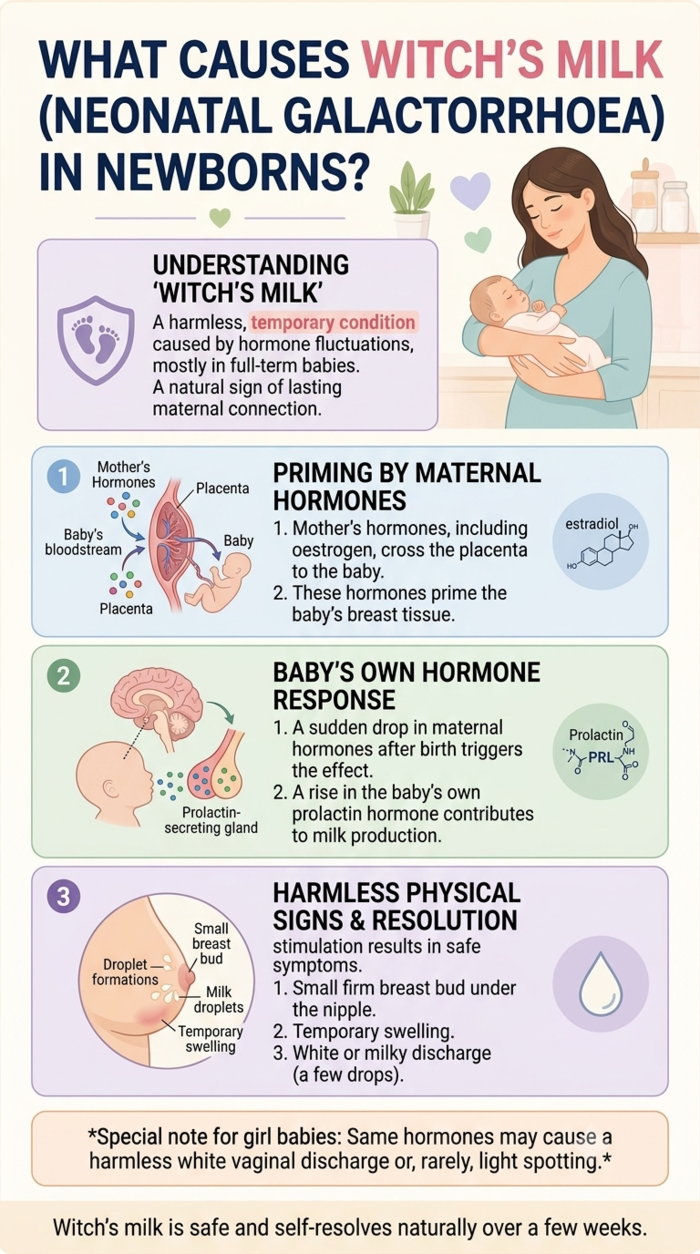
What Causes Witchs Milk in Newborns?
Neonatal galactorrhoea is mostly seen in full-term babies and is linked mainly to hormonal changes before and after birth.During pregnancy, the mother's oestrogen and other hormones cross the placenta into the baby's blood. After birth, the baby's exposure to these hormones changes suddenly, but the hormones are still in the baby's body for a few days. They stimulate the baby's breast tissue, resulting in:
- A small, firm breast bud beneath the nipple
- Mild swelling around the nipple
- A few drops of white or milky discharge
The same hormones can cause other temporary changes in newborn girls, such as a white vaginal discharge or, rarely, light spotting in the first week.
How Long Does Witchs Milk Last in Newborns?
Witch's milk usually disappears on its own as the mother's hormones leave the baby's circulation. Breast swelling can appear by about day three after birth. In most babies, it goes down by the second week.In some babies, swelling or leaking continues for longer. Witch's milk can last up to two months, and small breast buds may stay for several months. Girls often have swelling for longer than boys. A longer course is usually still normal if the baby is feeding well and the skin looks healthy.
Witch’s milk is usually harmless and settles on its own within a few weeks. It could be accompanied by a small enlargement of the breast tissue. But if the breast becomes increasingly red, warm, swollen, or painful, or if there is pus-like or bloody discharge, then medical attention will be important.
What to Do and Not Do at Home
Leave the breasts alone. Pressing, squeezing, or massaging them does not remove the milk. It can irritate the tissue, keep the milk coming, and allow bacteria to enter, which can cause a painful infection or an abscess (a pus-filled lump).In many homes, elders advise pressing the breast bud, rubbing it with oil, or applying a coin or warm cloth to "clear" the milk. These methods are not medically advised. The same applies to neonatal oil massage: massage the arms, legs, back, and tummy as usual, but keep pressure off the chest and nipple area.
Practical care steps:
- Wash your hands before handling the baby.
- Keep the area clean and dry. Use soft cotton clothes.
- Dab any leaked fluid with clean cotton. Do not rub.
- Do not apply creams, oils, ghee, or home remedies to the nipples.
- Continue breastfeeding on demand.
When Should You See a Doctor for Witch's Milk?
Infection of the newborn breast (neonatal mastitis) is uncommon, but it needs quick treatment. It is seen mostly in babies under two months. Contact a paediatrician if you notice:- Redness, warmth or hardness of the breast
- Pain when the breast is touched, or crying when handled
- Pus or discharge that is yellow, green or blood-stained
- Swelling that is increasing
- Swelling or discharge that continues after two months
- Poor feeding or unusual sleepiness
Witch's milk is usually a temporary newborn hormonal change that resolves without treatment, but redness, pain, fever, pus, blood, or a baby who appears unwell should never be ignored.
Whether you’re pregnant, a new mom, or navigating postpartum, you don’t have to do it alone. Join our support group to connect, share, and support one another.
FAQs on Witch's Milk in Newborns: Causes, Duration, and When to See a Doctor
- Is witch's milk harmful for a baby?
No. It is a normal, temporary response to the mother's hormones and does not harm the baby. - Does witch's milk happen in premature babies?
It is uncommon. Premature babies have little breast tissue; witch's milk is seen mostly in full-term babies. - Should I squeeze or massage the baby's breast to remove the milk?
No. Squeezing can cause infection and can prolong milk production. Leave the area untouched.