
In this article, Dr Ruchita Munjal, Director, Department of Fertility at Cloudnine Group of Hospitals, Gurgaon, Sec 47, explains the key points couples should understand before choosing IUI. Knowing how the treatment works, when it is useful, and what to expect can help you prepare better.
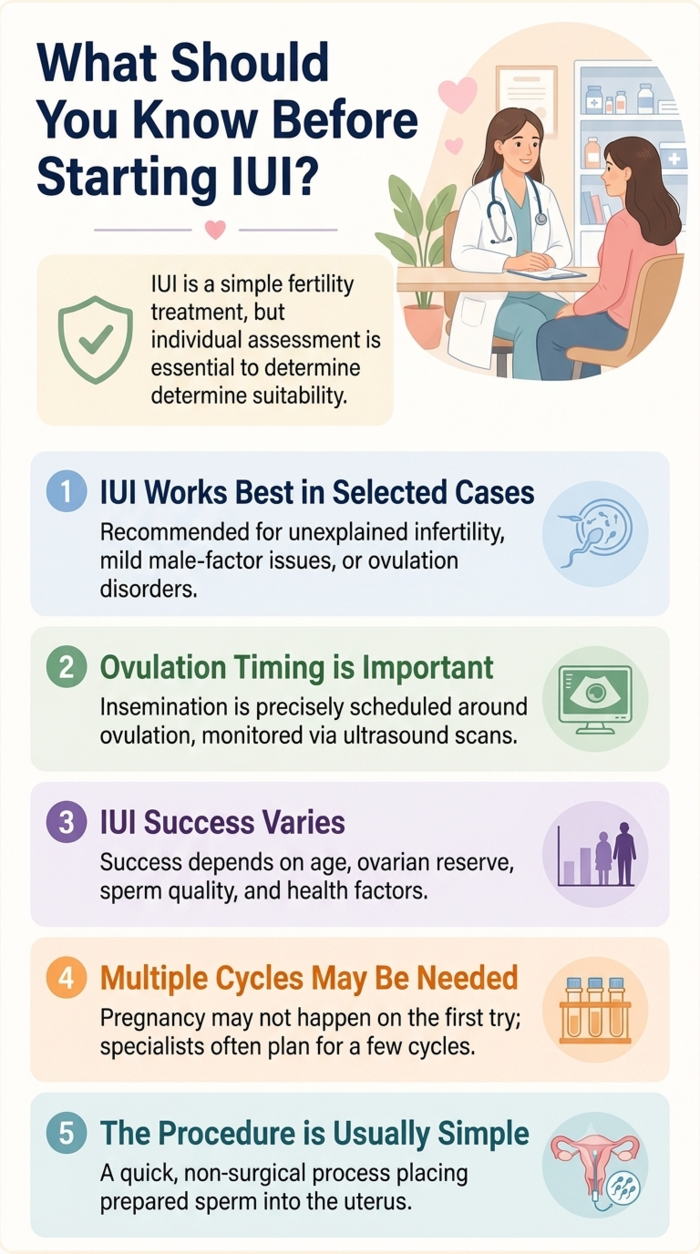
What Should You Know Before Starting IUI?
IUI is a relatively simple fertility treatment, but it is not suitable for everyone. A fertility specialist may assess ovulation, ovarian reserve, sperm quality, and the possible causes of infertility before recommending the procedure.1. IUI Works Best in Selected Cases
IUI may be recommended when there is a reasonable possibility of conception with the help of insemination. It can be considered for unexplained infertility, where routine fertility tests do not identify a clear reason for difficulty conceiving. It may also help couples dealing with mild male-factor infertility, particularly when sperm count or movement is mildly affected. Women with certain ovulation problems may undergo IUI along with medicines that help stimulate ovulation.
IUI can also be an option when donor sperm is being used. Before recommending treatment, the doctor considers several factors, including the woman's age, ovarian function, sperm quality, and reproductive health. Therefore, IUI should be recommended after an individual fertility assessment rather than chosen simply because it is a relatively simple procedure.
2. Ovulation Timing is Important
Timing is one of the most important parts of IUI treatment. The prepared sperm needs to be placed in the uterus close to ovulation so that sperm is available when the egg is released. Your doctor may monitor your menstrual cycle through ultrasound scans. These scans help track the growth of ovarian follicles and determine when ovulation is approaching.
Some women may have IUI during a natural cycle, while others may receive medicines to stimulate ovulation. In some cases, medication may be used to trigger ovulation at a planned time. Following scan appointments and medication instructions is important because the IUI procedure is scheduled according to the expected time of ovulation.
3. IUI Success Varies
IUI doesn't guarantee pregnancy, and the chances of success vary from one person to another. Several factors can influence the outcome. These include age, ovarian reserve, sperm quality, the cause of infertility, and the use of fertility medicines. Egg quality generally declines with age, while sperm count, movement, and quality can also affect fertilisation.
The reason for infertility is another important consideration. IUI may have a better role in some conditions than others. For this reason, couples should discuss their individual chances with their fertility specialist rather than relying only on a general success rate.
4. More Than One IUI Cycle May Be Recommended
Pregnancy does not always happen during the first IUI cycle. Depending on your age, fertility history, test results, and response to treatment, your fertility specialist may recommend trying IUI for a few cycles. Each cycle allows the medical team to assess ovulation, follicle development, and the response to medicines when they are used.
However, IUI should be continued with a clear plan. If pregnancy does not occur after the recommended attempts, the specialist may reassess the situation and discuss other fertility treatments, including IVF, when appropriate. Understanding this possibility before starting treatment can help couples prepare emotionally and practically for the fertility journey.
5. The Procedure is Usually Simple
IUI generally takes only a few minutes and usually does not require anaesthesia. Before the procedure, the semen analysis is specially prepared in the laboratory. This helps concentrate suitable sperm for insemination. The prepared sperm are often placed directly into the uterus through a thin catheter. Some women may experience mild cramping or light spotting afterwards.
These symptoms are generally temporary; however, severe pain, heavy bleeding, fever, or other unusual symptoms should be reported to your doctor.
“IUI can support conception when the right patients are selected, ovulation is carefully timed, and treatment is planned according to individual fertility factors and medical needs.”
- Dr Ruchita Munjal
Why is Individual Planning Important?
IUI should not follow a one-size-fits-all approach. The decision to use fertility medicines, monitor ovulation, and determine the number of treatment cycles should depend on individual fertility findings. Dr Ruchita Munjal stresses the importance of discussing the complete treatment plan with a fertility specialist before starting IUI.Before starting IUI, understand why it has been recommended and what factors may influence your chances of pregnancy. Ask about ovulation monitoring, fertility medicines, the number of cycles, and possible alternatives. Attend every scheduled appointment and follow medication instructions carefully. Most importantly, discuss your concerns openly with your fertility specialist and choose a treatment plan based on your individual fertility needs.
You’re not alone in your journey when trying to conceive. Join our supportive community to connect with others, share experiences, and find encouragement every step of the way.
FAQs on 5 Things to Know Before Starting IUI
- How soon can normal activities be resumed after IUI?
Most women can return to their normal activities after the procedure unless their fertility specialist gives different advice. Prolonged bed rest is generally not required. - Does an unsuccessful first IUI mean the treatment will not work?
Not necessarily. Pregnancy may occur in the first cycle. Depending on individual factors, a specialist may recommend additional IUI cycles before considering another treatment option. - Can IUI be done during a natural cycle?
Yes, women who ovulate regularly may undergo IUI during a natural cycle. Fertility medicines may be recommended when additional support for ovulation is needed.