
In this article:
Here, we explain the importance of day 3 for the fertility test and what these findings may reveal about your reproductive health.
What Happens During the Early Follicular Phase?
The early follicular phase begins with the start of your menstrual period. During this time, your ovaries begin preparing eggs for a new cycle. Because hormone levels are relatively stable and have not yet reached their peak, day 3 is considered an ideal time to evaluate your reproductive hormones and ovarian function.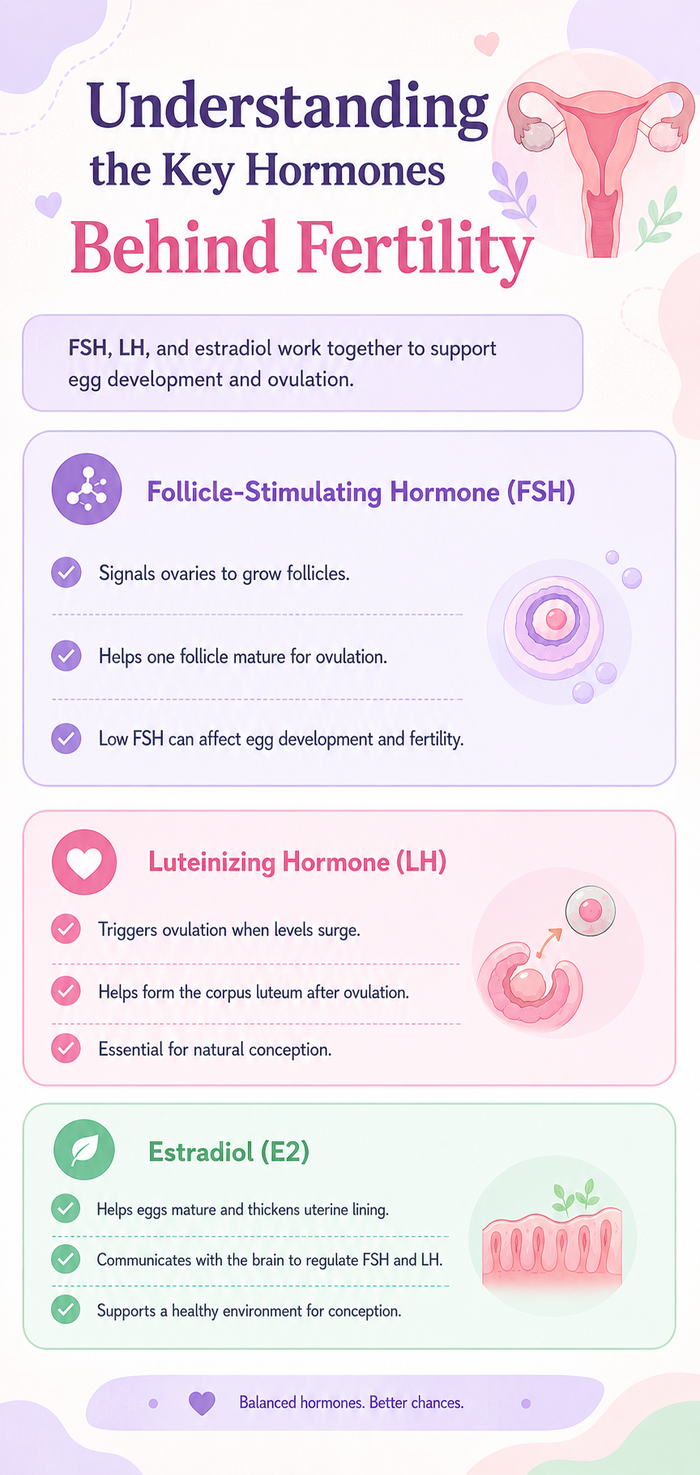
Understanding the Key Hormones Behind Fertility
Fertility depends on a balance of hormones that help to regulate your egg development and ovulation. Among the many hormones involved in reproduction, FSH, LH, and estradiol provide important information about how your ovaries are functioning on day 3.1. Follicle-Stimulating Hormone (FSH):
FSH is produced by your pituitary gland, a small gland at the base of your brain. At the start of each menstrual cycle, FSH signals your ovaries to grow a group of follicles. Each follicle holds an immature egg.
As these follicles grow, usually one becomes dominant and continues to mature until ovulation. FSH is responsible for starting and supporting follicle growth. It plays an important role in your egg development.
Without enough FSH activity, your ovaries may not mature an egg properly, which can affect fertility.
2. Luteinising Hormone (LH):
LH is another hormone produced by your pituitary gland. It works closely with FSH during your cycle. As your dominant follicle matures, LH levels rise, which is called the LH surge, triggering ovulation. This is when a mature egg is released from your ovary.
After ovulation, LH also helps form the corpus luteum, a temporary structure that makes hormones to support your uterine lining. Since ovulation is essential for natural conception, LH plays a key role in your fertility.
3. Estradiol (E2):
Estradiol is the main form of estrogen. It is produced by the growing follicles in your ovaries. As the follicles develop, estradiol levels rise. This hormone helps your egg mature and thickens your uterine lining, creating the right environment for a fertilised egg to implant.
Estradiol also communicates with the brain to regulate the production of FSH and LH, ensuring that the menstrual cycle progresses normally. By supporting both egg growth and uterine preparation, estradiol plays a key role in successful conception and pregnancy.
Understanding Your Day 3 Fertility Hormone Test Results
The levels of FSH, LH, and estradiol measured on Day 3 can offer important insights into fertility. While normal ranges may vary slightly between laboratories, the table below provides a general guide to understanding what your results may mean.| FSH (Follicle-Stimulating Hormone) | Less than 10 mIU/mL | May indicate diminished ovarian reserve, meaning the ovaries require more stimulation to develop follicles | May suggest a pituitary or hypothalamic disorder affecting hormone production |
| LH (Luteinizing Hormone) | 1.9-12.5 mIU/mL | May be associated with PCOS or other hormonal imbalances | May indicate inadequate hormonal signalling from the pituitary gland |
| Estradiol (E2) | 25-75 pg/mL | May mask elevated FSH levels and could indicate early follicle development | May reflect reduced estrogen production by the ovaries |
Can One Abnormal Result Affect Your Chances of Pregnancy?
Hormone levels give doctors clues about how your ovaries are working. But one abnormal result does not tell the full story. For example, some women with high FSH or others with hormonal imbalances can still conceive naturally.This is why doctors usually look at FSH, LH, and estradiol levels together instead of focusing on just one. They may also consider other tests, such as an ultrasound scan, blood test, ovarian reserve assessment, or additional hormone testing, to get a more complete picture of your fertility health.
Lifestyle Changes That May Support Hormonal Balance
The following lifestyle changes may help you support hormonal balance and reproductive health:- Maintain a healthy body weight
- Include plenty of fruits, vegetables, whole grains, and protein in your meals
- Engage in regular moderate physical activity
- Get 7-9 hours of quality sleep each night
- Manage stress through relaxation techniques, yoga, or meditation
- Stay hydrated throughout the day
- Reduce excessive caffeine intake
- Attend regular health check-ups to monitor reproductive health
You’re not alone in your journey when trying to conceive. Join our supportive community to connect with others, share experiences, and find encouragement every step of the way.
FAQs on Day 3 Fertility Hormone Test: What Happens and What Your Results May Mean
- Can stress affect fertility hormone test results?
Short-term stress usually does not significantly affect test results. However, ongoing stress may influence hormone balance and menstrual cycle patterns over time. - Can fertility medications affect hormone test results?
Yes, certain fertility medications can affect hormone levels and may influence test results. Inform your doctor about any medications or supplements you are taking before the test.