In this article:
What is Empty Follicle Syndrome?
Empty Follicle Syndrome (EFS) is a condition in which no eggs are retrieved from mature ovarian follicles during IVF.
It is considered uncommon.
The follicles may appear normal on ultrasound. However, no eggs are obtained during the retrieval procedure.
Types of Empty Follicle Syndrome
| Type | What It May Indicate |
|---|---|
| False Empty Follicle Syndrome | Often linked to problems with the trigger injection or its timing |
| Genuine Empty Follicle Syndrome | No eggs are retrieved despite appropriate medication and hormone levels |
Why Were No Eggs Retrieved During IVF?
Several factors may contribute.Problems With the Trigger Injection
The trigger injection helps mature the eggs before retrieval. The following are the causes that may render the trigger injection ineffective:
- Not given at the right time
- Missed dose
- Problems with administration
- Medication might not be effective
Reduced Ovarian Response
Sometimes, follicles develop on ultrasound, but the eggs inside may not mature properly.
This is more likely in:
- Individuals with diminished ovarian reserve
- Advanced maternal age
- Certain ovarian disorders
Occasionally, technical factors during retrieval may contribute.
Although uncommon, the following factors may also influence egg collection:
- Follicle position
- Follicle accessibility
Researchers believe that certain abnormalities in follicle development or egg maturation may also lead to this condition.
However, the exact cause is not always clear.
Does Empty Follicle Syndrome Mean IVF Has Failed?
Not necessarily.One episode of EFS does not mean future IVF cycles will not be successful.
Many individuals go on to have successful egg retrievals in later cycles.
Your doctor may plan another IVF cycle after diagnosing the cause behind the EFS and managing it.
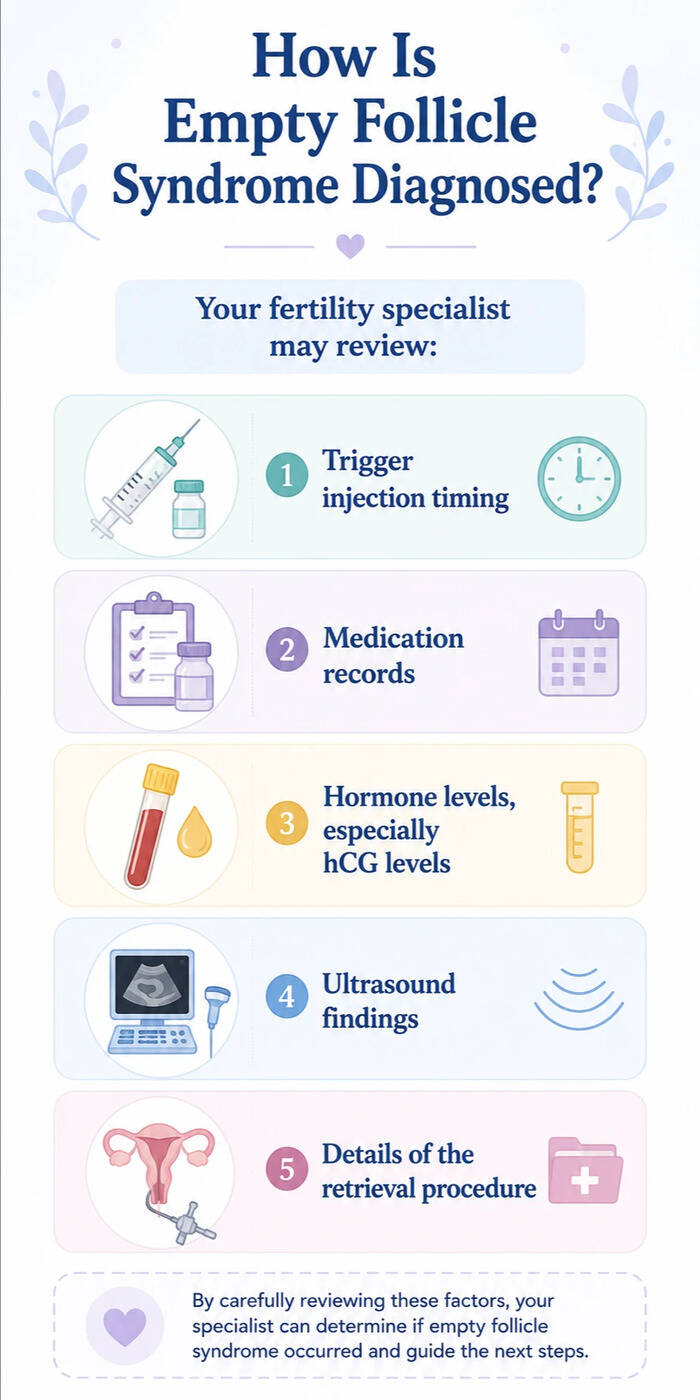
How Is Empty Follicle Syndrome Diagnosed?
Your fertility specialist may review:- Trigger injection timing
- Medication records
- Hormone levels, especially hCG levels
- Ultrasound findings
- Details of the retrieval procedure
Signs That May Suggest EFS
| Finding | What It May Indicate |
|---|---|
| Mature follicles on ultrasound | Follicles appeared ready for retrieval |
| Appropriate ovarian stimulation | Ovaries responded to fertility medication |
| No eggs retrieved | Possible Empty Follicle Syndrome |
| Low hCG level after trigger | Possible trigger-related issue |
What Happens After an Empty Follicle Syndrome Diagnosis?
Treatment mainly depends on the cause that might be responsible for EFS.The following are the approaches that your fertility specialist may follow:
- Trigger medication adjustment
- Changing trigger timing
- Using a different stimulation protocol
- Reassessing ovarian reserve
- Planning a future IVF cycle with closer monitoring
Can Empty Follicle Syndrome Be Prevented?
Not all cases can be prevented.However, careful monitoring may help reduce the risk of trigger-related problems.
This may include:
- Following medication instructions closely
- Confirming trigger timing
- Monitoring hormone levels when required
When Should You Discuss Future Fertility Options?
You may benefit from a detailed discussion with your fertility specialist if:- No eggs were retrieved during IVF
- EFS has occurred more than once
- You have concerns about ovarian reserve
- You want to understand your chances in future IVF cycles
supportive community
FAQs on Why Were No Eggs Retrieved During IVF? An Insight Into Empty Follicle Syndrome
- Is Empty Follicle Syndrome common?
- No. It is considered a rare complication of IVF.
- Can you have successful IVF after Empty Follicle Syndrome?
Yes. Many people achieve successful egg retrieval and pregnancy in later IVF cycles. - Does Empty Follicle Syndrome mean there were never any eggs in the follicles?
Not always. In some cases, the issue may be related to egg maturation or the trigger injection rather than the complete absence of eggs.