
In this article:
What Happens When You Arrive at the Hospital?
One of the most important things you can do when you arrive at the hospital in labour is to inform the care team of your GBS-positive status immediately. Your care team will then begin preparing to administer antibiotics as early as possible.
Time matters here; the antibiotics work best when they have had enough time to reach adequate levels in your bloodstream before delivery. It would be ideal if it were carried out four hours before delivery.
However, in cases where the status of GBS is still unclear when you go into labour, either you did not do the screening test on time, or you entered labour prematurely, then your physician will have to evaluate your risk individually.
How Often Are Antibiotics Given?
The antibiotic is not a one-time dose. It is given repeatedly throughout labour, typically every four hours, to maintain a consistent level of protection. This is why arriving at the hospital early and communicating your GBS status promptly gives the treatment the best chance to work effectively. Your doctor will decide based on allergy severity and sensitivity testing.
Does Having GBS Change Your Labour Experience?
For most women, a GBS-positive result does not significantly change the way labour unfolds. You can still have a vaginal birth, use pain relief options, move around during labour, and have your birth preferences respected wherever possible.
The main addition to your labour experience is the IV drip. This means you will have a cannula, a small, thin tube inserted into the back of your hand or forearm.
While this may feel a little restrictive, many women find it manageable, and it does not prevent them from changing positions or using a birthing ball. It is worth discussing your birth preferences with your midwife or obstetrician in advance so that the team is fully aware of your wishes alongside your GBS management plan.
What About a Caesarean Section?
When you undergo an elective caesarean section where your water has not broken, and you have not gone into labour, then you will not necessarily require GBS-specific antibiotics since the baby does not enter the birth canal in a caesarean operation.
If, on the other hand, your waters break before your scheduled caesarean or you go into spontaneous labour, your doctor may want to review your case and prescribe you antibiotics as required. The best person to advise you is your obstetrician, who knows the circumstances of your case.
What If You Experience Rapid Onset Of Labour?
Sometimes labour can progress very quickly, such that you do not get the chance to complete the antibiotics before giving birth. This can happen with second or subsequent births, or simply when labour progresses rapidly. In these cases, your care team will still administer as much of the antibiotic as possible before delivery.
Your baby will then be monitored more closely after birth to watch for any early signs of GBS illness. A shorter antibiotic course is not ideal, but it still offers some level of protection, and close observation of your newborn remains an important safeguard.
Signs You Should Watch Out for During the Birth Process
Despite the use of antibiotics, it is still necessary to pay attention to how you feel throughout the process.
Inform your doctor as soon as possible if you experience:
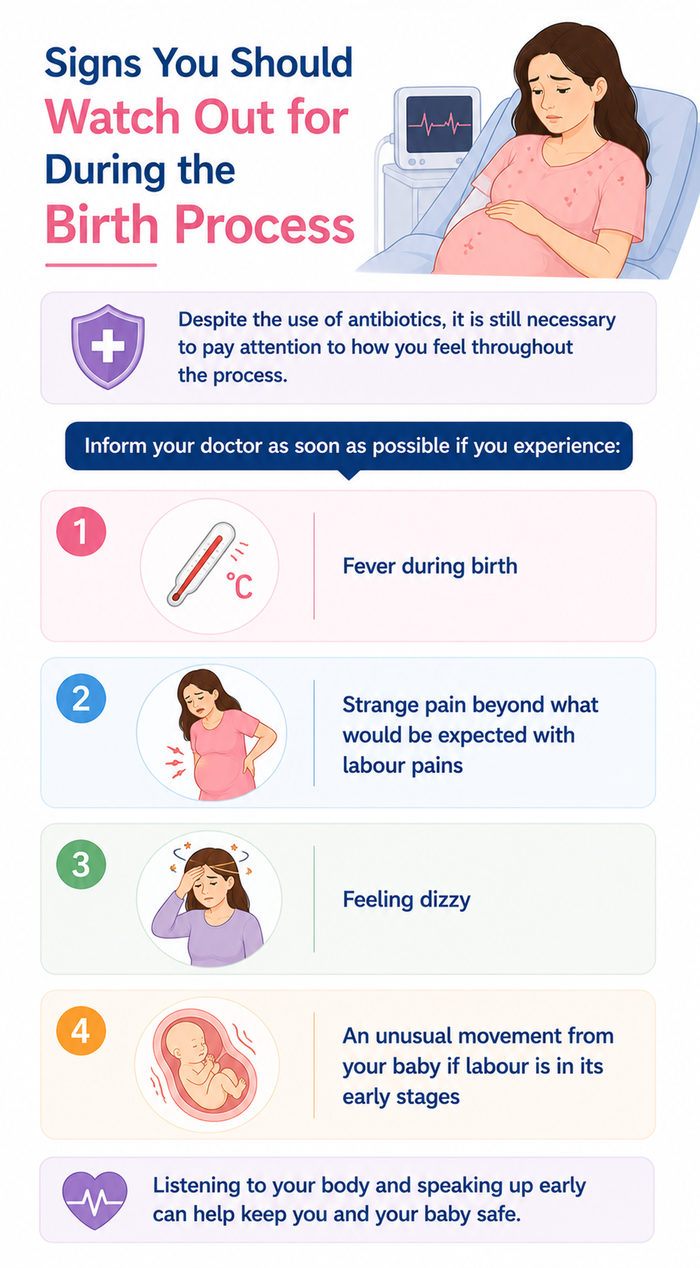
- Fever during birth
- Strange pain beyond what would be expected with labour pains
- Feeling dizzy
- An unusual movement from your baby if labour is in its early stages
After Your Baby Is Born
After the delivery of your baby, the attention will turn towards monitoring the newborn. This is standard procedure when dealing with a newborn from a GBS-positive mother.Baby Monitoring
Your care providers will monitor your baby extensively, especially during the first 12 to 24 hours after delivery:
- Physical Assessment: Assessing breathing, temperature, feeding, colour, and overall response.
- Blood Testing: If there are signs that suggest a problem with your baby, then a blood sample is drawn to see if there is an infection present.
- Length of Monitoring Period: In most cases, healthy babies get discharged normally. If there are any signs, the treatment starts immediately.
What If My Baby Shows Symptoms?
The symptoms that may be displayed by the baby with GBS disease come suddenly.
These include poor feeding, limpness, abnormal temperature, or difficulty breathing. If any of these are noticed, your baby will receive IV antibiotics immediately. Early treatment is very effective, and most babies respond well when GBS is caught and treated quickly.
When Should You Speak to Your Doctor?
There are certain situations where reaching out to your obstetrician or midwife promptly is important:
- If your waters break before labour begins, especially if you are GBS-positive, the risk of transmission increases with time.
- If you develop a fever at any point during labour.
- If you have premature labour.
- If you are unsure whether your birth centre or delivery setting is equipped to administer IV antibiotics.
Planning by discussing these scenarios with your doctor before your due date can save valuable time when labour actually begins.
Managing Group B Strep during labour is straightforward when the right steps are in place. A positive GBS result does not make your labour high-risk in an unmanageable way; it simply means your care team has a specific protocol to follow. Arriving at the hospital early, communicating your status clearly, and allowing antibiotics to be administered in time are the three most important things you can do. The rest is in the hands of a team that does this every day.
Whether you’re pregnant, a new mom, or navigating postpartum, you don’t have to do it alone. Join our support group to connect, share, and support one another.
FAQs on How Is Group B Strep Managed During Labour and Delivery?
- Can I refuse antibiotics during labour if I am GBS-positive?
Yes, you have the right to make decisions about your care. Nevertheless, it is advisable to discuss in depth with your physician regarding any risks that come along before making such a decision. Making an informed decision is always advisable. - Does the IV drip restrict my movements during labour?
A cannula will be inserted for the drip, but it does not mean you must stay in one position. Many women continue to move, use birthing aids, and change positions throughout labour with the drip in place.