In this article:
When Should You Start Giving ORS to Your Baby?
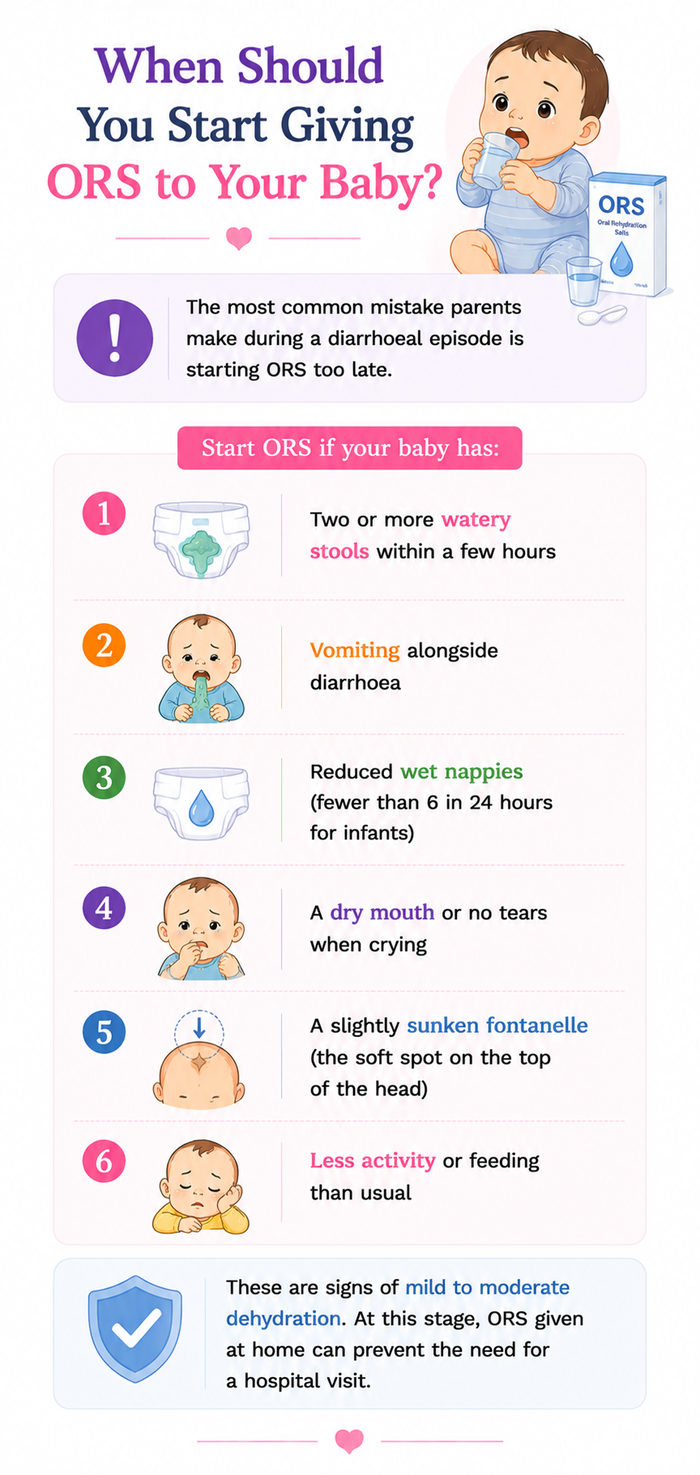
The most common mistake parents make during a diarrhoeal episode is starting ORS too late.
Start ORS if your baby has:
- Two or more watery stools within a few hours
- Vomiting alongside diarrhoea
- Reduced wet nappies (fewer than 6 in 24 hours for infants)
- A dry mouth or no tears when crying
- A slightly sunken fontanelle (the soft spot on the top of the head)
- Less activity or feeding than usual
These are signs of mild to moderate dehydration. At this stage, ORS given at home can prevent the need for a hospital visit.
Go to a doctor immediately if your baby shows:
- No wet nappy for 6 or more hours
- Deeply sunken eyes or fontanelle
- Extreme drowsiness or inability to wake
- Blood in the stool
- High fever (above 39°C / 102°F)
- Persistent vomiting that prevents any fluid from staying down
- Age below 3 months with diarrhoea or vomiting
Severe dehydration requires intravenous (IV) fluids in a clinical setting. ORS is not a substitute in these cases.
How to Give ORS to a Baby: Age-by-Age Guide
According to WHO and UNICEF diarrhoea treatment guidelines, ORS should be given as follows, based on the child's age.
For babies under 6 months:
Consult a paediatrician before giving ORS to a baby under 6 months. If advised, give small amounts (around 30–50 ml) over the first hour, using a spoon, dropper, or oral syringe. Never use a feeding bottle to administer ORS. Continue breastfeeding alongside ORS; do not replace breastfeeds with ORS. For exclusively breastfed infants, increasing frequency of feeds is also a key part of management.
For babies 6 months to 2 years:
Give 50–100 ml of ORS after each loose stool. Offer it in small sips every 1–2 minutes using a spoon. If your baby vomits after drinking, wait 10 minutes, then resume at a slower pace. Do not stop giving ORS because of vomiting; small, frequent sips are usually tolerated.
For children 2 years and above:
Give 100–200 ml of ORS after each loose stool. At this age, children can drink from a cup. Continue offering ORS until loose stools stop and urine output returns to normal. Older children can also be encouraged to drink ORS voluntarily in small, frequent sips rather than large amounts at once.
How to Prepare ORS Correctly
Home-made ORS solutionA home-made sugar-salt solution can be used as a temporary measure if a pharmacy sachet is not immediately available. According to WHO, the home preparation method uses 1 litre of clean boiled and cooled water, 6 level teaspoons of sugar, and half a teaspoon of salt. Stir until fully dissolved before giving it to your baby.
This is not a substitute for a medical-grade ORS sachet, which also contains potassium and citrate, but it can help maintain hydration until you can access a proper sachet. Getting the measurements wrong, particularly using too much salt, can be dangerous for a baby. If in doubt, go to a chemist or a health centre instead of preparing it at home.
Pharmacy ORS sachet
Mix one sachet in 1 litre of clean, cooled boiled water. Stir well until the powder dissolves completely. Do not add extra water to dilute it, or use less water to make it stronger. Do not add sugar, salt, or any flavouring to the prepared solution. Discard any unused solution after 24 hours and prepare a fresh batch.
WHO-approved ORS, given at the correct dose for the child's age and prepared as directed, remains the first-line treatment for fluid loss in children with diarrhoea or vomiting.
Whether you’re pregnant, a new mom, or navigating postpartum, you don’t have to do it alone. Join our support group to connect, share, and support one another.
FAQs on How and When to Give ORS to a Baby: Dosage, Signs, and What to Watch
- My baby keeps vomiting the ORS. What should I do?
Wait 10 minutes after a vomiting episode, then resume ORS at a slower pace, a small spoonful every 2–3 minutes rather than larger sips. Most babies tolerate ORS when given this way. If your baby is unable to keep any ORS down after multiple attempts, stop home treatment and go to a doctor. - How do I know if ORS is working?
Signs that ORS is helping include more frequent wet nappies, improved alertness, return of tears when crying, a moist mouth, and the baby becoming more willing to feed. Most cases of mild dehydration improve within 3–4 hours of correct ORS use. - Should I stop giving ORS once my baby's diarrhoea stops?
You can stop ORS once there are no more loose stools, and your baby is well hydrated. Continue zinc supplementation for 10 to 14 days as recommended, as it prevents recurrence of diarrhoea in the following months.