In this article:
The NIS is different from the vaccination schedule recommended by the Indian Academy of Paediatrics (IAP).
However, the IAP schedule may include additional vaccines that are not provided under the government programme.
National Immunisation Schedule for Children in India
Here is the age-wise NIS for children:| Age | Vaccines under NIS |
| At birth | BCG, OPV-0, Hepatitis B birth dose |
| 6 weeks | OPV-1, Pentavalent-1, RVV-1, fIPV-1, PCV-1 |
| 10 weeks | OPV-2, Pentavalent-2, RVV-2 |
| 14 weeks | OPV-3, Pentavalent-3, RVV-3, fIPV-2, PCV-2 |
| 9–12 months | MR-1, PCV booster, JE-1* |
| 16–24 months | MR-2, DPT booster-1, OPV booster, JE-2* |
| 5–6 years | DPT booster-2 |
| 10 years | Td |
| 16 years | Td |
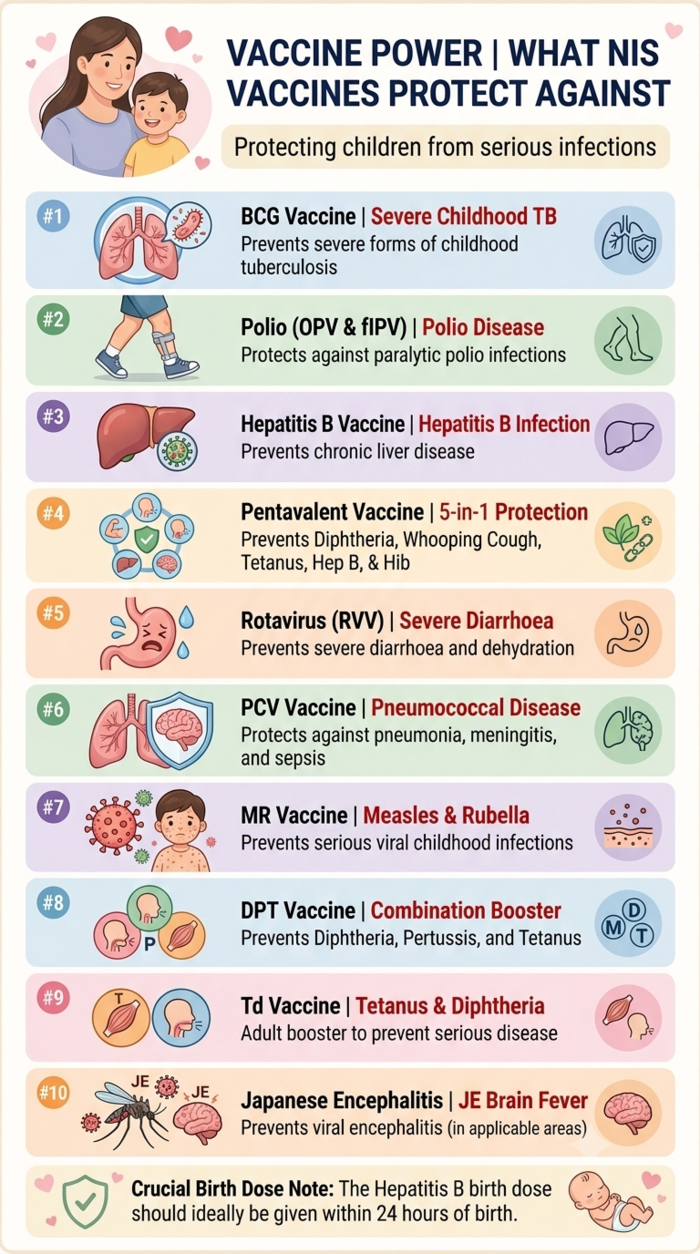
What Do These Vaccines Protect Against?
The vaccines included in the NIS protect children against several potentially serious infections.- BCG: Tuberculosis, particularly severe forms of childhood TB
- OPV and fIPV: Polio
- Hepatitis B vaccine: Hepatitis B infection
- Pentavalent vaccine: Diphtheria, pertussis, tetanus, hepatitis B and Haemophilus influenzae type b (Hib)
- Rotavirus vaccine (RVV): Rotavirus diarrhoea
- Pneumococcal conjugate vaccine (PCV): Pneumococcal disease
- MR vaccine: Measles and rubella
- DPT: Diphtheria, pertussis and tetanus
- Td: Tetanus and diphtheria
- JE vaccine: Japanese encephalitis in applicable areas
Why Is It Important to Vaccinate Your Child on Time?
Vaccination helps protect children against infections that can cause serious illness and complications. Babies and young children are particularly vulnerable to several vaccine-preventable diseases.Following the recommended schedule helps your child receive protection at the appropriate age. It is also important to complete the recommended vaccine series and keep your child’s vaccination record updated.
Parents should keep the child’s vaccination card safely and take it to every healthcare visit. The exact vaccine and timing can depend on the child’s age and previous vaccination history. If a dose is missed, parents should not restart the entire vaccination series on their own. A healthcare professional can review the record and recommend a catch-up schedule.
What If Your Child Misses a Vaccine?
If your child misses a scheduled vaccination, do not panic. Speak to your paediatrician or vaccination provider as soon as possible.Depending on your child’s age and previous vaccinations, the healthcare professional can recommend an appropriate catch-up vaccination schedule. Keep your child’s vaccination card or previous immunisation records with you for the visit.
Do not assume that the entire vaccination series needs to be restarted because a dose was delayed.
NIS vs IAP Vaccination Schedule: What Is the Difference?
The NIS is part of the Government of India’s Universal Immunisation Programme and covers vaccines provided through the national public-health programme.The IAP vaccination schedule, recommended by the Indian Academy of Paediatrics, is a broader paediatric vaccination schedule and may recommend additional vaccines that are not included in the government programme.
Therefore, your child may be advised to receive vaccines in addition to those listed in the NIS. Your paediatrician can guide you based on your child’s age, health, vaccination history and individual risk factors.
Every child’s vaccination needs may vary. You should consult your paediatrician to ensure your child receives the right vaccines at the right time. If any dose is delayed or missed, talk to the doctor for the appropriate next steps.
Whether you’re pregnant, a new mom, or navigating postpartum, you don’t have to do it alone. Join our support group to connect, share, and support one another.
FAQs on National Immunisation Schedule (NIS) in India: A Parent’s Guide to Childhood Vaccinations
- Is vaccination under the NIS free in India?
Vaccines included under the government’s Universal Immunisation Programme are provided through designated public-health facilities. - What should I do if my child misses a vaccine?
Contact your paediatrician or vaccination centre. They can assess your child’s previous vaccination records and advise you on the appropriate catch-up doses. - Does the NIS include every vaccine my child may need?
Not necessarily. The IAP schedule includes additional vaccine recommendations. Your paediatrician can explain which vaccines are appropriate for your child.