In this article:
What Is Ovarian Reserve?
Ovarian reserve refers to the number of eggs remaining in a woman's ovaries that have the potential to be released during future menstrual cycles. Women are born with all the eggs they will ever have, and this number gradually declines with age. Although egg loss is a natural part of ageing, the rate of decline varies from person to person.What Is Egg Quality?
Egg quality refers to how healthy an egg is and its ability to be fertilised, develop into a healthy embryo, and result in a successful pregnancy. High-quality eggs usually have the correct number of chromosomes, which supports normal embryo development and reduces the risk of miscarriage. While several factors can influence reproductive health, age has the greatest impact on egg quality.Ovarian Reserve vs Egg Quality: Key Differences
The table below highlights the main differences between ovarian reserve and egg quality:| Feature | Ovarian Reserve | Egg Quality |
| What it measures | Number of eggs remaining | Health and genetic normality of eggs |
| Main factor affecting it | Age, ovarian surgery, chemotherapy, genetics | Mainly age |
| Can it be measured directly? | Yes, through fertility tests | No, only estimated indirectly |
| Common tests | AMH, AFC, FSH | No single direct test; assessed through age, IVF outcomes, embryo quality |
Can You Have Low Ovarian Reserve but Good Egg Quality?
Yes. It is possible to have a low ovarian reserve but still have good-quality eggs, particularly in younger women. For example, a woman in her early 30s with a low AMH level may have fewer eggs remaining, but those eggs can still be healthy enough to be fertilised and develop into a healthy pregnancy. This is because age has a greater influence on egg quality than ovarian reserve.Can You Have Normal Ovarian Reserve but Poor Egg Quality?
Yes. A woman can have a normal ovarian reserve but still have poor egg quality, especially after the age of 38. A normal AMH level indicates that there are enough eggs remaining in the ovaries, but it does not reveal how healthy those eggs are. As women age, eggs are more likely to develop chromosomal abnormalities, which can reduce the chances of fertilisation and implantation.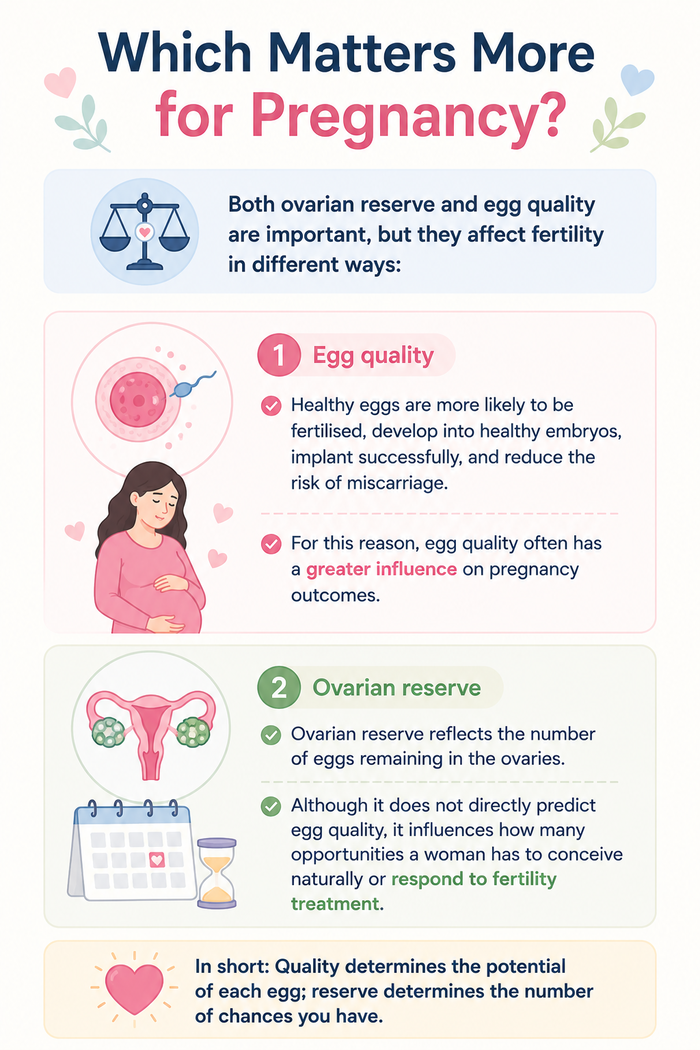
Which Matters More for Pregnancy?
Both ovarian reserve and egg quality are important, but they affect fertility in different ways:- Egg quality: Healthy eggs are more likely to be fertilised, develop into healthy embryos, implant successfully, and reduce the risk of miscarriage. For this reason, egg quality often has a greater influence on pregnancy outcomes.
- Ovarian reserve: Ovarian reserve reflects the number of eggs remaining in the ovaries. Although it does not directly predict egg quality, it influences how many opportunities a woman has to conceive naturally or respond to fertility treatment.
Can You Improve Ovarian Reserve or Egg Quality?
Although ovarian reserve and egg quality naturally decline with age, certain steps may help support your overall reproductive health. These include:Ovarian reserve
Ovarian reserve cannot usually be increased because women are born with a finite number of eggs. However, you can take steps to protect your remaining ovarian function.These include:
- Avoid smoking, as it may accelerate the decline in ovarian reserve
- Seek timely treatment for conditions that may affect the ovaries, when appropriate
- Discuss fertility preservation, such as egg freezing, if you are planning to delay pregnancy or face treatments that could affect fertility
Egg quality
Although age-related changes in egg quality cannot be reversed, healthy habits may help support your reproductive health.These include:
- Eat a balanced, nutrient-rich diet
- Maintain a healthy weight and stay physically active
- Manage medical conditions such as diabetes or thyroid disorders
- Avoid smoking and limit alcohol consumption
- Take prenatal vitamins or other supplements only as advised by your doctor
When Should You See a Fertility Specialist?
Consult a fertility specialist for a personalised evaluation in the following situations:- You are under 35 years and have been trying to conceive for 12 months without success
- You are 35 years or older and have been trying to conceive for 6 months without success
- Your fertility tests show low AMH or other abnormal results
- You have irregular or absent menstrual periods
- You have a history of ovarian surgery, endometriosis, chemotherapy, or recurrent pregnancy loss
You’re not alone in your journey when trying to conceive. Join our supportive community to connect with others, share experiences, and find encouragement every step of the way.
FAQs on Ovarian Reserve vs Egg Quality: What's the Difference?
- Is low AMH the same as poor egg quality?
No. A low AMH level indicates a reduced ovarian reserve, meaning fewer eggs remain in the ovaries. It does not measure egg quality. Many younger women with low AMH still have healthy eggs and can conceive naturally or with fertility treatment. - Which declines first: ovarian reserve or egg quality?
Both ovarian reserve and egg quality decline with age, but ovarian reserve often starts decreasing earlier. Egg quality also declines over time, especially after the mid-30s. However, the rate of decline varies from person to person and cannot be predicted by age alone. - Can IVF improve egg quality?
No. IVF cannot improve the quality of your eggs. Instead, it helps retrieve available eggs, fertilise them in the laboratory, and transfer an embryo into the uterus. The success of IVF still depends largely on the quality of the eggs used.