In this article:
To understand how sperm capacitation affects conception, whether problems with this process can affect fertility, and what couples should know when trying to get pregnant, we spoke with Dr Shyla Usman Ali, Fertility Specialist at Birla Fertility & IVF, Chennai.
Why Does Sperm Capacitation Matter When Trying to Conceive?
Sperm capacitation matters because sperm may reach the egg but still be unable to fertilise it if they have not undergone the necessary changes.For couples trying to conceive, capacitation is one of the many steps involved in natural fertilisation. However, it does not determine pregnancy chances on its own. Egg quality, sperm count, sperm movement, fallopian tube health and the timing of intercourse also play important roles.
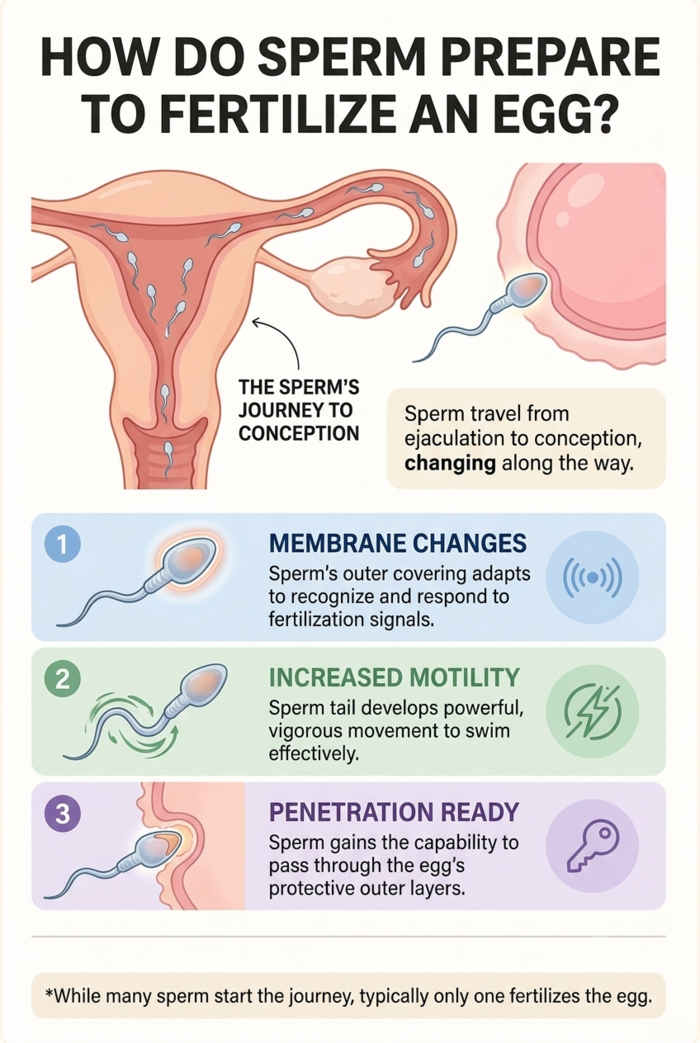
How Do Sperm Prepare to Fertilise an Egg?
After ejaculation, sperm travel through the cervix and uterus towards the fallopian tubes. During this journey, they undergo changes that prepare them for fertilisation.These changes include:
- Changes in the sperm's outer covering: The sperm membrane changes, allowing sperm to respond to fertilisation signals.
- Stronger movement: The sperm tail begins moving more vigorously, helping it move towards the egg.
- Preparation to penetrate the egg: Sperm become capable of undergoing the acrosome reaction, which helps them pass through the egg's protective outer layers.
Can Problems With Sperm Capacitation Affect Your Chances of Pregnancy?
Yes. If sperm do not undergo capacitation properly, they may be unable to fertilise an egg, even if they reach it.However, this does not mean that every couple experiencing difficulty conceiving has a problem with sperm capacitation. Other factors, such as low sperm count, poor motility, abnormal sperm function, egg-related concerns or blocked fallopian tubes, can also affect fertilisation.
Capacitation is an important step in natural fertilisation, but difficulty conceiving does not automatically indicate a problem with this process. A complete fertility assessment helps identify whether sperm-related or other reproductive factors may be affecting conception.
Can You Improve Sperm Capacitation Naturally?
There is currently no proven food, supplement or lifestyle change that directly improves sperm capacitation. It is a biological process that happens naturally inside the female reproductive tract.However, maintaining good overall sperm health can support male reproductive function.
Men trying to conceive can:
- Eat a balanced diet with fruits, vegetables, whole grains and adequate protein.
- Avoid smoking and recreational drugs.
- Limit alcohol consumption.
- Maintain a healthy weight and stay physically active.
- Get adequate sleep.
- Avoid frequent exposure to excessive heat around the testicles.
Does Sperm Capacitation Matter During IVF and ICSI?
Sperm capacitation is relevant to natural conception and conventional IVF, but its role differs across fertility treatments.- During conventional IVF: The fertility team prepares sperm in the laboratory and places them with the eggs. Sperm undergo capacitation under laboratory conditions before fertilisation.
- During ICSI: A single sperm is injected directly into the egg. This bypasses several natural steps, including the need for sperm to penetrate the egg's outer layers independently. However, sperm viability and the egg's ability to activate and develop remain important.
When Should You See a Doctor?
Consider consulting a fertility specialist if:- You have been trying to conceive for 12 months without success if you are under 35.
- You have been trying for six months without success if you are 35 or older.
- Your partner has an abnormal semen analysis.
- There is a known reproductive condition or previous fertility concern.
- You have experienced repeated unsuccessful fertility treatment.
FAQs on Sperm Capacitation: Does It Affect Your Chances of Getting Pregnant?
- Where does sperm capacitation occur?
It mainly occurs in the uterus and fallopian tubes as sperm travel towards the egg. - Is sperm capacitation the same as the acrosome reaction?
No. Capacitation prepares sperm for fertilisation, while the acrosome reaction helps sperm penetrate the egg's outer layer. - Can sperm capacitation be checked in a semen analysis?
No. A routine semen analysis checks sperm count, movement and shape, not capacitation.