In this article:
What Are Vacuoles in Human Oocytes?
Vacuoles are tiny, fluid-filled pockets that may sometimes be seen inside a human egg, also called an oocyte. They form within the inner part of the egg, called the cytoplasm, and are visible only under a microscope during IVF. Their size and number can vary from one egg to another, and fertility specialists assess them as part of the overall evaluation of egg quality.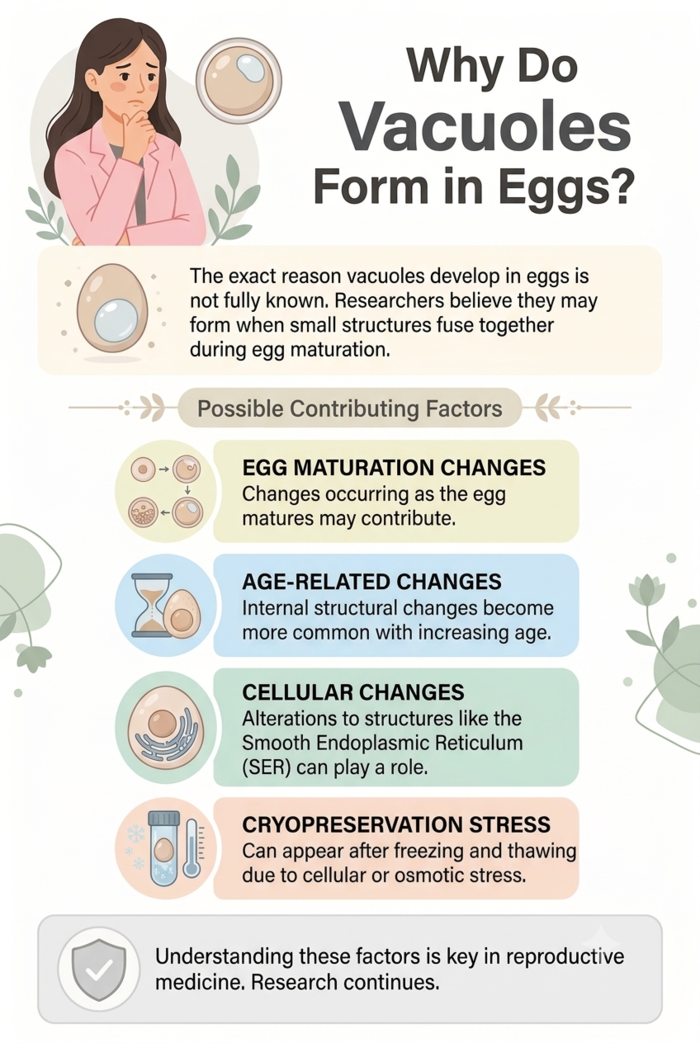
Why Do Vacuoles Form in Eggs?
The exact reason vacuoles develop in eggs is not fully known. Researchers believe they may form when small structures inside the egg, particularly smooth endoplasmic reticulum (SER) or Golgi-derived vesicles, fuse together during egg maturation.Some possible reasons include:
- Egg maturation: Changes that happen as an egg matures may contribute to vacuole formation.
- Age-related changes: Changes in the egg's internal structure may become more common with increasing age.
- Cellular changes: Changes in structures such as the smooth endoplasmic reticulum (SER) may play a role.
- Cryopreservation: Vacuoles can also appear after freezing and thawing because of cellular or osmotic stress.
Do Vacuoles Affect Fertilisation and Embryo Development?
Having a vacuole does not automatically mean an egg may have poor IVF results. The effect can vary depending on the vacuole's size, number, and other features of the egg.A study published in Fertility and Sterility looked at 223 IVF cycles and found that larger vacuoles were associated with differences in fertilisation, and embryos with vacuoles had lower blastocyst development rates.
However, a case report published in Reproductive BioMedicine Online found that human oocytes with large cytoplasmic vacuoles could still fertilise, develop into embryos and result in a viable birth
How Do Embryologists Assess Eggs With Vacuoles?
Embryologists look at the overall appearance of the egg, not just the vacuole. They may consider:- Size: How large the vacuole is
- Number: Whether there is one or several
- Location: Where it is inside the egg
- Egg maturity: Whether the egg is ready for fertilisation
- Other features: The overall appearance of the egg under the microscope
- Embryo development: How the egg performs after fertilisation
Does Having Vacuoles Reduce IVF Success Rates?
A vacuole does not automatically mean that IVF will be unsuccessful. Its presence is only one part of how an egg is assessed, and the final outcome depends on many other factors as well.“Successful IVF depends on multiple factors working together, including maternal age, ovarian reserve, sperm quality, embryo genetics, laboratory conditions, and endometrial receptivity. An egg containing a vacuole can still fertilise normally and develop into a healthy embryo, while a morphologically normal egg may not always result in pregnancy.”
- Dr Nayana D H, Consultant – IVF, Aster Women & Children, Bangalore
Can Vacuoles Be Prevented?
There is no proven way to prevent vacuoles from forming in eggs. Since their exact cause is not fully understood, there is also no specific treatment to stop them.If you want to support overall egg health and reduce avoidable factors during IVF, you can:
- Maintain healthy habits to support overall egg health
- Follow the recommended IVF treatment plan
- Take only supplements advised by your fertility specialist
- Go for regular IVF monitoring as advised
Whether you’re trying to conceive or navigating IVF, you’re not alone. Join our supportive communities to connect, share, and find strength with others on the same journey.
FAQs on Vacuoles in Human Oocytes: Do They Affect IVF Success?
- Can vacuoles disappear after the egg is fertilised?
No. Vacuoles observed inside the egg before fertilisation generally do not disappear. Instead, embryologists monitor how the embryo develops after fertilisation to determine whether the vacuoles appear to have affected its growth. - Are vacuoles common in all IVF cycles?
Small vacuoles may occasionally be seen during routine egg assessment, but they are not present in every IVF cycle. Their frequency varies depending on individual eggs and laboratory observations. - Do vacuoles affect frozen embryo success?
Current evidence focuses mainly on egg quality before fertilisation. Once a healthy embryo has developed and is suitable for freezing, its implantation potential depends on several factors beyond the original presence of vacuoles in the egg.