In this article:
What Is Thalassemia and Why Is Testing Important Before Pregnancy?
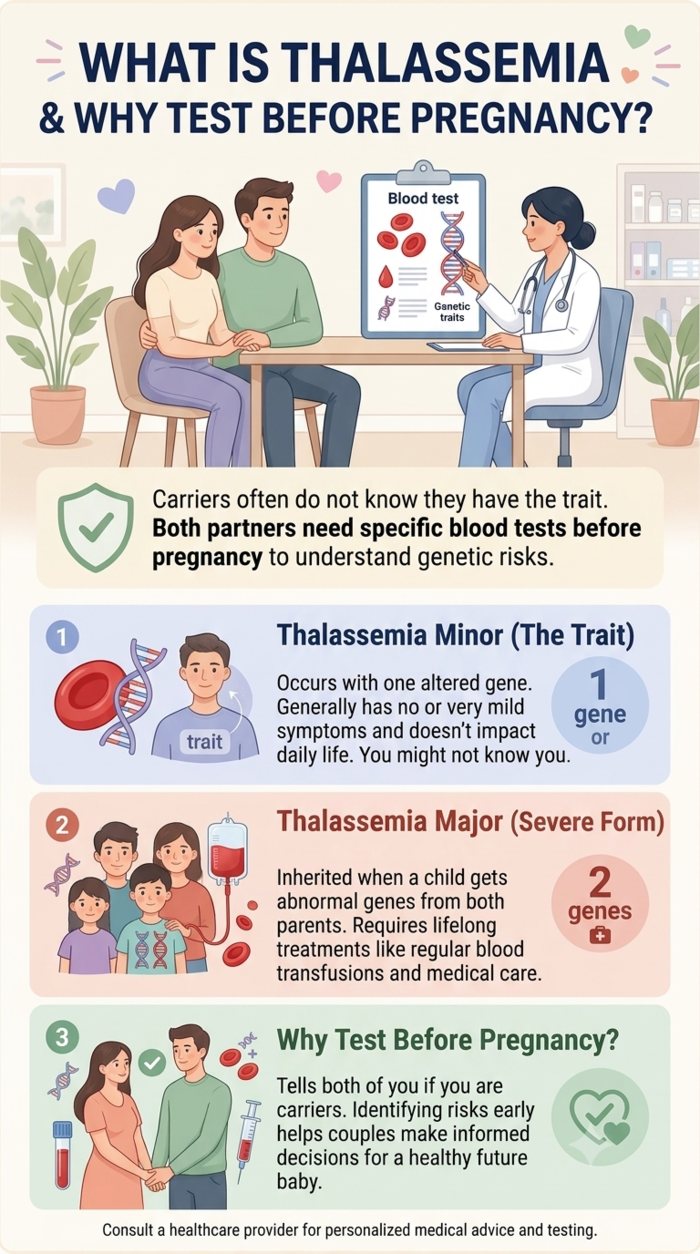
Thalassemia is a genetic disorder caused by abnormal formation of haemoglobin, the protein in red blood cells that carries oxygen throughout the body. They include:- Thalassemia Minor: With one altered gene, you will experience only mild symptoms. This is known as nontransfusion-dependent thalassemia. The absence of symptoms means that you can also be referred to as having beta-thalassemia trait or thalassemia minor. The condition itself doesn't generally impact daily life.
- Thalassemia Major: When a child inherits two abnormal genes, one from each parent. They are born with the severe form of the condition, which typically requires regular blood transfusions, iron chelation therapy and often a bone marrow transplant.
Inheritance of Thalassemia
Thalassemia follows an autosomal recessive inheritance pattern. The implications are:- If one parent is a carrier, the baby has a 50 % chance of being a carrier but will not have thalassemia major.
- If both parents are carriers, there is a 25 % chance the baby will have thalassemia major, a 50 % chance they will carry the trait, and a 25 % chance they will be completely healthy.
- If one parent suffers from thalassemia major and the other parent carries the thalassemia trait, there is a 50 % risk of the baby being born with thalassemia major.
Why Is Thalassemia Testing Particularly Important in India?
According to NHM, India has the highest incidence of cases of thalassemia major in the world, with an estimated 1 to 1.5 lakh cases and almost 42 million people being carriers of beta-thalassemia disease. 10,000 to 15,000 babies suffering from thalassemia major are born each year. It is not advisable to assume that your risk is negligible based on your region or family background, as a blood test can confirm this, and the risk of having a child with thalassemia major for a couple is significant.How to Screen It
The screening test for thalassemia is a quick, simple and relatively inexpensive blood test. The commonly used tests are:- Complete blood count (CBC).
- Haemoglobin Electrophoresis or HPLC (High-performance Liquid Chromatography).
- DNA testing.
What to Do if Both Partners Are Carriers
There is good news for carrier couples. There are several steps they can take if both partners carry the thalassemia trait. They are:- Prenatal diagnosis, such as chorionic villus sampling between 10 and 13 weeks of pregnancy or amniocentesis at 15 to 20 weeks, can be performed to determine the baby's condition.
- Preimplantation genetic testing, where embryos produced through IVF can be tested before being transferred back into the uterus.
- Natural conception followed by antenatal testing.
- Genetic counselling is a highly advisable procedure for childbearing couples.
When to Get Tested
Ideally, both partners should get tested before conception. Pre-pregnancy screening and carrier identification allow ample time for the couple to gather any information they need and for them to consider their options thoroughly. If screening has not been carried out before pregnancy, couples should arrange for it as soon as possible, ideally during their first trimesterThalassemia testing before conception is a simple but effective measure against preventable suffering. In the Indian context, with its high number of carriers, the test is crucial for all prospective parents regardless of geographical location or ethnic background. All partners must be screened for carriers; one clear negative report does not guarantee safety; talk to your doctor before planning your pregnancy.
FAQ on Why Both Partners Must Be Tested for Thalassemia Before Getting Pregnant
- Is Thalassemia screening part of the normal routine tests done during prenatal examinations?
Typically, only a basic screening test (complete blood count) is performed during routine checkups; MCV or MCH might flag abnormalities, but cannot fully confirm the trait. It is essential to ask the doctor explicitly for a thalassemia screening test (Haemoglobin Electrophoresis or HPLC). - Can the trait affect my health during pregnancy?
Carriers of the thalassemia trait may experience mild anaemia, which can be exacerbated due to pregnancy's higher nutritional needs. They must have their haemoglobin and iron levels checked regularly and only be given high iron supplements after confirming iron deficiency as the cause of anaemia. - Is there a cure for Thalassemia major?
There is currently no absolute treatment for thalassemia major, but patients have been able to enjoy quality lives through bone marrow transplantation and stem cell transplantation, though some patients cannot afford this treatment. Others rely on frequent blood transfusions and iron chelation.