In this article:
What Causes Engorgement While Breastfeeding?
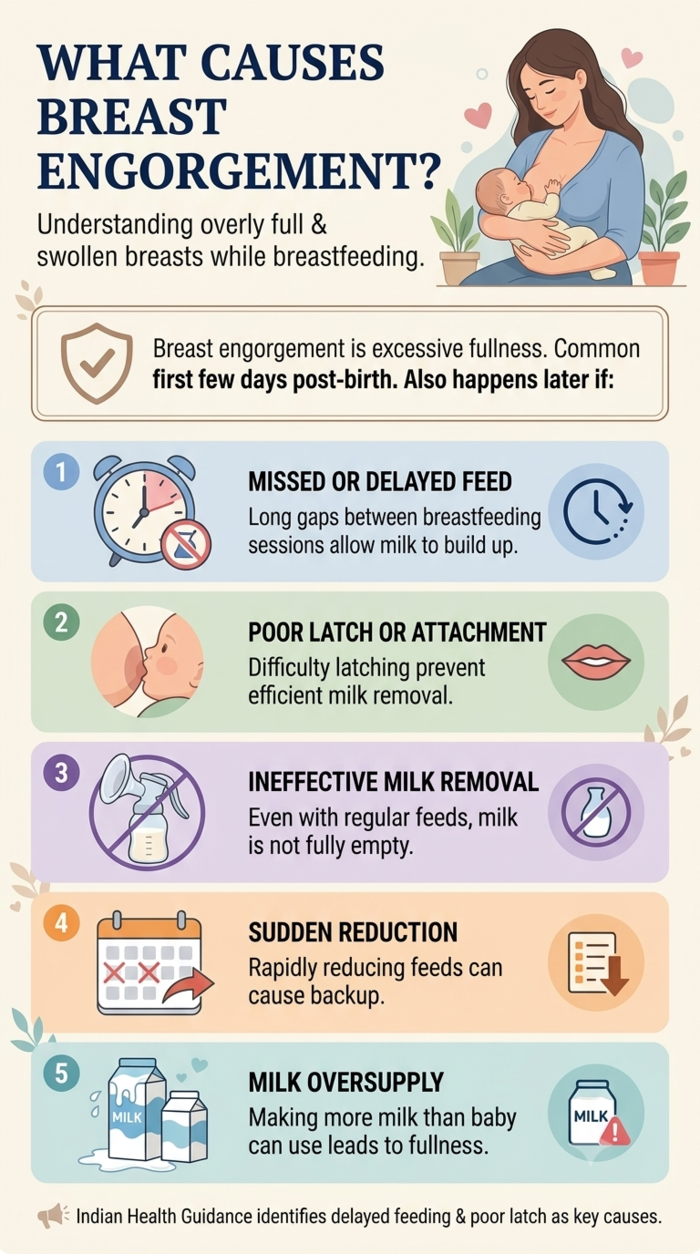
Breast engorgement happens when the breasts become excessively full and swollen. It is common in the first few days after birth as milk production increases and adjusts to the baby's needs.Engorgement may also happen later if:
- The baby misses or delays a feed
- There are long gaps between breastfeeding sessions
- The baby has difficulty latching
- Milk is not being removed effectively
- The mother suddenly reduces breastfeeding
- There is an oversupply of breast milk
How Does Breast Engorgement Lead to Mastitis?
Milk volume rises sharply between days 3 and 5 after birth. If milk is not removed often enough, breast tissue can become increasingly swollen and inflamed. Pressure and inflammation can make breastfeeding or milk expression more difficult, creating a cycle of swelling and poor milk removal.The breast can move through these stages:
- Engorgement: Both breasts feel full, firm, and swollen.
- Ductal narrowing: Swelling narrows the milk ducts and may cause a tender lump, often called a plugged duct.
- Inflammatory mastitis: An area of one breast becomes swollen, red, and painful.
- Bacterial mastitis: Bacteria multiply in stagnant milk or enter through a cracked nipple, causing fever and chills.
- Abscess: A pus-filled collection that forms when bacterial mastitis does not respond to treatment. This is uncommon.
A hospital study of postnatal mothers in India found mastitis in 5.1%. Among these mothers, 75% had engorgement, 44% had cracked nipples, and 32% had poor attachment of the baby to the breast. First-time mothers made up 57% and anaemic mothers 45%. Milk cultures grew Staphylococcus aureus (75%) and MRSA (25%), and 4.4% developed an abscess.
Although engorgement does not always lead to mastitis, persistent inflammation and ineffective milk removal can contribute to breast inflammation and, in some cases, infection. With timely support, most breastfeeding mothers can recover while continuing to feed their babies, if comfortable and medically appropriate.
Engorgement vs Mastitis: What Is the Difference?
| Feature | Engorgement | Mastitis |
| Breasts affected | Usually both | Usually one |
| Timing | Mostly days 3–5 after delivery; can occur later | Any time during breastfeeding |
| Pain | Generalised fullness and tenderness | Localised pain and tenderness |
| Skin | Tight and shiny, without a red patch | A red, warm, painful segment |
| Fever | None, or a slight rise | 100.4°F or higher, with chills and body aches |
| Course | Eases within 1–2 days with frequent feeding | Persists or worsens |
How to Relieve Breast Engorgement at Home and Prevent Mastitis
You can:- Feed often: Do not skip or space out feeds. If the baby cannot feed, express milk by hand or with a pump.
- Soften the areola: Expressing a little milk before a feed helps the baby latch deeply when the areola is tight.
- Check the latch: Ask the hospital nurse, a family member, or a lactation consultant to observe a feed.
- Cold compress: Use a cold compress between feeds to reduce swelling and discomfort.
- Avoid prolonged heat and deep massage: Hot-water bag application and firm oil massage are traditional postnatal practices in India. Prolonged heat can worsen swelling, and forceful kneading can injure inflamed tissue. Use light strokes towards the armpit if massaging.
- Treat cracked nipples early: Bacteria can enter the breast through skin breaks.
- Wear a comfortable, supportive bra: A tight bra or strap can press on part of the breast and slow milk flow from that area.
- Rest and stay hydrated: Rest helps your body recover, and drinking water whenever you're thirsty keeps you hydrated.
When Should You See a Doctor for Mastitis?
See a doctor if you have:- A temperature of 100.4°F or higher, chills, or flu-like symptoms lasting more than 24 hours despite frequent feeding
- A red, hot area that spreads or does not improve
- A soft, fluid-filled lump that may indicate an abscess
- Symptoms that keep returning in the same part of the breast
Whether you’re pregnant, a new mom, or navigating postpartum, you don’t have to do it alone. Join our support group to connect, share, and support one another.
FAQs on Can Breast Engorgement Turn Into Mastitis?
- Can I breastfeed if I have mastitis?
Yes. Feeding helps move milk; it doesn't harm the baby, and bacterial mastitis isn't contagious. - Can engorgement happen months after delivery?
Yes. It can occur at any stage of breastfeeding when the breast holds more milk than is removed, for example, after missed feeds.