In this article:
Why Does Brown Discharge Happen in Early Pregnancy?
The most common causes include:
Implantation bleeding
When a fertilised egg attaches to the lining of the uterus, it can cause a small amount of bleeding. This is called implantation bleeding, and it typically occurs 6 to 12 days after conception, around the time you would normally expect your period. According to the Cleveland Clinic, about 1 in 4 pregnant women experience implantation bleeding.The bleeding is light, lasts 1 to 3 days, and appears brown because it is slow-moving and old by the time it leaves the body. Many women mistake implantation bleeding for a light period and do not realise they are pregnant until weeks later.
Old blood from your previous period
Some blood from your last menstrual cycle can remain inside the uterus and pass out slowly in the early weeks of pregnancy. This is harmless and tends to resolve on its own within a day or two.Cervical sensitivity after sex or an internal examination
During pregnancy, the cervix receives a much larger blood supply than usual. This makes it more sensitive. Sexual intercourse or an internal examination (such as a transvaginal ultrasound) can cause minor irritation and a small amount of brown spotting. This usually stops within 24 hours and does not affect the pregnancy.Subchorionic haematoma
A subchorionic haematoma is a collection of blood between the placenta and the wall of the uterus. It is a common finding on first-trimester ultrasounds. As the blood slowly drains, it can appear as brown discharge over several days or weeks.Most subchorionic haematomas resolve on their own without treatment, and the majority of pregnancies with this finding go on to be healthy.
Hormonal changes and IVF medications
Women undergoing IVF or IUI cycles who take progesterone support medications (vaginal pessaries or injections, widely used in fertility clinics) may notice brown spotting throughout the first trimester. This is a known side effect of the medication and is not a sign of pregnancy loss.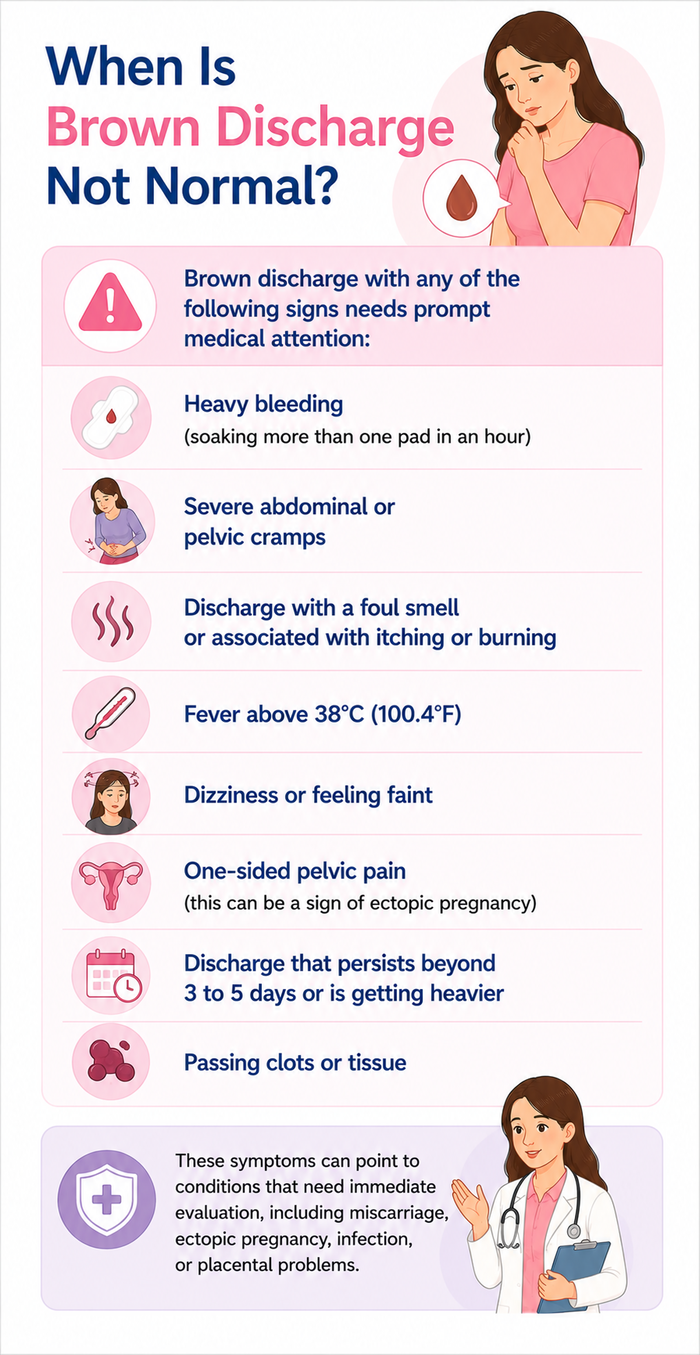
When Is Brown Discharge Not Normal?
Brown discharge with any of the following signs needs prompt medical attention:
- Heavy bleeding (soaking more than one pad in an hour)
- Severe abdominal or pelvic cramps
- Discharge with a foul smell or associated with itching or burning
- Fever above 38°C (100.4°F)
- Dizziness or feeling faint
- One-sided pelvic pain (this can be a sign of ectopic pregnancy)
- Discharge that persists beyond 3 to 5 days or is getting heavier
- Passing clots or tissue
These symptoms can point to conditions that need immediate evaluation, including miscarriage, ectopic pregnancy, infection, or placental problems.
Brown Discharge vs. Miscarriage: What Is the Difference?
Miscarriage does not typically begin with brown discharge alone. It usually progresses from brown spotting to red or bright bleeding, accompanied by worsening cramps.
Passing clots or tissue-like material is a more definitive sign. If you experience brown discharge without pain and without it getting heavier, the risk of miscarriage is low. However, any concerns should be checked by a doctor, as an ultrasound provides the clearest picture.
What to Do If You Notice Brown Discharge in Early Pregnancy?
Here are a few steps you can take:
- Do not panic. Brown spotting without other symptoms is rarely serious in early pregnancy.
- Note the amount, colour, and duration, which helps your doctor assess the situation quickly.
- Avoid sex and strenuous activity until you have spoken to your doctor.
- Contact your gynaecologist if the discharge lasts more than 3 days, increases in volume, turns red, or is accompanied by pain, fever, or dizziness.
- Go to an emergency room if you have severe pain, heavy bleeding, or feel faint.
Brown discharge in early pregnancy is usually old blood leaving the body and is not a cause for alarm on its own. Knowing what is normal, and recognising the signs that are not, helps you seek care at the right time and avoid unnecessary worry.
Whether you’re pregnant, a new mom, or navigating postpartum, you don’t have to do it alone. Join our support group to connect, share, and support one another.
FAQs on Is Brown Discharge in Early Pregnancy Normal?
- Can brown discharge be a sign of pregnancy?
For some women, brown spotting is the first sign that they are pregnant, occurring because of implantation bleeding before a positive pregnancy test is even taken. If you notice brown discharge around the time your period is due, it is worth taking a pregnancy test. - Does brown discharge mean I am having a miscarriage?
Not necessarily. Most early miscarriages involve bright red bleeding that becomes progressively heavier, often with cramps. Brown discharge alone, particularly if light and brief, is often a sign of implantation bleeding, cervical irritation, or old blood rather than a miscarriage. - How long does brown discharge last in early pregnancy?
In most cases, brown discharge related to implantation bleeding or cervical irritation lasts 1 to 3 days. Discharge from a subchorionic haematoma may last longer, sometimes several weeks, and should be monitored by your doctor via ultrasound.