In this article:
What Are the Major Types of Dystocia?
Doctors usually classify dystocia into three major categories called the “3 Ps” of labour dystocia.| Category of Dystocia | Related to | What May Happen |
| Power dystocia | Uterine contractions | Weak contractions |
| Passenger dystocia | The baby | Size, position, or presentation problems |
| Passage dystocia | Maternal pelvis or birth canal | Difficulty in the baby passing through the pelvis |
Power Dystocia
Power dystocia happens when uterine contractions are not strong, coordinated, or frequent enough to support normal progress of labour.Common Causes of Power Dystocia
- Weak uterine contractions
- Irregular contractions
- Maternal exhaustion
- Prolonged labour
- Overdistended uterus
- Dehydration
Signs Doctors May Observe
- Slow cervical dilation
- Delayed labour progression
- Reduced descent of the baby
- Long gaps between contractions
Possible Management
Doctors may:- Monitor labour closely
- Give IV fluids
- Recommend rest
- Use oxytocin to strengthen contractions
- Consider assisted delivery if needed
Passenger Dystocia
Passenger dystocia occurs when factors related to the baby make labour difficult.Common Types of Passenger Dystocia
| Subtype | Meaning |
| Foetal macrosomia | Baby is larger than average |
| Malpresentation | Baby presents in an abnormal position |
| Malposition | Baby’s head position makes delivery difficult |
| Shoulder dystocia | Baby’s shoulder becomes stuck after head delivery |
Foetal Macrosomia
This refers to a larger-than-average baby.It may increase the risk of:
- Difficult vaginal delivery
- Shoulder dystocia
- Birth injuries
- Emergency Caesarean section
Malpresentation
Malpresentation means the baby is not positioned head-first for delivery. Malpresentation can be of the following types:- Breech presentation
- Transverse lie
- Face presentation
- Brow presentation
Malposition
In malposition, the baby’s head is down but rotated abnormally, which may prolong labour and increase back pain during labour.Shoulder Dystocia
Shoulder dystocia occurs when the baby’s shoulder becomes trapped behind the maternal pelvic bone after the head is delivered.Possible Risk Factors
- Larger baby
- Diabetes during pregnancy
- Previous shoulder dystocia
- Assisted vaginal delivery
Shoulder dystocia may increase the risk of:
- Less supply of oxygen to the baby
- Nerve injuries
- Birth trauma
Passage Dystocia
Passage dystocia occurs when the maternal pelvis or soft tissues make labour progression difficult.Causes of Passage Dystocia
- Small or abnormally shaped pelvis
- Pelvic bone abnormalities
- Fibroids blocking the birth canal
- Soft tissue obstruction
What Problems May Occur
- Slow labour progression
- Obstructed labour
- Failure of the baby to descend
- Increased need for Caesarean delivery
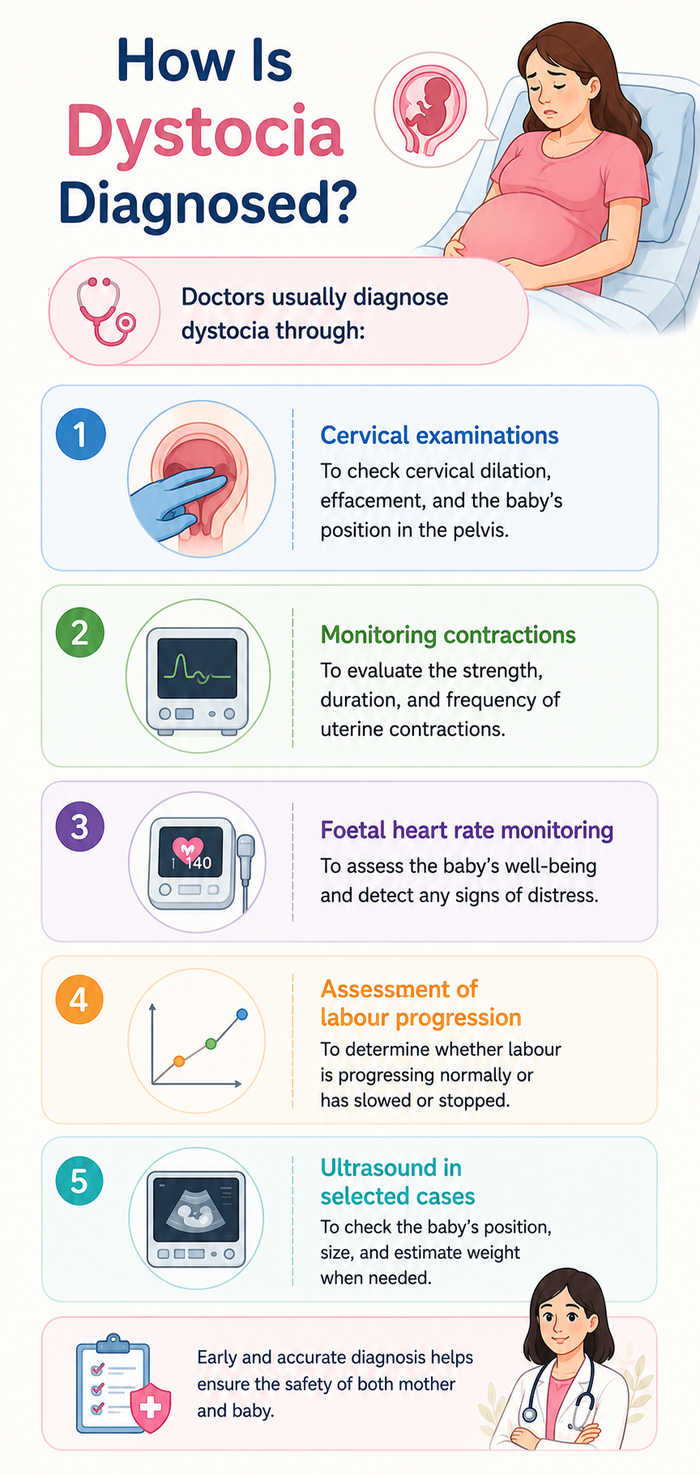
How Is Dystocia Diagnosed?
Doctors usually diagnose dystocia through:- Cervical examinations
- Monitoring contractions
- Foetal heart rate monitoring
- Assessment of labour progression
- Ultrasound in selected cases
Can Dystocia Be Managed Safely?
Many cases of dystocia can be managed safely with early monitoring and appropriate management.Management may include:
- Labour monitoring
- Oxytocin-assisted labour
- Position changes
- Assisted vaginal delivery
- Emergency Caesarean section when necessary
- The type of dystocia
- Maternal condition
- Baby’s condition
- Labour progression
When Should You Seek Immediate Medical Attention?
You should reach out to your doctor immediately if you notice:- Severe abdominal pain
- Reduced foetal movements
- Labour lasting unusually long
- Heavy bleeding
- Sudden weakness or dizziness
- Rupture of membranes without labour progression
Whether you’re pregnant, a new mom, or navigating postpartum, you don’t have to do it alone. Join our support group to connect, share, and support one another.
FAQs on What Is Dystocia? Understanding the Three Types of Difficult Labour
- Is dystocia common during labour?
Dystocia is one of the common causes of prolonged or difficult labour. However, many cases are managed successfully with medical support. - Is shoulder dystocia the same as dystocia?
No. Shoulder dystocia is one subtype of passenger dystocia. - Does dystocia always require Caesarean delivery?
No. Some cases improve with medical management. However, others may require assisted vaginal delivery or Caesarean section depending on labour progression.