
In this article:
Our experts explain why knowing about this approach can help you stay prepared and supported when the need for assisted labour arises.
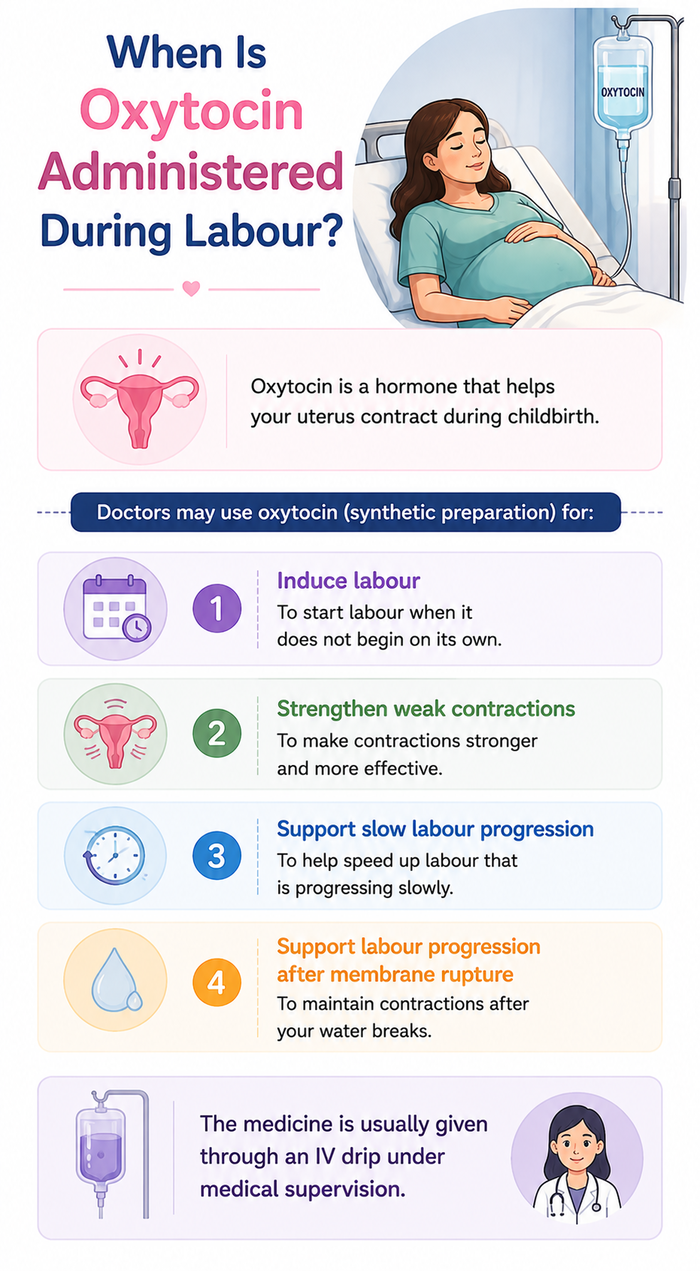
When Is Oxytocin Administered During Labour?
Oxytocin is a hormone that helps your uterus contract during childbirth.Doctors may use oxytocin (synthetic preparation) for the following purposes:
- Induce labour
- Strengthen weak contractions
- Support slow labour progression
- Support labour progression after membrane rupture
What Is The Significance of the 3-3-3 Rule for Oxytocin?
The 3-3-3 rule involves the close supervision of three major areas during oxytocin administration.| Monitoring aspect | What doctors check |
| Uterine contractions | Frequency, strength, and duration of contractions |
| Foetal heart rate | Signs of foetal stress due to poor oxygen availability |
| Maternal condition | Blood pressure, pulse, pain levels, and progression of labour |
Why Is Close Monitoring Necessary In Oxytocin-Assisted Labour?
Oxytocin may increase contraction intensity quickly. Therefore, careful observation is necessary during labour.Excessive uterine contractions may result in:
- Deficient supply of oxygen to the baby
- Abnormal foetal heart rate patterns
- Maternal exhaustion
- Increased labour complications
- Higher need for emergency interventions
How Doctors Monitor Labour During Oxytocin Use
Your doctor monitors the following parameters during oxytocin-assisted labour:Contraction Monitoring
Doctors monitor:
- Number of contractions
- Duration of each contraction
- Time gap between contractions
Foetal Heart Rate Monitoring
The baby’s heart rate is monitored continuously to detect the following:
- Heart rate drops
- Delayed recovery after contractions
- Signs of foetal distress
Maternal Assessment
Your healthcare team may also monitor:
- Blood pressure
- Pulse
- Pain levels
- Cervical dilation
- Overall labour progression
What Happens If Contractions Become Too Strong?
If contractions become excessively frequent or prolonged, doctors may:| Medical response | Purpose |
| Reduce oxytocin dose | Slow down the excessive contractions |
| Stop oxytocin temporarily | Allow the uterus to relax |
| Change your position | Improve blood flow to the baby |
| Continue foetal monitoring | Assess the baby’s condition closely |
| Give IV fluids | Support circulation and hydration |
When Is Extra Caution Needed With Oxytocin?
Doctors may use oxytocin with extra caution if you have a history of the following:- Previous Caesarean section
- Multiple pregnancy
- Certain placental conditions
- High-risk pregnancy
- Signs of foetal distress before labour
Whether you’re pregnant, a new mom, or navigating postpartum, you don’t have to do it alone. Join our support group to connect, share, and support one another.
FAQs on What Is the 3-3-3 Rule for Oxytocin? Explained for New Moms
- Is the 3-3-3 rule used during every induced labour?
It is mainly used when oxytocin is given to induce or strengthen labour contractions. - Can oxytocin affect the baby’s oxygen supply?
Excessively strong or frequent contractions may temporarily reduce oxygen flow to the baby. Therefore, it becomes crucial to monitor the process. - Is oxytocin labour always painful?
The intensity of labour pain varies among individuals. However, stronger contractions caused by oxytocin may increase pain intensity in some cases.