In this article:
Why Does Your Belly Feel Hard?
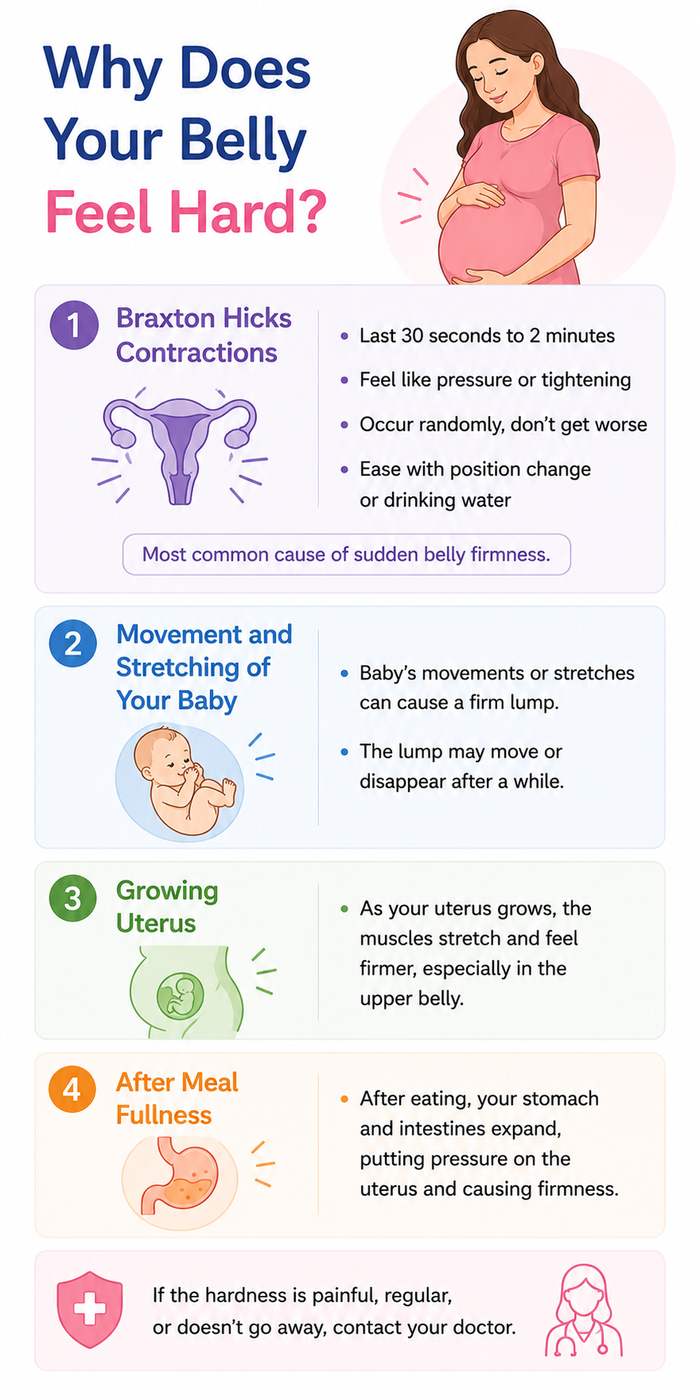
Braxton Hicks ContractionsBraxton Hicks contractions are contractions that your uterus undergoes starting from around 20 weeks. When the muscles of your uterus contract during Braxton Hicks contractions, your whole stomach area becomes firm. Braxton Hicks contractions generally:
- Occur for 30 seconds to two minutes
- Give you the feeling of pressure or tightening in your belly area
- Occur randomly and do not become more severe with time
- Disappear when you change your position or when you drink water
Movement And Stretching Of Your Baby
When your baby extends its limbs, there will be a firmness on your abdomen for a few seconds, which eventually softens down after your baby takes a rest. Here are the signs:
- A firm lump at a particular location that may move around or disappear
- A firm belly due to the movement of your baby
As your uterus expands due to the growth of your baby, the muscles of the uterus become more noticeable and firmer to the touch on the outside. This is why you begin to notice that the upper part of your abdomen feels firmer throughout your pregnancy, simply because the uterus is expanding.
After Meal Fullness
Once you have eaten, your stomach and intestines expand as they process the food that you have eaten. This will then put pressure on the uterus, causing the abdomen to feel tight and firm.
Why Does Your Belly Feel Soft?
When Baby Starts to Move Away From The FrontIf your baby moves to another position in your belly, moving towards your back or to either side, your belly will start feeling softer as there will be no limbs or the back of your baby pressing against your belly anymore.
When Muscles are Relaxed
Relaxin hormone, secreted by your body during pregnancy, will loosen all ligaments and muscles in your abdomen and pelvic area. If your abdominal muscles are completely relaxed, then your belly will be soft automatically, especially when you are lying down.
When You Have an Empty Bladder
A full bladder causes your belly to become firm in the lower area. When you relieve yourself of a full bladder, the firmness disappears, and your lower belly becomes softer than before.
In Early Pregnancy
When your pregnancy has just started, your uterus is relatively small and stays in the lower part of your pelvis. It does not cause much firmness yet; thus, your belly remains soft during this period of time.
When to Contact Your Doctor?
Contact your doctor if:- Your pregnancy is less than 37 weeks, and you feel tightening sensations that differ from Braxton Hicks.
- You experience decreased fetal movement with hardening of the abdomen.
- You have pain, pressure, and bleeding with hardening of the abdomen.
- You are not sure whether the sensations that you are feeling are Braxton Hicks or contractions.
Whether you’re pregnant, a new mom, or navigating postpartum, you don’t have to do it alone. Join our support group to connect, share, and support one another.
FAQs on Why Does Your Pregnant Belly Feel Hard Sometimes and Soft at Other Times?
- How can you differentiate between Braxton-Hicks and actual contractions?
Braxton Hicks contractions are irregular and ease with movement or hydration. Real labour contractions are regular, grow stronger and longer, and do not ease with rest or hydration. If you experience contractions before 37 weeks, contact your doctor immediately. - Does having a hard stomach in pregnancy indicate any problem?
No, in almost all cases. Having a hard stomach in pregnancy is normal due to Braxton-Hicks contractions, baby movements, a full bladder, or a growing uterus. But a continuous hard belly, the presence of pain and bleeding, and rhythmic contractions before 37 weeks of pregnancy require an immediate visit to your doctor. - What can you do if your hard belly is causing you pain?
If you experience a hard belly with sharp pain, pain that is unbearable, or pain that persists despite changes in position, you should see a healthcare practitioner. While a hard belly can be nothing to worry about, experiencing pain with it needs to be evaluated.