
Dr Amritha Shetty, Consultant, Obstetrics and Gynaecology, MBBS, DGO, DNB (Obstetrics and Gynaecology), Birthright by Rainbow Children’s Hospital, mentions 5 common myths surrounding IUI and the facts couples should be aware of.
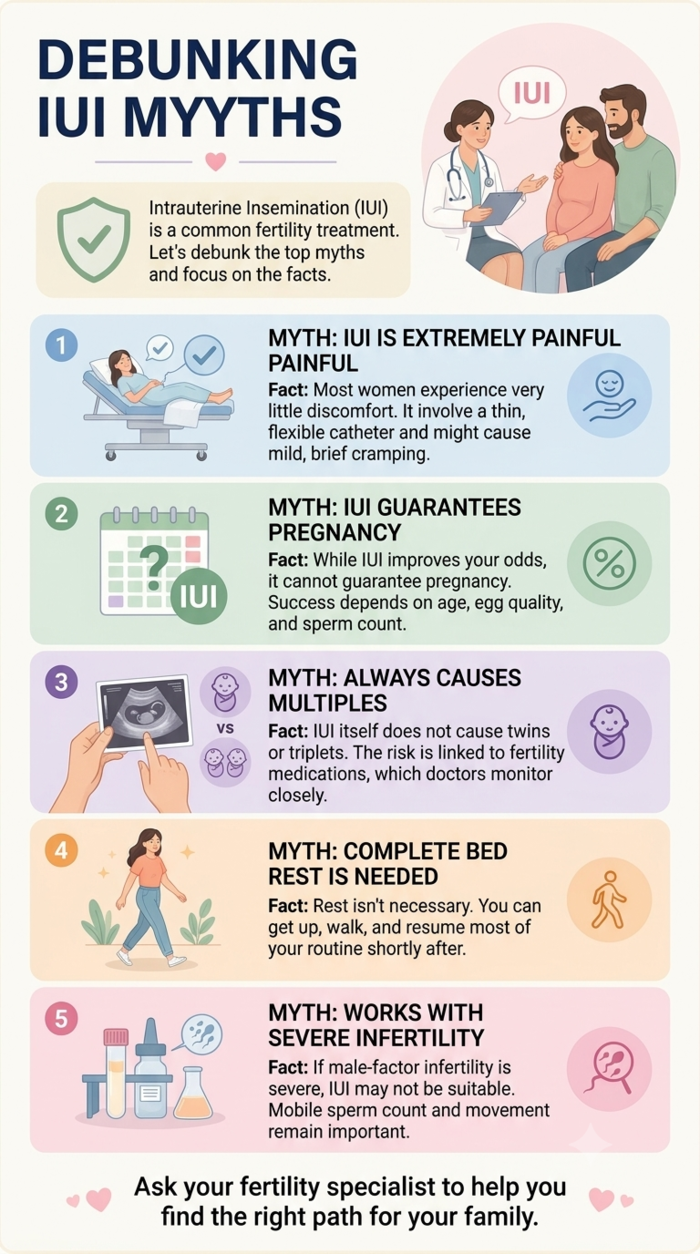
Myth 1: IUI is an Extremely Painful Procedure
Fact: Most women experience little discomfort during IUI. The procedure involves inserting a thin, flexible catheter through the cervix to place specially prepared sperm directly into the uterus. Some women may experience mild cramping, similar to menstrual cramps, during or shortly after the procedure.IUI is generally quick and does not usually require anaesthesia. However, individual experiences may vary depending on cervical sensitivity and other factors. Dr Amritha Shetty explains that most women can resume their usual activities shortly after the procedure.
Myth 2: IUI Guarantees Pregnancy
Fact: IUI can improve the chances of conception in suitable couples, but it does not guarantee pregnancy. Success depends on several factors, including the woman's age, ovulation, ovarian reserve, sperm quality and the underlying cause of infertility.The use of fertility medications and the number of mature eggs developing during a cycle may also influence the outcome. Some couples conceive during their first attempt, while others may need multiple cycles. If pregnancy does not occur after a suitable number of attempts, the fertility specialist may reassess the treatment plan and discuss alternatives such as in vitro fertilisation (IVF).
Careful monitoring of ovarian stimulation is essential to reduce the risk of multiple pregnancies and ensure safer fertility treatment.
Myth 3: IUI Always Causes Twins or Triplets
Fact: IUI itself does not cause multiple pregnancies. The risk mainly increases when fertility medications stimulate the ovaries to develop more than one mature egg. If multiple eggs are fertilised, twins or, occasionally, higher-order pregnancies may occur.To minimise this risk, fertility specialists monitor follicular development through ultrasound scans and adjust medication doses when necessary. A cycle may sometimes be cancelled if too many mature follicles develop.
Myth 4: Complete Bed Rest is Necessary After IUI
Fact: Prolonged bed rest is not necessary after an IUI procedure. Most women can get up, walk and return to their regular daily activities shortly afterwards. Resting briefly at the clinic may be advised, but lying down for several hours or days has not been shown to improve pregnancy rates.Women can generally continue routine activities, including light exercise, unless their doctor recommends otherwise. Following prescribed medications and attending scheduled appointments are more important than restricting normal movement.
Myth 5: IUI Works Even When Sperm Quality is Severely Compromised
Fact: IUI may not be suitable for couples with severe male-factor infertility. During the procedure, the semen sample is processed in a laboratory to separate mobile sperm from seminal fluid and other components. The selected sperm are then placed inside the uterus, closer to the fallopian tubes.However, sperm production cannot correct severe abnormalities or compensate for very low sperm numbers and poor motility. Adequate post-wash sperm count and movement are important for treatment success. Depending on the semen analysis, the specialist may recommend further investigations or treatments such as IVF with intracytoplasmic sperm injection (ICSI).
Who is a Suitable Candidate for IUI?
Couples who experience unexplained infertility challenges as well as minor male infertility cases might be advised to opt for IUI treatment. IUI is also thought to be a good option in cases of cervical fertility issues or ovulatory dysfunction that can be treated using medication. Furthermore, IUI might be an option for couples that rely on donor sperm in their family planning initiative.However, women suffering from blocked tubes or certain serious reproductive conditions might require another fertility approach. Because of this, it is essential to carefully review ovulation, latency of the fallopian tubes, and fertility test results in order to decide on the best treatment option available.
While IUI can be an effective initial option for couples battling different types of infertility issues, it is also very important to be aware of what it can and cannot do. It cannot ensure pregnancy, and its effectiveness may vary depending on the specific reproductive condition in a couple. Couples who are experiencing infertility should avoid depending on unverified claims available on the internet and, instead, seek an accurate assessment of their reproductive ability.
FAQs on 5 Common Myths About IUI Treatment Debunked
- What is the maximum number of IUI cycles that a couple can go through before IVF?
Most specialists recommend 3 to 6 IUI cycles before considering IVF, depending on the age, fertility diagnosis, treatment response, and individual circumstances. - When to take a pregnancy test after IUI?
A pregnancy test is generally recommended 14 days after IUI to obtain a reliable result and avoid false positives from fertility medications. - How long does an IUI procedure take?
An IUI procedure typically takes 10 to 15 minutes. It is minimally invasive, usually painless or mildly uncomfortable, and does not require hospital admission.