
In this article:
What Is Bombay Blood Group and How Is It Different From O?
Every red cell carries the H antigen, the basic structure needed to form the A and B antigens of the ABO blood group system. In the Bombay (hh) phenotype, H is absent, so A and B cannot form either. The red cells carry none of the three antigens.On routine ABO testing, Bombay blood can appear similar to group O. However, there is an important difference: ordinary group O blood contains H antigen, whereas Bombay blood does not. People with the Bombay phenotype usually have anti-H, anti-A, and anti-B antibodies in their blood.
Dr Bhende identified it in Mumbai (then Bombay) in 1952. The condition is inherited (both parents carry the hidden gene, usually without knowing) and is particularly relevant in India because the Bombay phenotype is more frequently reported in South Asian populations than in many other parts of the world. Estimates in India are around 1 in 10,000 people, although the frequency varies between populations.
Is Bombay Blood Group Dangerous in Pregnancy?
Having the Bombay blood group does not usually cause health problems by itself. The main concern during pregnancy is blood transfusion preparedness. Case reports describe uneventful pregnancies and deliveries.Pregnancy and childbirth can sometimes involve significant bleeding. If a woman with the Bombay phenotype needs a red blood cell transfusion, standard O blood cannot be used because O red blood cells contain H antigen. Exposure to H antigen can cause a potentially severe haemolytic transfusion reaction because of anti-H antibodies.
Can Bombay Blood Group Cause Problems for the Baby?
The mother's anti-H antibodies raise a theoretical concern about haemolytic disease of the foetus and newborn (HDFN), in which maternal antibodies cross the placenta and affect foetal red blood cells.However, reported cases suggest that HDFN caused by maternal anti-H is very rare. Published pregnancy cases have included women with high anti-H antibody levels whose babies did not develop HDFN.
Anti-A or anti-B antibodies from the mother can add to the effect if the baby’s group is A or B. After birth, the baby is checked for anaemia and jaundice.
The Bombay blood group does not automatically make a pregnancy high-risk. The main concern is ensuring that compatible blood is available if a transfusion becomes necessary. Early identification, careful planning, and coordination between obstetricians and blood banks can help reduce delays and improve safety for both mother and baby.
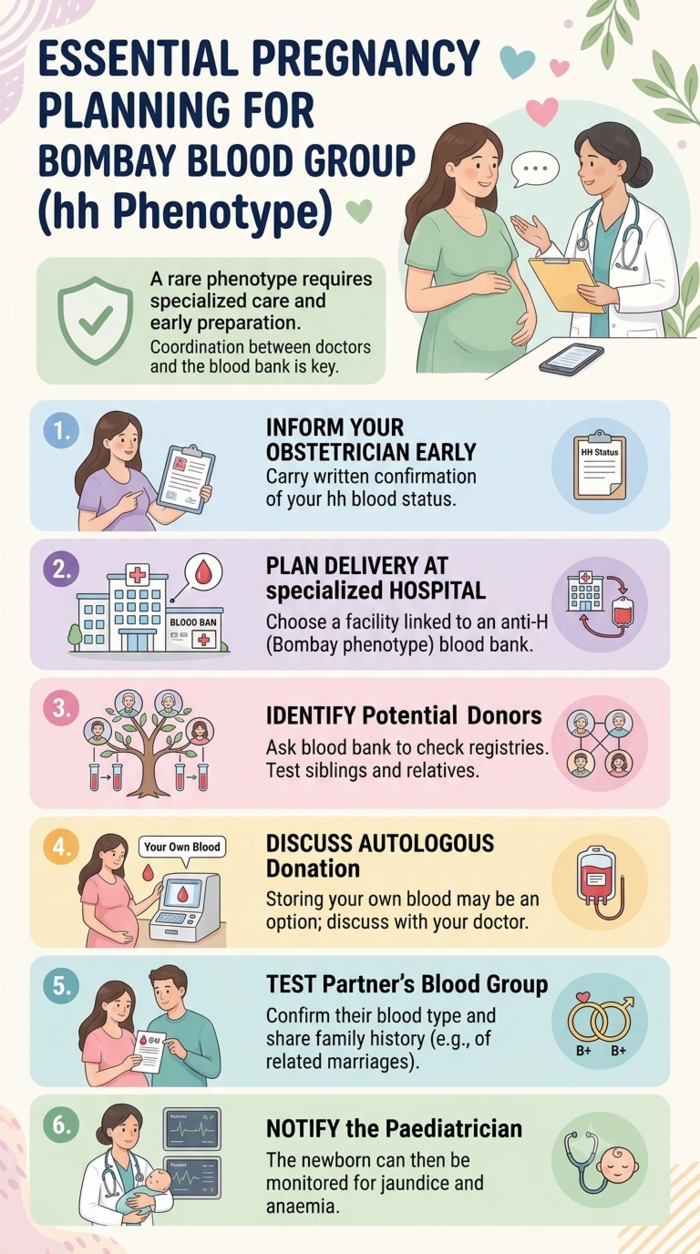
What Should a Pregnant Woman With Bombay Blood Group Do?
If you have been diagnosed with the Bombay phenotype, follow the steps below:- Tell the obstetrician early: Carry the written confirmation of hh status.
- Plan delivery at a hospital linked to a blood bank: Reports advise units that can obtain Bombay (anti-H) blood.
- Ask the blood bank about donors: Blood banks keep contact records of Bombay donors. Siblings and close relatives can be tested.
- Discuss autologous donation: Storing her own blood has been reported during pregnancy. The doctor decides if it suits her.
- Test the partner’s blood group: Tell the doctor about your partner’s blood group and any family history of Bombay blood group or marriage between relatives.
- Inform the paediatrician: The newborn can then be monitored for anaemia and jaundice.
Whether you’re pregnant, a new mom, or navigating postpartum, you don’t have to do it alone. Join our support group to connect, share, and support one another.
FAQs on Bombay Blood Group (hh): Why It Matters in Pregnancy
- Is Bombay blood group the same as O negative?
No. O negative has H antigen and lacks the Rh factor. Bombay lacks H, A, and B antigens, and Rh is typed separately. - Can a woman with Bombay blood group have a normal pregnancy?
Yes. Several reports describe uneventful pregnancies and deliveries. - Will my baby have Bombay blood group?
Only if the father also carries the hidden gene. If he does not, the baby carries one copy and has a normal blood group.