In this article:
What Can Pregnancy Scans Show About the Babys Brain?
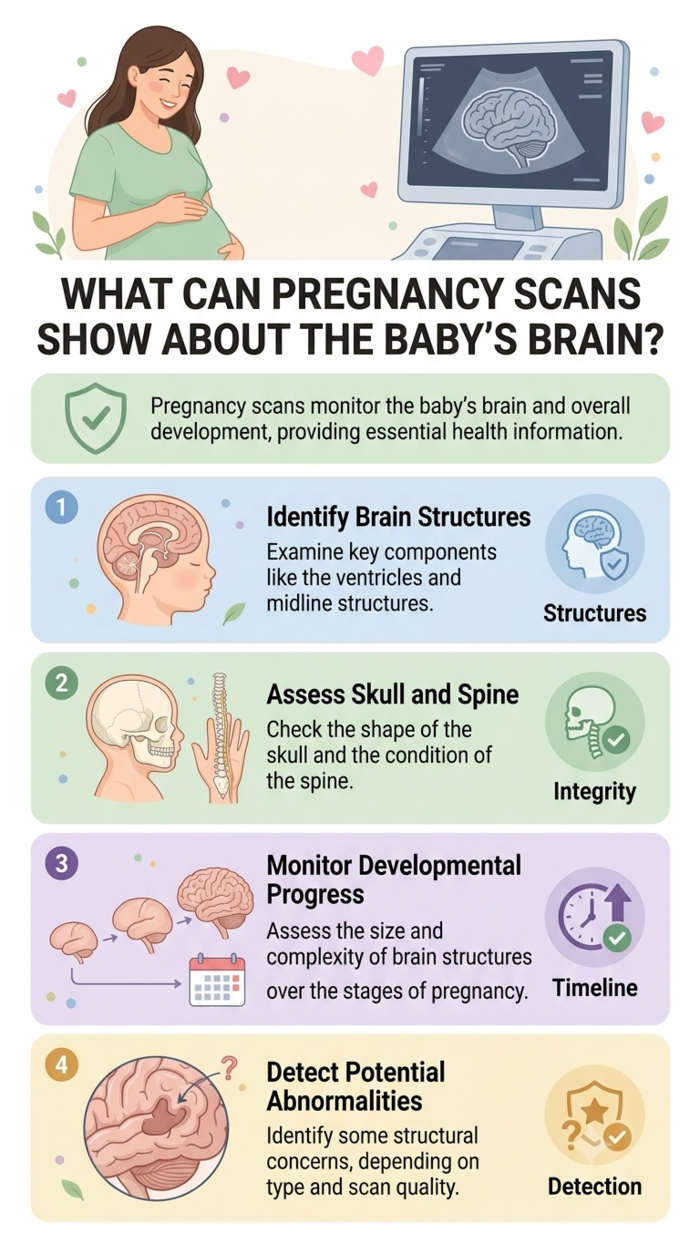
Pregnancy scans help doctors monitor the baby's brain and overall development. During these examinations, doctors assess:- Brain structures: The brain, ventricles (fluid-filled spaces), midline structures and their overall appearance are examined
- Skull and spine: Ultrasound also checks the skull, spine and other organs for structural concerns
- Developmental changes: Brain structures are assessed according to the stage of pregnancy
- Detection: Some abnormalities can be identified, depending on their type, severity, timing, and image quality
Prenatal scans can identify many brain abnormalities, but they cannot detect every condition. Some problems may become clearer only after birth and developmental care.
What is the Role of the 18-22-Week Anomaly Scan?
The 18- to 20-week anomaly scans, which are also known as detailed anomaly scans or TIFFA (Targeted Imaging for Foetal Anomalies) scans, are an essential part of prenatal assessment. This scan may detect:- Abnormalities in brain ventricles
- Neural tube defects
- Various brain growth abnormalities
- Abnormal skull and brain
- Alterations in the appearance of some brain structures
Can Some Brain Abnormalities Develop Later?
There are certain brain abnormalities in a foetus that may either arise as development takes place, or they may also become clear in later scans even though earlier scans show normal results. This means that having a normal TIFFA scan will not rule out all possible brain issues. If risk exists or any new problem appears, it is possible that another scan will be carried out. Following up at appropriate intervals has to be done throughout pregnancy for foetal monitoring.What is Foetal Neurosonography Recommended?
Foetal neurosonography is a more detailed ultrasound examination focused specifically on the developing brain and central nervous system. It allows a foetal medicine specialist to examine brain structures in greater detail than a routine pregnancy scan.It may be advised when there is:
- An unusual finding on the routine anomaly scans
- A suspected brain or spinal abnormality
- A concern about brain development
- A relevant family or pregnancy history
- A need for more detailed assessment following an ultrasound finding
When May Foetal MRI be Needed?
In some situations, foetal MRI (magnetic resonance imaging) may provide additional information. It can offer detailed images of the foetal brain and may be particularly useful when ultrasound findings are difficult to interpret or when a specific brain abnormality needs further assessment.Foetal MRI is not required for every pregnancy. It is generally considered when the treating team believes that the additional information may help with diagnosis, counselling, or planning care.
Can All Types of Foetal Brain Impairment be Detected Before Birth?
Pregnancy scans are particularly useful for identifying structural abnormalities, but not every condition that affects brain function causes visible structural changes during pregnancy. Some neurological or developmental conditions may not become apparent until after birth. In some cases, concerns may only emerge when a child develops and reaches specific milestones involving movement, communication, learning, or other abilities.What Happens if a Scan Shows a Possible Brain Abnormality?
An abnormal or uncertain scan finding does not necessarily provide a final diagnosis. The next step usually depends on what has been identified. Doctors may recommend a repeat ultrasound, foetal neurosonography or foetal MRI. Additional consultations may also be suggested to help parents understand the finding and its possible implications.Dr Swati Vyas emphasises the importance of detailed evaluation because some findings may change as pregnancy progresses. Parents may also receive counselling about available investigations, expected monitoring, and possible care after delivery.
The healthcare team may involve specialists from foetal medicine, neonatology, paediatrics or paediatric neurology depending on the suspected condition.
While many scans in foetal brain development can be identified through pregnancy scans, some conservative methods are ineffective when it comes to the diagnosis of other disorders. In those cases, regular monitoring of the baby and conducting necessary tests should be carried out. If any problems are detected, additional assessment through foetal neurosonography needs to be conducted.
Whether you’re pregnant, a new mom, or navigating postpartum, you don’t have to do it alone. Join our support group to connect, share, and support one another.
FAQs on Can Foetal Brain Impairment Be Detected During Pregnancy Scans?
- Do maternal health issues have an impact on the brain development of the baby?
Maternal health issues during pregnancy can affect the baby's brain development. Conditions such as infections, diabetes, high blood pressure, nutritional deficiencies, and certain medications may influence foetal growth and neurological development. - Do abnormal scan results automatically suggest the baby has a disability?
No, abnormal scan results do not automatically mean the baby has a disability. Some findings may be temporary or require further evaluation, follow-up scans, or specialised testing for clarification. - Is it advisable to perform genetic testing after finding a brain anomaly on an ultrasound?
Genetic testing may be recommended after a foetal brain anomaly is detected, depending on the finding and other risk factors. Doctors may suggest further scans, counselling, or diagnostic testing.