
In this article:
However, the risk of this happening increases significantly when conceived through fertility procedures such as in vitro fertilisation (IVF), intrauterine insemination (IUI), and others. However, the danger lies within the ectopic pregnancy as it may cause the fallopian tube to rupture, leading to major internal haemorrhage.
Why Does This Happen More Often?
Some reasons for heterotopic pregnancy include:
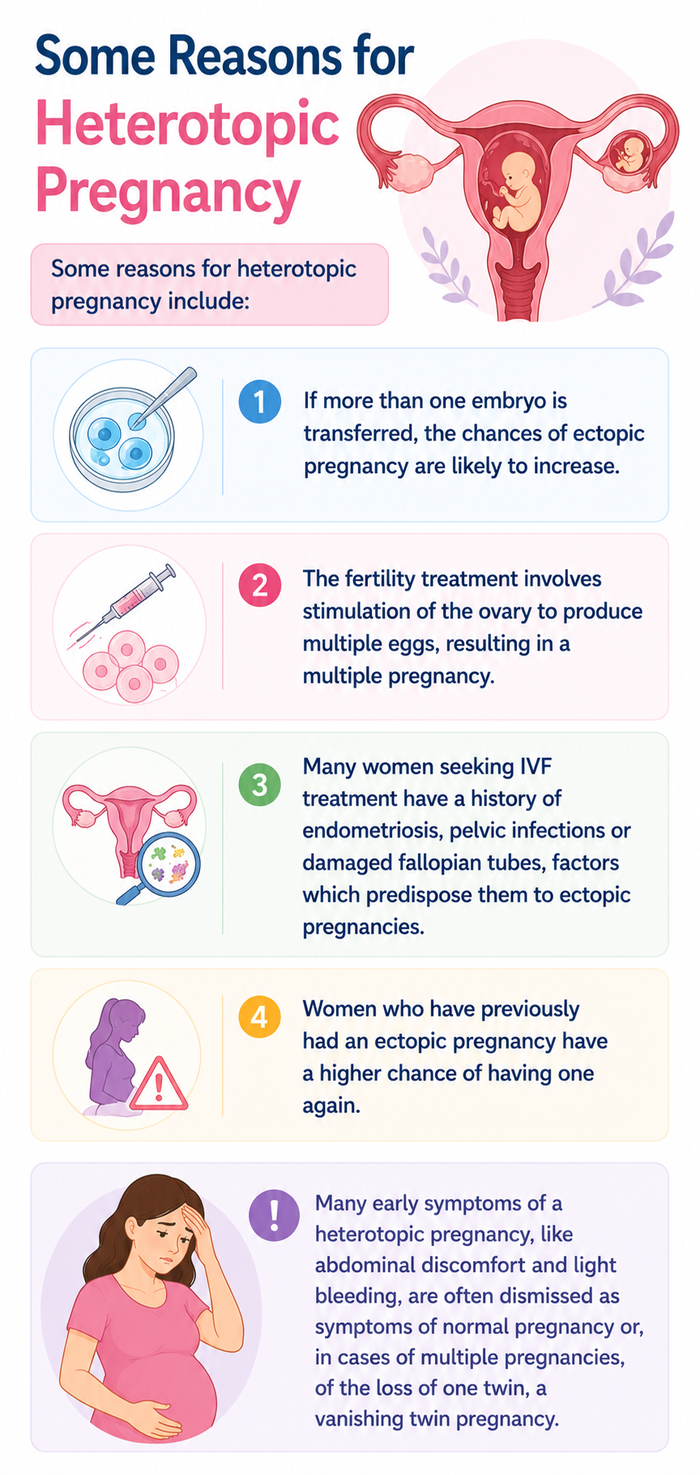
- If more than one embryo is transferred, the chances of ectopic pregnancy are likely to increase.
- The fertility treatment involves stimulation of the ovary to produce multiple eggs, resulting in a multiple pregnancy.
- Many women seeking IVF treatment have a history of endometriosis, pelvic infections or damaged fallopian tubes, factors which predispose them to ectopic pregnancies.
- Women who have previously had an ectopic pregnancy have a higher chance of having one again.
Many early symptoms of a heterotopic pregnancy, like abdominal discomfort and light bleeding, are often dismissed as symptoms of normal pregnancy or, in cases of multiple pregnancies, of the loss of one twin, a vanishing twin pregnancy.
How Are Heterotopic Pregnancies Often Missed?
A recent case from Manipal Hospital is an example of how this complication can go undiagnosed. A woman who underwent IUI was diagnosed with a twin pregnancy, one pregnancy sac appearing non-viable and not progressing. Later, with severe abdominal pain and vaginal bleeding, she reported to the emergency room. An emergency scan confirmed an intrauterine pregnancy as well as significant internal bleeding caused by a ruptured tubal ectopic pregnancy.
This woman underwent laparoscopic surgery during which her ectopic pregnancy was aborted without affecting her intrauterine pregnancy. This case emphasises that sometimes, despite having a good intrauterine pregnancy, the patient is suffering from an ectopic pregnancy, which may rupture to become dangerous in some cases. These types of cases are becoming common all across India because of the growing number of fertility treatments.
When Should These Symptoms Be Taken Seriously?
Sometimes, even if an intrauterine pregnancy is confirmed, women who have been on IVF or IUI should take the following symptoms seriously:
- Severe pain in the abdomen.
- Vaginal spotting or bleeding along with abdominal pain.
- Shoulder tip pain, a possible symptom of internal bleeding irritating the diaphragm.
- Sudden dizziness, fainting or weakness.
- Rapidly worsening abdominal bloating.
Any one of these signs, when occurring in a woman who is undergoing or has recently undergone assisted conception, should warrant an immediate trip to the emergency room for an ultrasound rather than waiting to see if symptoms improve.
Diagnosis and Treatment of Heterotopic Pregnancy
While a routine early pregnancy scan may confirm an intrauterine pregnancy, it may not detect a small ectopic sac, especially if it is not the focal point of the examination. In the presence of the above warning signs, a more comprehensive ultrasound specifically looking for free fluid within the abdomen (indicating bleeding) and the presence of both intrauterine and extrauterine gestational sacs is required.
Treatment options will depend on the stage at which the heterotopic pregnancy is discovered:
- Surgical Treatment: Laparoscopic surgery is the most common method for removing the ectopic pregnancy, typically by removing the affected fallopian tube while keeping the intrauterine pregnancy intact.
- Medical Treatment: This treatment cannot be used in heterotopic pregnancies when an intrauterine pregnancy is present, as it can harm the foetus.
- Expectant Management: This is reserved for rare and selected cases with no rupture and positive signs of natural resolution under close medical supervision.
The early detection and management of this condition are very important to save the intrauterine pregnancy and ensure the safety of the woman.
Although heterotopic pregnancy is an uncommon occurrence, it has become more frequent because of the increasing use of IVF and IUI procedures. Women who get pregnant using these procedures need to know that having an intrauterine pregnancy does not exclude the possibility of ectopic pregnancy. Prompt diagnosis and treatment of heterotopic pregnancy are essential for saving the mother's life and potentially saving her intrauterine pregnancy.
Whether you’re pregnant, a new mom, or navigating postpartum, you don’t have to do it alone. Join our support group to connect, share, and support one another.
FAQs on What Is a Heterotopic Pregnancy After IVF? A Rare but Serious Condition Explained
- Can a heterotopic pregnancy be detected on a routine early scan?
It is possible that this might not be true since the purpose of an early pregnancy scan is to confirm the intrauterine pregnancy, which means that there might be no ectopic sac that shows up in the scan because it is too small to be seen. - Can an intrauterine pregnancy survive after heterotopic pregnancy treatment?
Yes, as long as the treatment is done effectively and in time, the intrauterine pregnancy survives with a high chance of success. - Does that mean that the IVF treatment will not be effective again for you in case of this heterotopic pregnancy?
No, not at all. You can consider further IVF treatment, where you transfer one embryo at a time, as advised by your fertility specialist.