We spoke to Dr Mannan Gupta, Chairman & HOD, Obstetrics and Gynaecology, Elantis Healthcare, New Delhi, to understand this better and get you verified information.
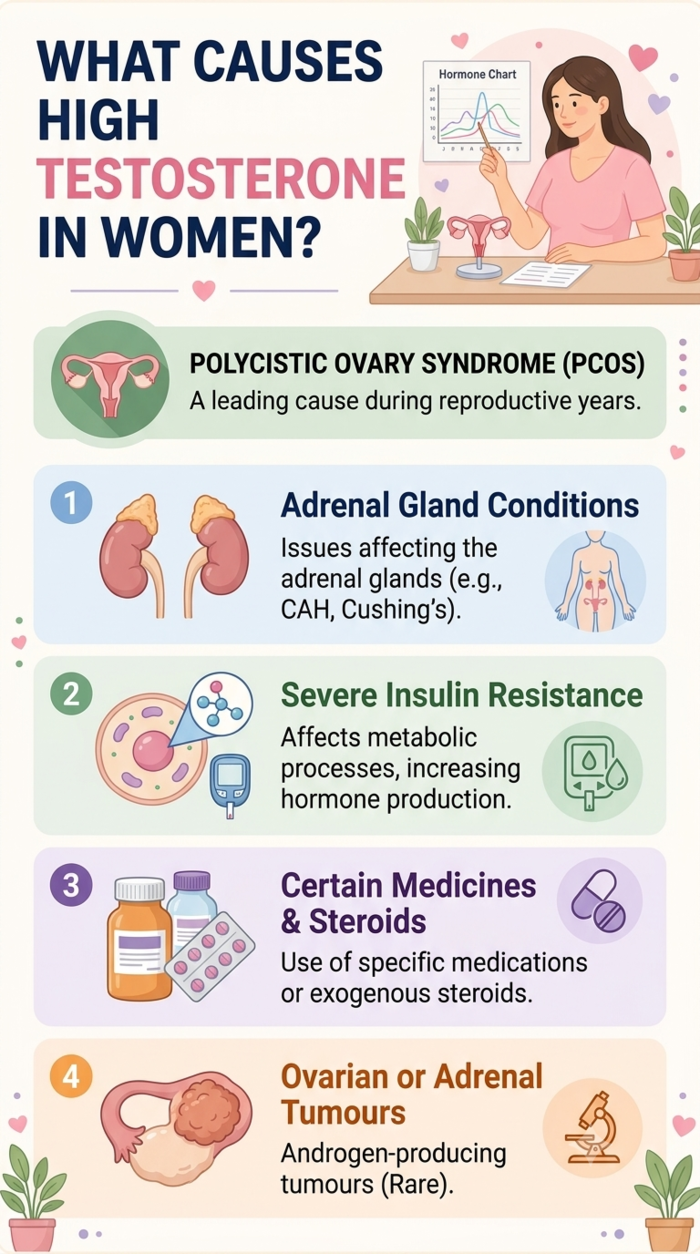
What Causes High Testosterone in Women?
PCOS is a leading cause of high testosterone during the reproductive years. Other possible causes include:- Certain medicines or use of steroids
- Congenital adrenal hyperplasia, a group of inherited conditions affecting the adrenal glands
- Cushing's syndrome
- Disorders affecting the ovaries or adrenal glands
- Severe insulin resistance
- Rarely, an androgen-producing ovarian or adrenal tumour
How Does High Testosterone Affect Ovulation?
High testosterone may interfere with the normal hormonal signals that control follicle development and ovulation. As a result, an egg may not be released regularly.This can lead to:
- Irregular or missed periods
- Infrequent ovulation
- Difficulty identifying the fertile window
- Anovulation
- Difficulty becoming pregnant
How Does High Testosterone Affect Male Fertility?
When testosterone rises above the normal range, the body reads this as a signal that enough testosterone already exists. This disrupts the natural feedback between the testes and the brain, causing the pituitary gland to reduce its production of luteinising hormone (LH) and follicle-stimulating hormone (FSH), the two hormones that signal the testes to produce sperm.With LH and FSH suppressed, sperm production slows or, in some men, stops entirely. This effect is most pronounced with injectable testosterone and anabolic steroids, and can also occur with testosterone gels or supplements taken without medical supervision. Hormonal causes also include lifestyle factors, heat exposure, and infections.
The good news is that fertility problems associated with hormonal imbalance are often manageable. Identifying the underlying cause through appropriate hormonal tests and medical evaluation is important. With timely diagnosis, lifestyle changes, and doctor-recommended treatment, many individuals can improve their reproductive health and chances of conception.
What Are the Symptoms of High Testosterone in Men and Women?
In men, signs include:- Acne
- Mood changes
- Reduced testicular size
- A lower sperm count on semen analysis
- Irregular or absent periods
- Excess facial or body hair
- Scalp thinning
- Persistent acne
How Is High Testosterone Treated For Fertility?
In men, treatment usually means stopping the source of excess testosterone, such as steroids or unsupervised hormone therapy, after which sperm production often recovers over several months.In women with PCOS, first-line treatment includes lifestyle changes: a body weight reduction of around 5% can meaningfully improve PCOS symptoms and restore ovulation, alongside ovulation-inducing medication. When these measures do not lead to pregnancy, IVF is an effective option for PCOS-related infertility.
Can You Get Pregnant With High Testosterone?
The effect of high testosterone on fertility largely depends on the underlying cause and whether ovulation is affected. For women with PCOS-related anovulatory infertility and no other infertility factors, treatment can help restore or induce ovulation.The current international PCOS guideline recommends letrozole as the first-line medication for ovulation induction in women with PCOS who are not ovulating regularly. Other treatments, including clomiphene, metformin, injectable gonadotrophins, or IVF, may be considered depending on the individual situation.
High testosterone can interfere with ovulation and fertility, but identifying and treating the underlying cause can improve the chances of conception for both men and women.
FAQs on Can High Testosterone Levels Affect Fertility?
- Can high testosterone prevent pregnancy?
High testosterone can make pregnancy more difficult if it interferes with ovulation, but it does not necessarily prevent pregnancy. Many women with PCOS and high testosterone conceive naturally or with fertility treatment. - Can high testosterone cause infertility in men?
Yes. Testosterone above the normal range, especially from steroids or unsupervised therapy, suppresses LH and FSH and lowers sperm count. - What testosterone level is considered too high for fertility?
There is no single fertility-specific cut-off; reference ranges vary by lab and sex. A doctor interprets testosterone alongside LH, FSH, and symptoms rather than the number alone.