In this article:
How Long Does It Take to Get Pregnant After Stopping Birth Control Pills?
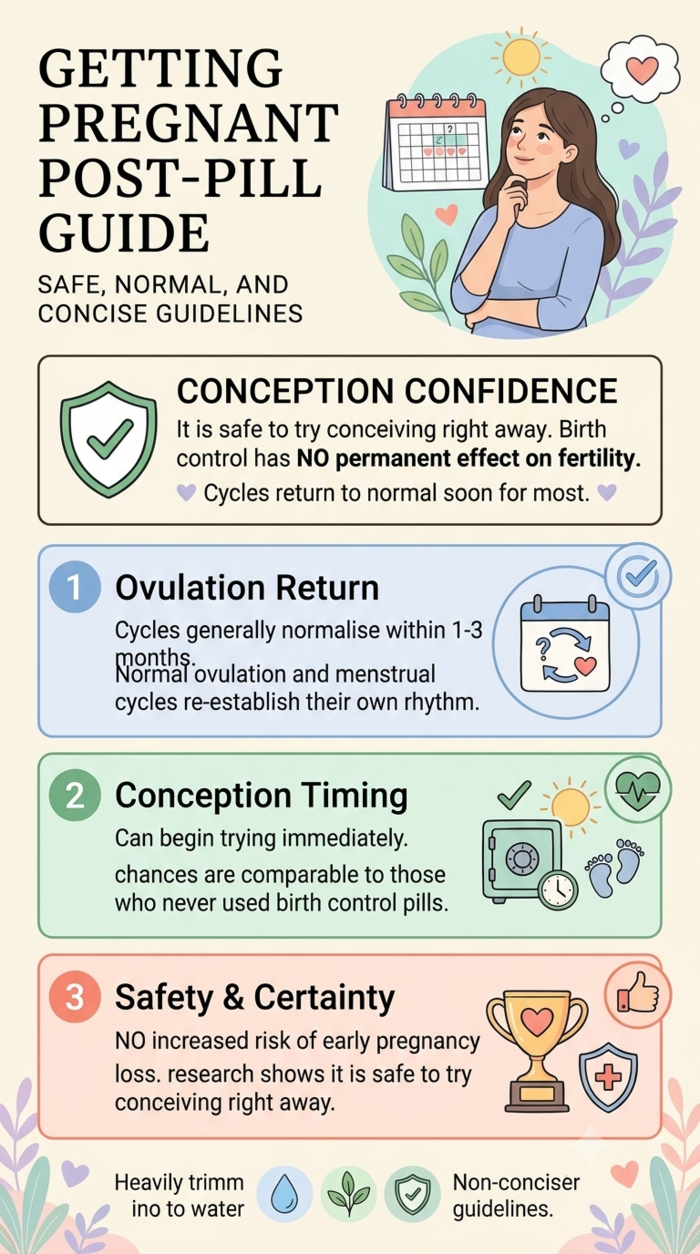
Long-term use of birth control pills does not permanently affect fertility, and most women regain normal ovulation within a few months of stopping. The progestin-only mini-pill's effects on cervical mucus and the uterine lining reverse quickly once the pill is stopped. Trying to conceive can begin immediately, with pregnancy chances comparable to women who never used it.For combination pills (oestrogen and progestin), cycles usually normalise within one to three months. However, the first period after stopping may arrive later than expected as the body re-establishes its own hormonal rhythm.
Current research shows it is safe to try conceiving right away, and taking birth control before pregnancy does not cause early pregnancy loss. A regular cycle after stopping is generally a reassuring sign, since menstrual cycles that are not unusually heavy or painful suggest the absence of an underlying gynaecological condition.
Does the IUD or Implant Delay Fertility?
Non-hormonal methods reverse the fastest. Pregnancy is possible immediately after stopping barrier methods such as condoms, and there is no change to the menstrual cycle when these are discontinued. The same applies to the copper IUD; once removed, there is no hormonal residue to clear, and ovulation continues on its usual cycle.Hormonal IUDs and implants release localised progestin. Once removed, hormone levels drop rapidly, and most women ovulate within the following cycle. This differs from injectable contraception, which is designed to act systemically for months at a time.
How Long Does Fertility Take to Return After Contraceptive Injections?
The contraceptive injection carries the longest and most variable delay. Return of fertility after stopping the contraceptive injection is delayed, taking an average of 10 months, and some women take longer.Women planning a pregnancy within the next year are generally advised against starting the injection, given this predictable lag compared with pills, rings, or IUDs.
Fertility Return Timeline by Contraceptive Method
| Contraceptive method | Typical time to return of fertility | When to start trying to conceive |
| Barrier methods (condoms) | Immediately after discontinuation | Right away |
| Copper IUD | Immediately after removal | Right away |
| Combination pill (oestrogen + progestin) | 1–3 months | As soon as stopped; expect 1–2 irregular cycles first |
| Progestin-only pill (mini-pill) | Immediately to 1 cycle | As soon as stopped |
| Hormonal IUD or implant | Within 1 cycle of removal | As soon as removed |
| Vaginal ring or patch | 1–3 months | As soon as stopped; expect 1–2 irregular cycles first |
| Contraceptive injection | Average of 10 months; some women longer | Plan at least 12 months if timing pregnancy |
What Causes Irregular Periods After Stopping Birth Control?
Contraceptives can mask underlying conditions such as PCOS, thyroid disorders, or irregular ovulation that existed before starting the method. Periods that were irregular before contraception often remain irregular after stopping; this reflects the pre-existing pattern, not a new effect of the birth control itself.In India, PCOS is increasingly diagnosed among urban women in their twenties and thirties, and gynaecologists often recommend a cycle-tracking period of two to three months before assuming a fertility problem.
If periods do not return within three months (or six to twelve months after an injection, depending on age), a consultation with a gynaecologist to check thyroid function, prolactin levels, and ovarian reserve is a reasonable next step.
When to See a Doctor About Fertility After Birth Control
A gynaecology consultation is advisable if periods have not resumed after three months (for pill, ring, or IUD users), if there is no pregnancy after twelve months of trying for women under 35, or after six months of trying for women over 35.Basic tests including AMH (ovarian reserve), thyroid function, and a pelvic ultrasound help identify whether delayed fertility is related to contraception or an unrelated condition.
Fertility after stopping birth control is, for most women, a matter of weeks to months rather than a lasting concern, and planning around the specific method used allows for realistic expectations from the start.
You’re not alone in your journey when trying to conceive. Join our supportive community to connect with others, share experiences, and find encouragement every step of the way.
FAQs on Fertility After Stopping Birth Control: What to Expect
- Can I get pregnant the first month after stopping birth control pills?
Yes. Ovulation can resume within the same cycle after stopping the pill, and conception is possible as early as the first month off. - Does pregnancy after stopping birth control affect the baby's health?
No. There is no evidence linking prior birth control use to birth defects or pregnancy complications once contraception is stopped. - Should I take folic acid before stopping birth control?
Yes. Starting folic acid at least one month before stopping contraception is recommended, as it lowers the risk of neural tube defects in early pregnancy.