In this article:
Why Is My Period Late But the Pregnancy Test Is Negative?
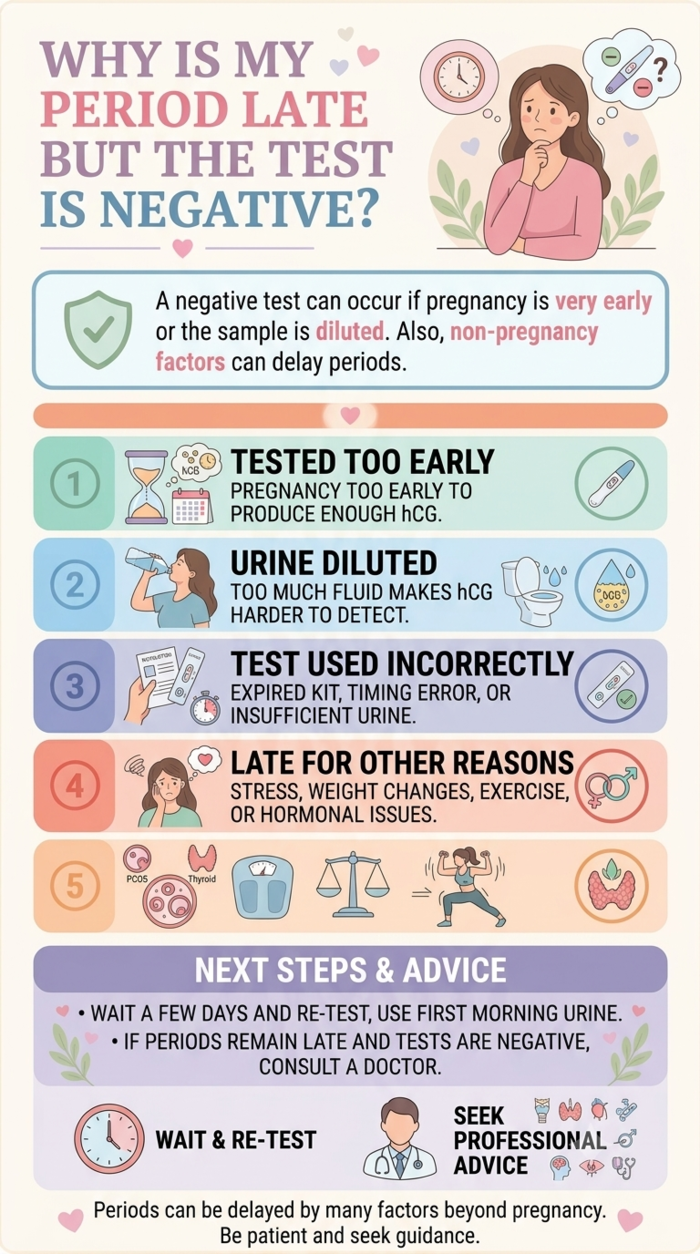
A negative pregnancy test can happen for several reasons:- You tested too early: Ovulation does not necessarily occur on the same day every month. If you ovulated later than usual, your period will also arrive later. In this situation, a pregnancy may be too early to produce enough hCG for the test to detect.
- The urine was diluted: Drinking a large amount of fluid before testing can dilute urine and make hCG harder to detect. Using concentrated urine, particularly the first urine after waking, may improve the chance of detecting an early pregnancy.
- The test was not used correctly: An expired test, incorrect timing, insufficient urine, or checking the result outside the manufacturer's recommended time can affect the result. Always check the expiry date and follow the instructions supplied with the particular kit.
- Your period is late for another reason: Pregnancy is not the only cause of a missed or delayed period. Stress, changes in weight, excessive exercise, breastfeeding, hormonal contraception, polycystic ovary syndrome (PCOS), and thyroid disorders can all affect menstrual cycles.
When to Retest After a Negative Result
If your period has not started and the first test is negative, follow these steps:- Wait 3–7 days and use first-morning urine, which is the most concentrated.
- Waiting a week after the missed period gives the most reliable home result.
- A blood test (beta-hCG) detects lower hormone levels than a urine test and can confirm or rule out early pregnancy.
In case of a negative test, it is also recommended to take the test after a few more days. It is also suggested to take the test early in the morning with first urine, as it helps detect lower hCG levels. If, even after multiple negative tests, periods don't arrive, the woman should consult a gynaecologist. Timely medical advice and appropriate testing are key before jumping to any assumptions or next steps.
Reasons for a Late Period When You Are Not Pregnant
A late period without pregnancy usually points to delayed ovulation or a hormonal change. Common causes include:- PCOS: Affects ovulation and often causes irregular or missed periods.
- Thyroid disorders: An underactive or overactive thyroid can disturb the cycle.
- High prolactin: The hormone that drives milk production can suppress ovulation.
- Stress, illness, travel, or shift changes: These can push ovulation later.
- Weight change, crash dieting, or intense exercise: All can lower reproductive hormones.
- Medicines: Hormonal contraceptives, some antidepressants, and steroids can affect periods.
- Breastfeeding and perimenopause: Both change cycle timing.
When to See a Doctor
Consult a gynaecologist if:- Your period is more than a week late, and tests remain negative.
- You have missed three periods in a row, or have had no period for six weeks.
- You have acne, excess facial hair, hair loss, rapid weight change, or milky nipple discharge.
- Repeat urine or blood hCG test
- Thyroid, prolactin, FSH, and LH blood tests
- Pelvic ultrasound to check the uterus and ovaries
A late period with a negative pregnancy test does not always rule out pregnancy. Repeating the test after 3-7 days and seeing a doctor if the period still does not arrive gives a clearer answer.
FAQs on Late Period, Negative Pregnancy Test: Could You Still Be Pregnant?
- Can I be pregnant if my period is late and the test is negative?
Yes. Testing too early, late ovulation, or diluted urine can cause a false negative. Retest after 3–7 days with first-morning urine. - How late can a period be with negative tests before I see a doctor?
See a doctor if the period is more than a week late with negative tests. A period absent for six weeks counts as missed. - Is a blood test more accurate than a home urine test?
A blood test detects lower hCG levels, so it can confirm pregnancy earlier. A urine test is reliable from the first day of a missed period.