In this article:
When Do Twins Start Touching Each Other in the Womb?
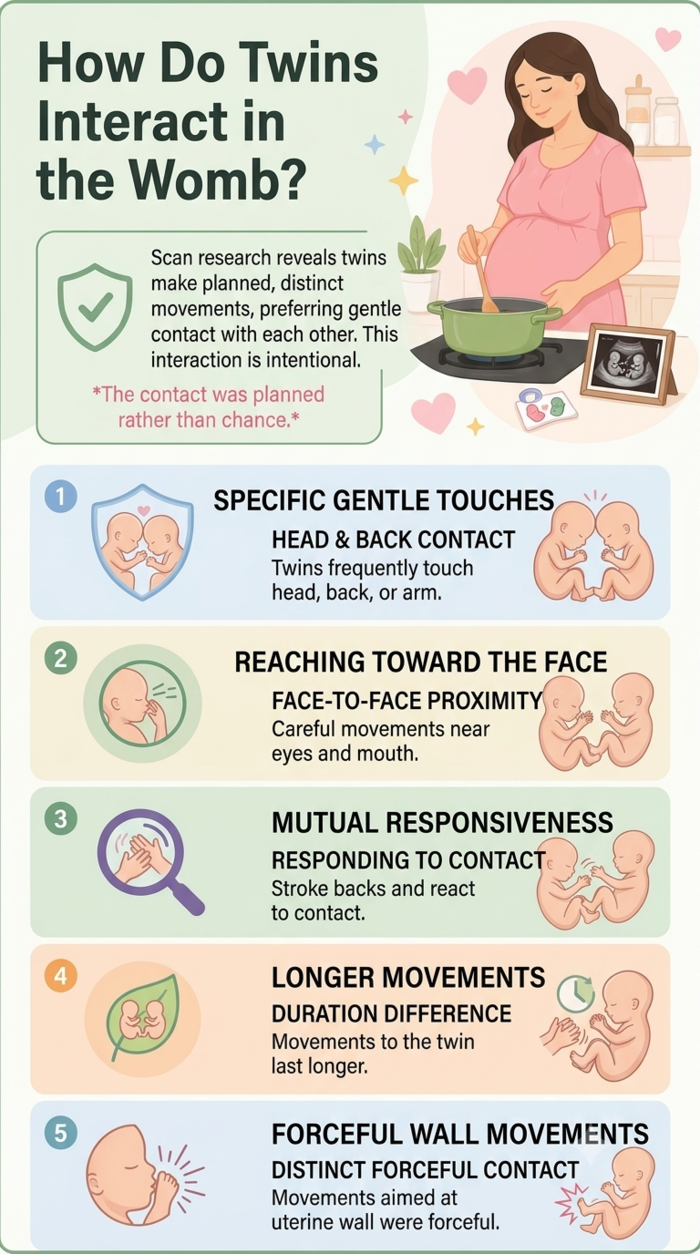
Contact between twins begins around 11 weeks of gestation, although their movements are initially small and their bodies may be too far apart for frequent contact. As the babies grow, their movements become stronger and more coordinated.A 2010 study used 4D ultrasound on five pairs of twins at 14 and 18 weeks of pregnancy. By 14 weeks, the babies were already directing movements at each other. By 18 weeks, nearly 30% of their movements were aimed at the twin.
How Do Twins Interact in the Womb?
The scans recorded these movements:- Touching the twin’s head, back, or arm
- Reaching towards the twin’s face
- Stroking the twin’s back
- Responding when the other twin makes contact
Can Identical Twins Interact More?
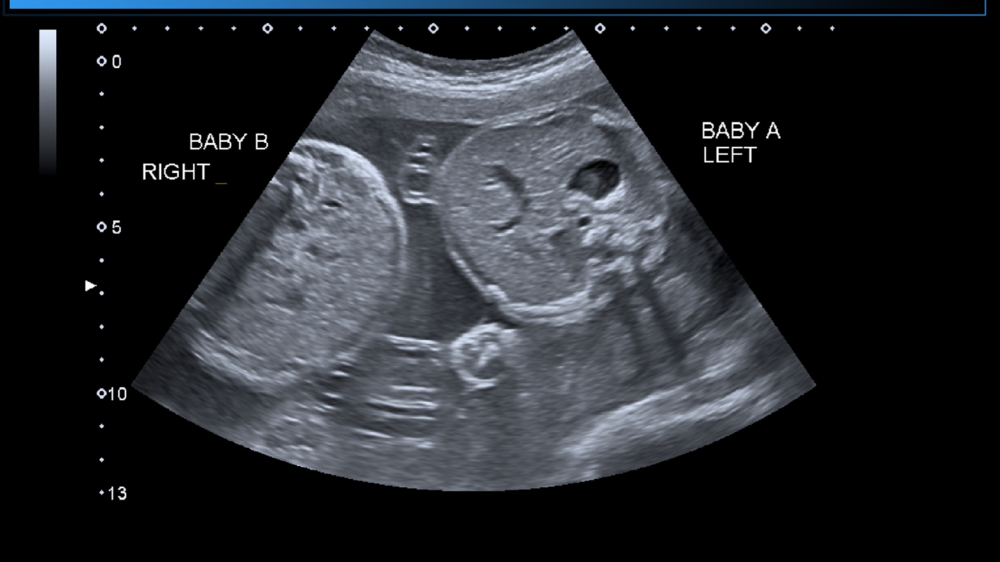
Not necessarily. Most twins have separate amniotic sacs. In rare cases, identical twins share one sac, which is called monochorionic monoamniotic (MCMA) twins.Twins in separate sacs can still touch each other through the membrane between them. MCMA twins float in the same fluid; they can move against each other directly.
Whether twins share a placenta or sac is a medical distinction that helps determine pregnancy monitoring and risks; it does not by itself determine whether twins will have a particular type of relationship after birth.
Their prenatal interactions are fascinating evidence of early motor and sensory development, but they should not be interpreted as proof that twins are having conscious conversations or playing together in the way older children do.
Do Twins Feel Each Other in the Womb?
Twins can respond to physical contact with each other, but it is not possible to know exactly what an unborn baby consciously feels or thinks about that contact.The developing nervous system allows foetuses to respond to touch and other sensory stimuli before birth. In twin pregnancies, researchers have observed responses when one twin touches or pushes against the other.
Current research can demonstrate movements and responses, but it cannot establish exactly what an unborn twin experiences mentally.
Twin Pregnancy Myths vs Facts
| Myth | Fact |
| Twins fight in the womb. | Twins push and kick as space reduces, mostly in the third trimester. Amniotic fluid cushions these movements, and doctors view them as normal foetal activity, not fighting. |
| Twins feel each other’s pain. | Unborn twins respond to touch, but no study has shown that one twin feels what happens to the other. |
| One twin can absorb the other in the womb. | In early pregnancy, one twin may stop developing and be reabsorbed. This is called vanishing twin syndrome, and it happens in the first trimester. It is a pregnancy loss. |
| Twins always need a caesarean. | Many twin pregnancies can end in a vaginal birth if the first baby is head-down and there are no complications. The decision depends on the babies’ position, whether they share a placenta, and the mother’s health. |
Whether you’re pregnant, a new mom, or navigating postpartum, you don’t have to do it alone. Join our support group to connect, share, and support one another.
FAQs on Can Twins Interact with Each Other in the Womb?
- When do twins start interacting in the womb?
Contact is recorded from about 11 weeks. By 14 weeks, twins make movements aimed at each other, and these increase by 18 weeks. - Can twins hurt each other in the womb?
Pushing and kicking are common, but amniotic fluid cushions the babies, and the movements rarely cause harm. Cord entanglement in monoamniotic twins is the main interaction-related risk, and doctors monitor for it. - Do twins recognise each other before birth?
It is not proven that unborn twins consciously recognise each other. Studies demonstrate physical interaction and responses to touch, not conscious recognition.