In this article:
What Are the Early Symptoms of Breast Cancer?
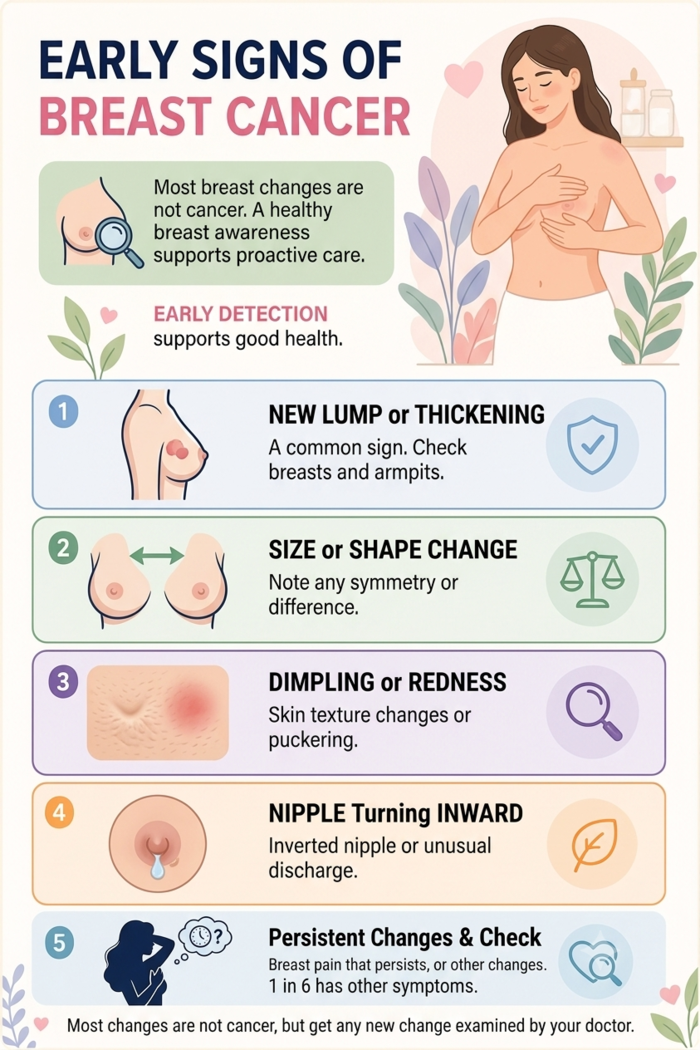
A new lump in the breast or armpit is the most common early sign. Other changes to watch for:- A change in breast size, shape, or symmetry
- Dimpling, redness, or thickening of the skin
- A nipple turning inward, or clear or bloody discharge
- Swelling near the armpit or collarbone
- Breast pain that does not settle after the next period
Breast Cancer Risk Factors in Indian Women
The risk factors of breast cancer can include:| Risk factor | Type | Detail |
| Increasing age | Cannot change | Risk rises as a woman gets older |
| Family history | Cannot change | A mother, sister, or daughter with breast cancer |
| Inherited gene changes | Cannot change | BRCA1, BRCA2 or PALB2 |
| Early first period | Cannot change | First period at 12 or earlier |
| Late menopause | Cannot change | Menopause after 50 |
| Chest radiation | Cannot change | Previous radiation treatment to the chest |
| Late or no pregnancy | Reproductive history | First full-term pregnancy at a later age, or no pregnancy |
| Short or no breastfeeding | Reproductive history | Breastfeeding for a short time, or not at all |
| Alcohol | Can change | About 7.1% higher risk for every 10 g consumed daily |
| Weight | Can change | Overweight or obesity |
| Tobacco | Can change | Smoking and other tobacco use |
| Hormone therapy | Can change | Some forms of hormone therapy after menopause |
Types of Breast Cancer
Breast cancer is grouped by where it starts and whether it has spread.- Ductal carcinoma in situ (DCIS): Cancer in the lining of the milk ducts that has not spread beyond it. It is also called stage 0 or non-invasive breast cancer.
- Invasive ductal carcinoma: Cancer that starts in the milk ducts and spreads into nearby breast tissue. It is the most common type.
- Invasive lobular carcinoma: Cancer that starts in the milk-producing glands (lobules) and spreads. It is the second most common type, grows more slowly, and is more often found in both breasts.
- Inflammatory breast cancer: A rare type in which cancer cells block lymph vessels in the breast skin. It has a high risk of recurrence.
- Paget disease of the breast: A rare type involving the skin of the nipple and areola.
- Triple-negative breast cancer: Cancer cells lack oestrogen receptors, progesterone receptors, and the HER2 protein. Recurrence is more common than in most other types.
- Metastatic breast cancer: Cancer that has spread from the breast to other parts of the body. It is also called stage 4.
How to Do a Breast Self-Examination at Home
Check once a month, about 5 to 7 days after your period starts. After menopause, pick the same date each month.- Stand in front of a mirror with arms at your sides. Look for changes in size, shape, or skin.
- Raise both arms and look again.
- Lie down. Using the pads of three fingers, press in small circles across the whole breast, from collarbone to bra line and into the armpit.
- Gently squeeze each nipple to check for discharge.
Breast Cancer Screening in India: When Should Women Get Checked?
Screening aims to detect breast cancer before symptoms appear. It is different from diagnostic testing, which is performed when a woman already has a lump or another concerning breast change.India’s public health programme includes clinical breast examination (CBE) for women aged 30 years and older, at least once every five years. Women with an abnormal finding can be referred for further assessment, which may include imaging such as ultrasound or mammography depending on the clinical situation.
Mammography recommendations vary by country and organisation. For example, the US Preventive Services Task Force recommends mammography every two years for women aged 40 to 74 years at average risk.
The Breast Imaging Society, India, recommends yearly mammography from age 40. For women under 40, ultrasound is often the first test. Women with a strong family history, a BRCA mutation, or earlier chest radiation may need to start sooner.
Breast Cancer During Pregnancy and Breastfeeding
Breast cancer found during pregnancy, within a year of giving birth, or during breastfeeding is called pregnancy-associated breast cancer. It occurs in about 1 in 3,000 pregnancies and most often affects women aged 32 to 38.Diagnosis can be late because:
- Pregnancy and breastfeeding make breasts larger, tender, and lumpy, which can hide a lump
- Denser breast tissue makes mammograms harder to read
- Routine screening is usually postponed until after pregnancy
Breast Self-Awareness
You should know what is normal for your breasts so you can recognise a new or unusual change. This is known as breast self-awareness.October is Breast Cancer Awareness Month, observed worldwide. The aim is to promote screening, explain risk factors, and support people affected by breast cancer.
Breast cancer awareness means knowing your normal, recognising warning signs, understanding your personal risk, and seeking timely medical evaluation when something changes.
Whether you’re pregnant, a new mom, or navigating postpartum, you don’t have to do it alone. Join our support group to connect, share, and support one another.
FAQs on Breast Cancer Awareness: Symptoms, Screening, and Risk Factors for Indian Women
- Can breast cancer be cured if found early?
Early-stage breast cancer is treatable and often curable. Early detection also leaves more treatment options. - Can men get breast cancer?
Yes, but it is rare. A lump or nipple change in a man also needs a doctor's examination. - Can breast cancer occur without a family history?
Yes. Having no family history does not eliminate the risk of breast cancer. Many women diagnosed with breast cancer have no known family history.