In this article:
She said that any vaginal bleeding during pregnancy should be reported promptly to a healthcare professional for further evaluation.
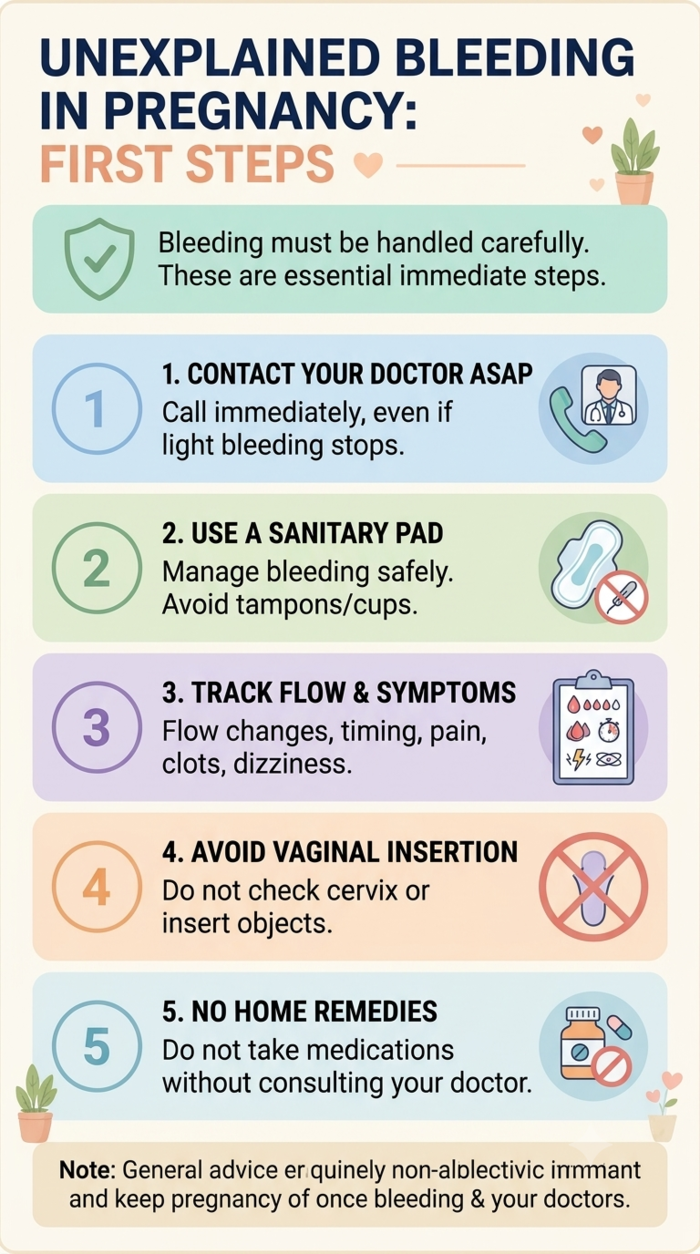
What Should You Do First If You Notice Bleeding?
You should take the following steps if you notice vaginal bleeding:- Contact your doctor as soon as possible, even if the bleeding is light or stops on its own.
- Use a sanitary pad to manage bleeding instead of tampons or menstrual cups during an episode of unexplained pregnancy bleeding.
- Keep note of when the bleeding started, whether it is getting heavier, and whether you have abdominal pain, cramps, clots, dizziness or weakness.
- Avoid inserting anything into the vagina, whether to examine your cervix yourself or to stop bleeding, unless your obstetrician advises you to do so.
- Do not self-medicate or use home remedies without consulting your doctor.
Your assessment and management may depend on your symptoms and stage of pregnancy.
When Does Bleeding During Pregnancy Need Emergency Care?
Some symptoms require immediate medical attention. Call your local emergency number or go to the nearest emergency department if you experience:- Heavy bleeding or bleeding that is rapidly increasing
- Severe abdominal or pelvic pain
- Shoulder-tip pain, particularly with abdominal pain or bleeding
- Dizziness, fainting or marked weakness
- Bleeding accompanied by feeling very unwell
If you feel faint, dizzy or weak, do not drive yourself. Ask for help.
Dr Swati Rai emphasised the importance of timely assessment, as the cause and urgency of bleeding can vary considerably.
What Can Cause Bleeding During Pregnancy?
The possible causes depend partly on how far along you are.| Stage of pregnancy | Possible causes |
| First trimester | Cervical changes, infection, miscarriage or ectopic pregnancy |
| Second and third trimesters | Cervical changes or infection, placental problems and other pregnancy-related complications |
Later in pregnancy, bleeding may be linked to conditions involving the placenta, including placenta praevia or placental abruption. These conditions require prompt medical assessment. Contact your maternity team immediately if you notice bleeding later in pregnancy, even if you have no pain.
Dr Swati Rai explains that your healthcare professional may recommend an ultrasound scan, a clinical examination or blood tests. The investigations depend on your symptoms pregnancy stage, and medical history. They help establish the likely cause and determine what care you need.
Do not assume that bed rest will prevent a miscarriage. It has not been proven to prevent pregnancy loss and should not replace medical evaluation. Follow your clinician's advice about activity and any further precautions.
Bleeding during pregnancy can have different causes, and symptoms alone cannot establish whether the pregnancy is at risk. Report any vaginal bleeding promptly and seek emergency care for heavy bleeding, severe pain or signs of faintness or weakness. Timely assessment helps determine the next steps for you and your pregnancy.
FAQs on First Aid for Vaginal Bleeding During Pregnancy
- Does bleeding during pregnancy always mean a miscarriage?
No. Bleeding can occur for several reasons, including cervical changes or infection, and some pregnancies continue normally. However, you should report any vaginal bleeding promptly so that a healthcare professional can assess the possible cause. - Should I wait to see if pregnancy bleeding stops?
No. Contact your obstetrician promptly, even if the bleeding is light or stops. If you have heavy bleeding, severe pain, shoulder-tip pain, dizziness or fainting, seek emergency medical care immediately. - Should I stay on bed rest if I experience bleeding?
Do not prescribe bed rest for yourself. Bed rest has not been shown to prevent miscarriage. Your healthcare professional can advise you about activity restrictions, if any, after assessing the cause of the bleeding.